

Bridled Tern vs Least Tern
Onychoprion anaethetus versus Sternula antillarum
Play a quiz with Bridled Tern and Least Tern
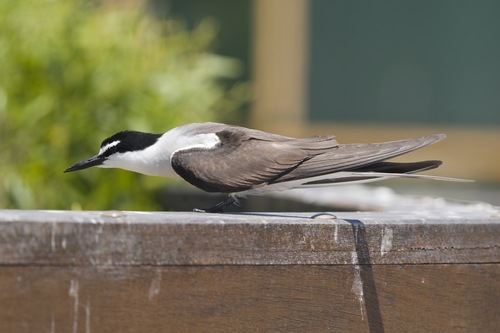 Bridled Tern
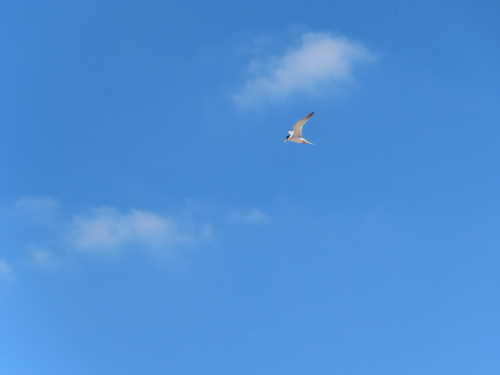 Least Tern
In short
The most reliable field mark is size and structure: Bridled Tern is much larger and more robust than Least Tern, with longer wings and a deeply forked tail. In flight, Bridled Tern shows dark gray upperparts and a distinctive pale hindneck collar, while Least Tern is much paler above with a smaller, compact build and a short, straight tail. Juvenile Bridled Terns are scaly gray above, whereas Least Tern juveniles are not described as such. Bill and leg color are also key: Bridled Tern has a black bill and legs, while Least Tern has a yellow bill (with a black tip in summer) and yellowish legs. These differences are visible at range and are consistent across ages and seasons.
Identification tips
- Size and bulk: Bridled Tern is much larger and heavier than Least Tern. If the bird looks small, delicate, and quick, it's likely a Least Tern. Size is reliable at moderate range.
- Bill color: Bridled Tern always has a black bill; Least Tern has a yellow bill with a black tip in summer, turning darker in winter. Bill color is visible at close to medium range and is diagnostic in breeding season.
- Leg color: Bridled Tern's legs are black; Least Tern's are yellowish. This is best seen when birds are perched or on the ground.
- Upperparts color: Bridled Tern has dark gray upperparts, noticeably darker than Least Tern's uniform pale gray back and wings. In good light, this contrast is clear.
- Hindneck collar: Bridled Tern shows a striking white collar on the hindneck, absent in Least Tern. This is a key mark in all plumages.
- Forehead and eyebrow: Bridled Tern has a narrow white forehead and eyebrow, while Least Tern has a white forehead patch above the bill and a black line through the eye. The Bridled's facial pattern is more sharply defined and includes the collar.
- Tail shape: Bridled Tern has a deeply forked tail, longer and more pointed than the short, straight tail of Least Tern. Tail shape is best judged in flight or when perched with tail spread.
- Wing pattern: Least Tern shows pale gray wings with black markings on the outer primaries; Bridled Tern's wings are dark gray, matching the back, without strong contrasting panels. This is visible in flight.
- Juvenile plumage: Juvenile Bridled Tern is scaly gray above, a feature not found in Least Tern juveniles. If you see a scaly-backed young tern, it's Bridled.
- Flight style: Least Tern flies with fast, jerky wingbeats and a hunched posture, bill angled down. Bridled Tern is more languid and graceful, with longer, more pointed wings.
- Habitat: Bridled Tern is strictly tropical and oceanic, rarely seen inland. Least Tern is found in North America, often in estuaries, lagoons, and sandy beaches, sometimes inland.
- Seasonal changes: Least Tern's bill and forehead become darker and whiter, respectively, in winter; Bridled Tern's key marks remain consistent year-round.
- Perched posture: Least Tern appears compact and short-legged when perched; Bridled Tern is longer, more upright, and heavier-bodied.
- Direct comparison: If both species are present, Bridled Tern will tower over Least Tern and appear much darker and longer-winged.
- Common pitfalls: Do not confuse Bridled Tern's dark gray back with Least Tern's pale gray; check for the hindneck collar and bill color as confirmation.
Size
Bridled Tern is significantly larger, measuring 30–32 cm in length with a 77–81 cm wingspan [wikipedia]. Least Tern is much smaller, at 22–24 cm long and a 50 cm wingspan [wikipedia]. This size gap is obvious in direct comparison or when familiar with either species. Bridled Tern is also more heavily built, while Least Tern is dainty and lightweight (39–52 g).
Plumage
- Juvenile/immature birds: Juvenile Bridled Tern is scaly gray above and pale below, a pattern not described for Least Tern juveniles. This scaly upperpart is a strong clue for young Bridled Terns.
- Adults (breeding): Bridled Tern has dark gray upperparts, white underparts, a narrow white forehead and eyebrow, and a striking white collar on the hindneck. Least Tern is much paler above (uniform pale gray), with a white underbody, a black cap, a white forehead patch, and a black line through the eye. Bridled Tern's collar and darker back are unique among these two.
- Adults (non-breeding): Least Tern's white forehead becomes more extensive and the black cap less sharply defined in winter. Bridled Tern maintains its dark upperparts and white collar year-round.
- Bill and legs: Bridled Tern always has a black bill and legs. Least Tern has a yellow bill with a black tip in summer (all blackish in winter) and yellowish legs.
- Wings: Least Tern shows pale gray wings with conspicuous black markings on the outer primaries. Bridled Tern's wings are long and dark gray, matching the back, without mention of black primary panels.
Behaviour
Bridled Tern typically feeds by plunge-diving directly into the sea, rarely using the stepped-hover technique. Least Tern hovers with fast, jerky wingbeats and a hunchbacked posture, then plunges shallowly to pick prey from the surface or just below. Least Tern's flight is distinctive: quick, buoyant, and often with the bill angled downward. Bridled Tern appears more languid and graceful, with longer, more pointed wings and a deeply forked tail.
Habitat
Bridled Tern is a tropical oceanic species, breeding on rocky islands and foraging over open sea. Least Tern breeds in North America and northern South America, preferring shallow estuaries, lagoons, and sandy beaches, often near bays or river mouths. Bridled Tern is rarely found inland or in freshwater habitats, while Least Tern can be seen in a wider range of coastal and sometimes inland sites during migration or breeding.