

Motmot

Bradfield's Hornbill vs African Grey Hornbill

Lophoceros bradfieldi versus Lophoceros nasutus

Play a quiz with Bradfield's Hornbill and African Grey Hornbill
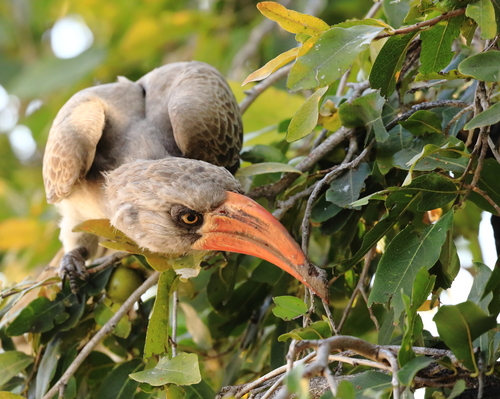
Bradfield's Hornbill (Lophoceros bradfieldi) Bradfield's Hornbill

African Grey Hornbill (Lophoceros nasutus) African Grey Hornbill

Media

Loading…

In short

The most reliable field mark to separate Bradfield's Hornbill from African Grey Hornbill is the bill: Bradfield's has a long, all-red bill with no casque, while African Grey Hornbill shows a dark bill with a pale stripe or tricolored tip and a small casque (especially in males). In flight or perched, Bradfield's is bulkier with a striking white belly and white-tipped tail, contrasting with its black back and wings. African Grey Hornbill is smaller, slimmer, and overall greyer-brown, with a white line down the crown and back (the latter visible mainly in flight). Female Bradfield's can show turquoise facial skin, absent in African Grey. Both species are hornbills of open woodland, but African Grey is much more widespread and likely in most regions.

Identification tips

  1. Bill color and structure: Bradfield's Hornbill has a long, all-red bill with no casque; African Grey Hornbill has a dark bill with a pale stripe (males) or tricolored with a red tip (females), and a small casque is present (especially in males). This is the single most reliable field mark for all ages except juvenile African Grey, which has an all-dark bill.
  2. Facial skin (females): Female Bradfield's Hornbill shows turquoise facial skin, absent in African Grey Hornbill of any sex or age.
  3. Eye color: Bradfield's Hornbill has yellow eyes, while African Grey Hornbill's eye color is not specified as distinctive in the notes.
  4. Body and belly color: Bradfield's Hornbill has a clean white belly, contrasting sharply with its black back and wings. African Grey Hornbill is more uniformly grey-brown, lacking the bold white belly.
  5. Tail pattern: Bradfield's has a long tail with white tip feathers; African Grey Hornbill's tail is dark and lacks a bold white tip.
  6. Crown and back stripes: African Grey Hornbill shows a white line down each side of the crown and another down the back (the latter visible mainly in flight). Bradfield's lacks these white lines.
  7. Size and build: Bradfield's is larger and bulkier (50–57 cm) compared to the smaller, slimmer African Grey (45–51 cm). This is most apparent when both are seen together or with experience.
  8. Flight style: African Grey Hornbill has an undulating flight and is often more agile; Bradfield's appears heavier and slower in flight.
  9. Juvenile bills: Juvenile African Grey Hornbills have all-dark bills, which can be confusing, but the absence of a casque and the presence of turquoise facial skin (in female Bradfield's) still help separate them.
  10. Plumage similarity between sexes: African Grey Hornbill sexes are similar in plumage, while Bradfield's females can be picked out by turquoise facial skin and smaller size.
  11. Vocalizations: African Grey Hornbill is very vocal, with a distinctive piping call. Bradfield's is less conspicuous vocally (no description provided), so a calling bird is likely African Grey.
  12. Habitat and abundance: African Grey Hornbill is widespread and common in open woodland and savannah; Bradfield's is local and uncommon, restricted to specific regions in southern Africa.
  13. Perched vs. in flight: The white-tipped tail and clean white belly of Bradfield's are visible both perched and in flight, while African Grey's white back line is best seen in flight.
  14. Casque presence: The small casque on African Grey Hornbill (especially males) is absent in Bradfield's, which always has a smooth bill profile.
  15. Contextual clues: If seen outside the limited range of Bradfield's (northeastern Namibia, northern Botswana, southern Angola, eastern Zimbabwe), the bird is almost certainly African Grey Hornbill.

Size

Bradfield's Hornbill is the larger of the two, measuring 50–57 cm in length, while African Grey Hornbill is smaller at 45–51 cm. Bradfield's is noticeably bulkier and more robust, with a heavier build and longer tail. African Grey Hornbill, though still a large bird, is slimmer and more lightly built, often appearing more agile in flight and when moving through branches. Females of both species are smaller than males, but this is most apparent in Bradfield's, where the size difference is more pronounced.

Plumage

No distinctive juvenile or immature upperwing pattern is described for either species, so separation relies on adult and general plumage. Bradfield's Hornbill stands out with a black back and wings, a clean white belly, and a long tail with white tip feathers. The red bill is unmarked and lacks a casque. Females show turquoise facial skin. The eyes are yellow. African Grey Hornbill is greyer overall, with grey and brown plumage, a darker head, flight feathers, and tail. A white line runs down each side of the crown, and another down the back (the latter only visible in flight). The bill is dark with a pale stripe (males) or tricolored with a red tip (females), and a small casque is present, especially in males. Juveniles resemble adults but have an all-dark bill. Both sexes of African Grey have similar plumage, lacking the turquoise facial skin of female Bradfield's. The belly is never as cleanly white as Bradfield's, and the tail lacks the bold white tip.

Behaviour

Both species forage in trees for fruit, insects, and small vertebrates, but Bradfield's Hornbill tends to be less conspicuous and is an uncommon resident in its range. African Grey Hornbill is more widespread and often seen flying with undulating flight or calling conspicuously from exposed perches. Bradfield's may appear heavier and slower in flight, while African Grey is more agile and active, often advertising its presence vocally.

Habitat

Bradfield's Hornbill is a local resident of mopane woodlands and mixed thorn fields in northeastern Namibia, northern Botswana, southern Angola, and eastern Zimbabwe. It is uncommon and has a patchy distribution. African Grey Hornbill is widespread across much of sub-Saharan Africa and the southwest Arabian Peninsula, favoring open woodland and savannah. In areas where both occur, African Grey is much more likely to be encountered.

Voice

African Grey Hornbill is noted for its loud, piping 'pee-o pee-o pee-o' call, often given from an exposed perch. Bradfield's Hornbill's vocalizations are not described in the provided notes, so voice is only diagnostic for African Grey Hornbill, which is conspicuous and vocal.

Submit a better description

Use the same sections as the comparison. Your text is published immediately.

The most reliable field mark to separate Bradfield's Hornbill from African Grey Hornbill is the bill: Bradfield's has a long, all-red bill with no casque, while African Grey Hornbill shows a dark bill with a pale stripe or tricolored tip and a small casque (especially in males). In flight or perched, Bradfield's is bulkier with a striking white belly and white-tipped tail, contrasting with its black back and wings. African Grey Hornbill is smaller, slimmer, and overall greyer-brown, with a white line down the crown and back (the latter visible mainly in flight). Female Bradfield's can show turquoise facial skin, absent in African Grey. Both species are hornbills of open woodland, but African Grey is much more widespread and likely in most regions.

  1. Bill color and structure: Bradfield's Hornbill has a long, all-red bill with no casque; African Grey Hornbill has a dark bill with a pale stripe (males) or tricolored with a red tip (females), and a small casque is present (especially in males). This is the single most reliable field mark for all ages except juvenile African Grey, which has an all-dark bill.
  2. Facial skin (females): Female Bradfield's Hornbill shows turquoise facial skin, absent in African Grey Hornbill of any sex or age.
  3. Eye color: Bradfield's Hornbill has yellow eyes, while African Grey Hornbill's eye color is not specified as distinctive in the notes.
  4. Body and belly color: Bradfield's Hornbill has a clean white belly, contrasting sharply with its black back and wings. African Grey Hornbill is more uniformly grey-brown, lacking the bold white belly.
  5. Tail pattern: Bradfield's has a long tail with white tip feathers; African Grey Hornbill's tail is dark and lacks a bold white tip.
  6. Crown and back stripes: African Grey Hornbill shows a white line down each side of the crown and another down the back (the latter visible mainly in flight). Bradfield's lacks these white lines.
  7. Size and build: Bradfield's is larger and bulkier (50–57 cm) compared to the smaller, slimmer African Grey (45–51 cm). This is most apparent when both are seen together or with experience.
  8. Flight style: African Grey Hornbill has an undulating flight and is often more agile; Bradfield's appears heavier and slower in flight.
  9. Juvenile bills: Juvenile African Grey Hornbills have all-dark bills, which can be confusing, but the absence of a casque and the presence of turquoise facial skin (in female Bradfield's) still help separate them.
  10. Plumage similarity between sexes: African Grey Hornbill sexes are similar in plumage, while Bradfield's females can be picked out by turquoise facial skin and smaller size.
  11. Vocalizations: African Grey Hornbill is very vocal, with a distinctive piping call. Bradfield's is less conspicuous vocally (no description provided), so a calling bird is likely African Grey.
  12. Habitat and abundance: African Grey Hornbill is widespread and common in open woodland and savannah; Bradfield's is local and uncommon, restricted to specific regions in southern Africa.
  13. Perched vs. in flight: The white-tipped tail and clean white belly of Bradfield's are visible both perched and in flight, while African Grey's white back line is best seen in flight.
  14. Casque presence: The small casque on African Grey Hornbill (especially males) is absent in Bradfield's, which always has a smooth bill profile.
  15. Contextual clues: If seen outside the limited range of Bradfield's (northeastern Namibia, northern Botswana, southern Angola, eastern Zimbabwe), the bird is almost certainly African Grey Hornbill.

Bradfield's Hornbill is the larger of the two, measuring 50–57 cm in length, while African Grey Hornbill is smaller at 45–51 cm. Bradfield's is noticeably bulkier and more robust, with a heavier build and longer tail. African Grey Hornbill, though still a large bird, is slimmer and more lightly built, often appearing more agile in flight and when moving through branches. Females of both species are smaller than males, but this is most apparent in Bradfield's, where the size difference is more pronounced.

No distinctive juvenile or immature upperwing pattern is described for either species, so separation relies on adult and general plumage. Bradfield's Hornbill stands out with a black back and wings, a clean white belly, and a long tail with white tip feathers. The red bill is unmarked and lacks a casque. Females show turquoise facial skin. The eyes are yellow. African Grey Hornbill is greyer overall, with grey and brown plumage, a darker head, flight feathers, and tail. A white line runs down each side of the crown, and another down the back (the latter only visible in flight). The bill is dark with a pale stripe (males) or tricolored with a red tip (females), and a small casque is present, especially in males. Juveniles resemble adults but have an all-dark bill. Both sexes of African Grey have similar plumage, lacking the turquoise facial skin of female Bradfield's. The belly is never as cleanly white as Bradfield's, and the tail lacks the bold white tip.

Both species forage in trees for fruit, insects, and small vertebrates, but Bradfield's Hornbill tends to be less conspicuous and is an uncommon resident in its range. African Grey Hornbill is more widespread and often seen flying with undulating flight or calling conspicuously from exposed perches. Bradfield's may appear heavier and slower in flight, while African Grey is more agile and active, often advertising its presence vocally.

Bradfield's Hornbill is a local resident of mopane woodlands and mixed thorn fields in northeastern Namibia, northern Botswana, southern Angola, and eastern Zimbabwe. It is uncommon and has a patchy distribution. African Grey Hornbill is widespread across much of sub-Saharan Africa and the southwest Arabian Peninsula, favoring open woodland and savannah. In areas where both occur, African Grey is much more likely to be encountered.

African Grey Hornbill is noted for its loud, piping 'pee-o pee-o pee-o' call, often given from an exposed perch. Bradfield's Hornbill's vocalizations are not described in the provided notes, so voice is only diagnostic for African Grey Hornbill, which is conspicuous and vocal.

Discard your changes?

You have unsaved edits. If you leave now, those changes will be lost.

Bradfield's Hornbill · African Grey Hornbill · My Tricky Birds