

Blyth's Reed Warbler vs Marsh Warbler
Acrocephalus dumetorum versus Acrocephalus palustris
Play a quiz with Blyth's Reed Warbler and Marsh Warbler
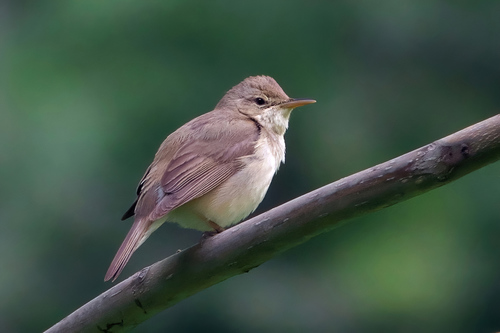 Blyth's Reed Warbler
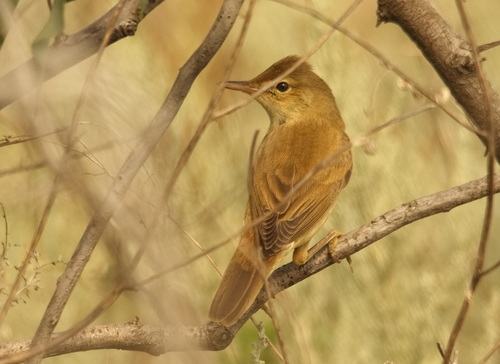 Marsh Warbler
In short
The most reliable field separation between Blyth's Reed Warbler and Marsh Warbler is structural: Blyth's Reed Warbler has shorter, rounder wings and a longer, heavier bill, while Marsh Warbler is more evenly proportioned with longer wings. Both species are plain brownish warblers with subtle differences in tone and face pattern, but these are often hard to judge in the field. Song is a strong clue: Marsh Warbler's song is a rich, highly imitative medley of other birds, while Blyth's Reed Warbler mixes harsh ticks and churring notes with some mimicry but is less musical. Habitat can help, but both can overlap in dense, damp vegetation. Careful attention to structure and, if available, song is key.
Identification tips
- Wing structure: Blyth's Reed Warbler has noticeably shorter, rounder wings compared to Marsh Warbler's longer, more pointed wings. This is best seen in perched birds or in flight, especially in side profile.
- Bill shape: Blyth's Reed Warbler has a longer, thicker bill with a pale pinkish-brown base to the lower mandible. Marsh Warbler's bill is shorter and more delicate. This is subtle but useful at close range.
- Overall proportions: Blyth's Reed Warbler appears more compact and front-heavy due to its short wings and long bill, while Marsh Warbler is more evenly proportioned.
- Face pattern: Both species have a pale supercilium, but Blyth's Reed's is often shorter and more restricted, while Marsh Warbler's face is plainer with less contrast.
- Plumage tone: Blyth's Reed is plain olive-brown above with little warmth, while Marsh Warbler can show slightly warmer or more olive tones, but this is variable and unreliable in poor light.
- Leg and foot color: Both have pale legs and feet, but Blyth's Reed's are specifically described as pale pinkish-brown.
- Song: Marsh Warbler's song is a continuous, highly imitative medley of other birds, often including African species. Blyth's Reed's song is harsher, with mechanical ticks and churring, and less extensive mimicry.
- Habitat (supporting): Blyth's Reed prefers woodland edge, scrub, and gardens, while Marsh Warbler favors tall, dense herbaceous vegetation on damp ground. Use with caution, as both can overlap.
- Behavior: Marsh Warbler often sings from exposed perches in tall vegetation, while Blyth's Reed is more likely to stay low and hidden.
- Flight jizz: Blyth's Reed may appear more rounded-winged and compact in flight, Marsh Warbler more elongated.
- Juvenile/immature plumage: No strong age-specific upperwing marks are described for either species, so do not rely on wing panels or contrasting edges.
- Season: In western Europe, Blyth's Reed is a rare but increasing breeder and migrant, while Marsh Warbler is more widespread in suitable habitat. Check local status for context.
- Sex: Both sexes are similar in appearance; song is given by males in both species.
- Hybridization: Rare hybrids have been recorded, so odd individuals may show mixed traits—prioritize structure and song in uncertain cases.
- Fallback: If in doubt and the bird is silent, prioritize structure (wing length, bill shape) over subtle plumage tones.
Size
Both species are medium-sized Acrocephalus warblers and overlap in length (Blyth's Reed: 12–14 cm, Marsh: similar). Blyth's Reed Warbler is slim with a relatively long bill and short, rounded wings, giving it a compact, front-heavy look. Marsh Warbler is also slim but has longer wings and a more balanced, less front-heavy appearance. Weight overlaps, but Blyth's Reed can be slightly lighter on average. In the field, size alone is rarely diagnostic, but the combination of wing length and bill shape is more useful.
Plumage
- Juvenile/immature upperwing pattern: No distinctive juvenile or immature upperwing marks are described for either species in the sources. Both are rather plain above, lacking strong panels or contrasting edges.
- Adults: Blyth's Reed Warbler is plain olive-brown above, with less olive on the short, rounded wings, and off-white underparts. The supercilium is short and whitish, running from bill base to eye, with a dusky eye-stripe. Marsh Warbler is also plain brown above and off-white below, but may show slightly warmer or more olive tones, though this is subtle and variable. Both lack strong wing bars or obvious contrasts. In practice, the differences in tone are unreliable in poor light or worn plumage.
- Face pattern: Both have a short pale supercilium, but Blyth's Reed's is often shorter and less distinct. Marsh Warbler's face can appear plainer, with less contrast between supercilium and eye-stripe.
- Bill and legs: Blyth's Reed has a longer, thicker, greyish-brown bill with a pale pinkish-brown base; legs and feet are similarly pale.
Behaviour
Both species are active in dense vegetation, often skulking but occasionally perching up to sing. Blyth's Reed Warbler is solitary and territorial in breeding season, typically staying low in shrubs or woodland edge. Marsh Warbler is also territorial and sings from exposed perches in tall herbaceous vegetation. Both can be elusive when not singing, but Marsh Warbler may be more likely to sing from a prominent perch. Flight is generally weak and direct in both, but Blyth's Reed may appear more rounded-winged and compact in flight.
Habitat
Habitat overlap is significant, but there are tendencies. Blyth's Reed Warbler breeds in damp broadleaved woodland edges, clearings, gullies, parks, gardens, and sometimes coniferous forest, often away from pure reedbeds. Marsh Warbler prefers rank, tall herbaceous vegetation (nettles, meadowsweet, willowherbs) on damp or seasonally flooded soils, sometimes in young osiers or low woody plants, and can breed in urban brownfields or arable crops. In the east, Marsh Warbler can use drier hillsides with shrubs. Both winter in different continents (Blyth's Reed in South Asia, Marsh in southeast Africa), but this is not useful for field ID in Europe. In areas of overlap, habitat alone is not diagnostic but can provide supporting context.
Voice
Song is a major separator. Marsh Warbler males produce a rich, continuous song packed with imitations of other birds—often dozens of species, including African birds in their repertoire. The song is highly varied, musical, and fast-paced, with little repetition. Blyth's Reed Warbler's song is more variable, with harsh ticks, chaks, and churring notes mixed with some melodious whistles and occasional mimicry, but is less musical and less imitative overall. Blyth's Reed's song is often described as more mechanical or scratchy. Calls are less distinctive, but Marsh Warbler's song is the best vocal clue.