
Blue-tailed Bee-eater vs Chestnut-headed Bee-eater
Merops philippinus versus Merops leschenaulti
Play a quiz with Blue-tailed Bee-eater and Chestnut-headed Bee-eater
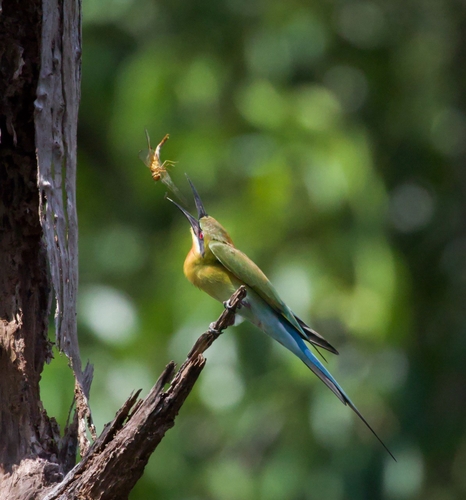 Blue-tailed Bee-eater
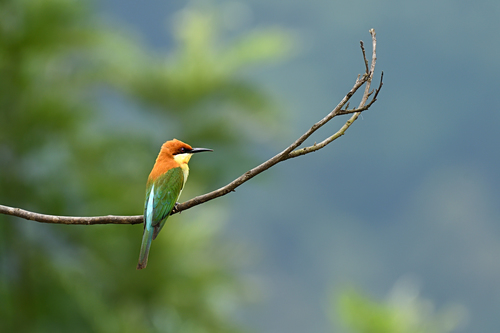 Chestnut-headed Bee-eater
In short
The most reliable field mark to separate Blue-tailed Bee-eater from Chestnut-headed Bee-eater is the head and throat coloration: Blue-tailed has a green head with a yellow-brown throat, while Chestnut-headed shows a rich chestnut crown, nape, and mantle with a yellow throat and face. Both species are slender, green bee-eaters with blue rumps and tails, but Blue-tailed has longer central tail feathers (especially in adults) and a smaller blue facial patch. Juveniles of both are duller, but Chestnut-headed juveniles lack the chestnut head and show a greenish crown. In flight or perched, focus on head color and tail shape for the quickest separation.
Identification tips
- Head and throat color (all ages): Blue-tailed Bee-eater has a green head with a yellow-brown throat and breast; Chestnut-headed Bee-eater shows a rich chestnut crown, nape, and mantle, and a yellow face and throat. This is the single most reliable mark.
- Tail shape and length (adults): Blue-tailed Bee-eater adults have long, pointed central tail streamers (especially males), making the tail appear longer and more tapered. Chestnut-headed Bee-eater lacks these streamers; its tail is shorter and squarer.
- Facial pattern: Blue-tailed has a small blue patch on the face and a black eye-stripe; Chestnut-headed has a yellow face with a black eye-stripe and no blue facial patch.
- Rump and tail color: Both have blue rumps and tails, but Blue-tailed's blue is more extensive and includes the entire tail; Chestnut-headed's blue is mostly on the rump and uppertail coverts, with the tail being greenish with blue margins.
- Juvenile differences: Juvenile Blue-taileds are dull green with a yellow-brown throat and lack tail streamers; juvenile Chestnut-headeds have a greenish crown and mantle and a yellow lower throat, lacking the chestnut head of adults.
- Breast and underparts: Blue-tailed's chestnut on the throat and breast is darker and more extensive than Chestnut-headed, which has a broad chestnut band below the yellow throat, then a black gorget, then green underparts.
- Bill and structure: Both have slender, black, decurved bills typical of bee-eaters; bill shape is not a separator.
- Size: Blue-tailed is larger and longer, especially with tail streamers; size can help if both are seen together but is unreliable alone.
- Perched jizz: Blue-tailed often appears longer and sleeker due to the tail streamers; Chestnut-headed is more compact.
- Flight jizz: In flight, Blue-tailed's long tail streamers are obvious in adults; Chestnut-headed's tail is short and square.
- Habitat context: Blue-tailed is more likely near open water and in lowlands; Chestnut-headed is more often in open woodland and highlands, but there is overlap.
- Voice: Calls are similar; not a strong field mark unless you know both species well.
- Sex differences: Both are sexually monomorphic to the human eye, though Blue-tailed males may have slightly longer tail streamers and darker throats.
- Pitfalls: Immature birds can be confusing—focus on head color (chestnut vs. greenish) and presence/absence of tail streamers for best results.
- Subspecies: Some Chestnut-headed subspecies (e.g., Javan) have all-yellow throats and blue tails, but still lack the chestnut crown and long tail streamers of Blue-tailed.
Size
Blue-tailed Bee-eater is noticeably larger: about 29 cm in body length (excluding its elongated central tail feathers, which add up to 7 cm more), and weighs 29–43 g [wikipedia]. Chestnut-headed Bee-eater is smaller and more compact, at 18–20 cm and 26–33 g [wikipedia]. The difference is most obvious when seen side-by-side or when the Blue-tailed's tail streamers are visible. However, size alone is not always reliable at a distance or in isolation.
Plumage
- Juveniles: Blue-tailed Bee-eater juveniles are drabber green, lack the elongated central tail feathers, and have a small blue face patch with a yellow-brown throat. Chestnut-headed Bee-eater juveniles are duller, with a green forehead, forecrown, and mantle, and a yellow lower throat (not chestnut); their breast and belly are paler and more olive. The absence of a chestnut head in Chestnut-headed juveniles is key.
- Adults: Blue-tailed Bee-eater adults are mostly green with a blue rump and tail, a small blue face patch, black eye-stripe, and a yellow-brown throat and breast (darker and more extensive than Chestnut-headed). The central tail feathers are elongated, especially in males. Chestnut-headed Bee-eater adults have a rich chestnut crown, nape, and mantle, yellow face and throat, a black eye-stripe, and a blue rump and uppertail coverts. Their tail is shorter and lacks the long streamers.
- Flight views: Both species show blue rumps and tails, but Blue-tailed's tail is longer and more pointed due to the streamers. Chestnut-headed's blue is more limited to the rump and uppertail coverts, and the tail is squarer.
Behaviour
Both species are gregarious, often seen feeding and roosting communally. They hunt insects by sallying from open perches and may be seen foraging over water. Blue-tailed Bee-eater is more strongly migratory and is known for mass diurnal migrations in some areas. Both species nest colonially in sandy banks, digging tunnels for their nests. There is no strong behavioral difference for field separation.
Habitat
Blue-tailed Bee-eater favors open habitats near water—river valleys, lakesides, estuaries, and sometimes even coastal areas. It is often seen in lowland areas and is more likely to be found near open water. Chestnut-headed Bee-eater prefers sub-tropical open woodland and is most common in highland areas, though it also breeds in sandy banks. Overlap occurs, but Blue-tailed is more tied to water, while Chestnut-headed is more woodland-associated.
Voice
Blue-tailed Bee-eater's call is a rolling, chirping, whistling 'teerp,' mainly given in flight. Chestnut-headed Bee-eater's calls are not described in detail in the provided notes, but both have typical bee-eater calls—soft, rolling, and whistled. Voice is not a strong separator unless you are very familiar with both.
Blue-tailed Bee-eater · Chestnut-headed Bee-eater · My Tricky Birds