

Motmot

Blue-spotted Wood-Dove vs Namaqua Dove

Turtur afer versus Oena capensis

Play a quiz with Blue-spotted Wood-Dove and Namaqua Dove
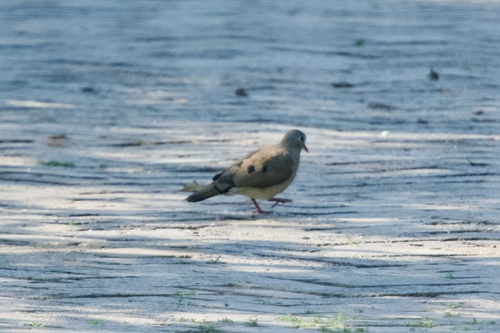
Blue-spotted Wood-Dove (Turtur afer) Blue-spotted Wood-Dove
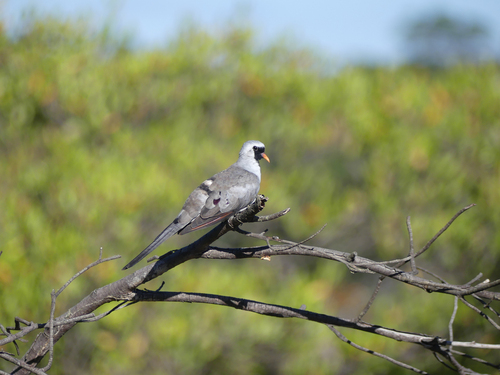
Namaqua Dove (Oena capensis) Namaqua Dove

Media

Loading…

In short

The most reliable field mark to separate Blue-spotted Wood-Dove from Namaqua Dove is the latter’s extremely long, black, pointed tail, which is unique among African doves and obvious both perched and in flight. Juvenile Namaqua Doves also show dark blotching on the wings and shoulders, a feature not found on Blue-spotted Wood-Dove. Adult male Namaqua Doves have a striking black face and breast, while Blue-spotted Wood-Dove lacks any black on the face or underparts. Both species are small doves, but Namaqua Dove is notably more slender and long-tailed, with a jizz more reminiscent of a miniature parrot or budgerigar. If you see a tiny dove with a long, thin tail and chestnut primaries in flight, it is almost certainly a Namaqua Dove.

Identification tips

  1. Tail shape and length: Namaqua Dove has an extremely long, black, pointed tail, which is obvious in all ages and both perched and in flight. Blue-spotted Wood-Dove has a short, typical dove tail.
  2. Juvenile wing pattern: Juvenile Namaqua Doves show dark blotching on the wings and shoulders, a feature never present in Blue-spotted Wood-Dove.
  3. Adult male face and breast: Adult male Namaqua Doves have a black face, throat, and breast, plus a yellow and red bill. Blue-spotted Wood-Dove never shows black on the face or underparts.
  4. Bill color: Female Namaqua Doves have a red-based grey bill; Blue-spotted Wood-Dove’s bill is not described, but lacks the red-based pattern.
  5. Primary color in flight: Namaqua Dove shows chestnut primary feathers in flight, contrasting with the otherwise grey plumage. Blue-spotted Wood-Dove does not have chestnut in the wing.
  6. Overall shape and jizz: Namaqua Dove is very slim and elongated, with a parrot-like or budgerigar-like appearance, especially in flight. Blue-spotted Wood-Dove is more compact and rounded.
  7. Belly color: Namaqua Dove has a white belly, contrasting with the grey upperparts. Blue-spotted Wood-Dove’s underparts are not described as white.
  8. Sex and age differences: Only adult male Namaqua Doves have the black face and breast; females and juveniles lack black but still show the long tail and bill color differences. Juveniles are blotched on the wings and shoulders.
  9. Habitat context: Namaqua Dove is more likely in open or arid habitats, while Blue-spotted Wood-Dove prefers woodland or denser cover. Use habitat as a supporting clue, not a primary mark.
  10. Vocalization: If you hear a quiet, mournful double hoo (kuh-whooo), it is Namaqua Dove. Blue-spotted Wood-Dove’s voice is not described here.
  11. Size: Both are small, but Namaqua Dove is especially tiny and slender, with a body mass around 36–40g and a 22 cm length, much of which is tail.
  12. Subspecies variation: On Madagascar, O. c. aliena males are darker and smaller, but the long tail and overall jizz remain distinctive.
  13. Potential pitfalls: Female and juvenile Namaqua Doves lack the male’s black face, but the long tail, slim build, and chestnut primaries in flight still separate them from Blue-spotted Wood-Dove.
  14. No blue spots: Despite the name, Blue-spotted Wood-Dove’s blue spotting is not described as a key field mark here, so do not rely on this unless seen well.
  15. When in doubt: If you see a small dove with a very long, pointed tail and any hint of chestnut in the wing, it is a Namaqua Dove, regardless of age or sex.

Size

Namaqua Dove is among the smallest African doves, weighing around 36–40g, and is noticeably more slender and elongated than Blue-spotted Wood-Dove. Its body length is about 22 cm, but the very long, pointed tail makes it appear even longer and more delicate in profile. Blue-spotted Wood-Dove is also small but has a more typical dove shape, lacking the exaggerated tail length and slim build of Namaqua Dove. In direct comparison, Namaqua Dove’s tail and overall proportions are the most obvious size and shape differences.

Plumage

Juvenile Namaqua Doves are dark-blotched on the wings and shoulders, a mark not present in Blue-spotted Wood-Dove of any age. Adult male Namaqua Doves are unmistakable with their black face, throat, and breast, plus a yellow and red bill, while females lack the black but have a red-based grey bill. Both sexes of Namaqua Dove show a mostly grey body, white belly, and chestnut primaries visible in flight. Blue-spotted Wood-Dove, by contrast, lacks any black on the face or underparts and does not have chestnut in the wing. Its plumage is more typical of Turtur doves, without the strong contrasts or long tail. The upperwing pattern in flight is not described for Blue-spotted Wood-Dove, but the absence of chestnut primaries and dark juvenile blotching are key. Female and immature Namaqua Doves resemble each other, but the tail and bill color remain helpful.

Behaviour

Namaqua Dove often perches upright and appears very slim and long-tailed, sometimes recalling a budgerigar in silhouette. Its flight is fast and direct, with the long tail trailing behind. Blue-spotted Wood-Dove behaves more like a typical small dove, with a compact, rounded shape and shorter tail. Namaqua Dove’s jizz is distinctive and often the first clue to its identity.

Habitat

Both species occur widely in sub-Saharan Africa, but Namaqua Dove is also found in drier regions, including Arabia and Madagascar. Blue-spotted Wood-Dove is abundant south of the Sahel but absent from southern Africa. Habitat overlap is possible, but Namaqua Dove is more likely in open, arid, or semi-arid areas, while Blue-spotted Wood-Dove prefers woodland and denser cover.

Voice

Namaqua Dove gives a quiet, short, double hoo, with the second note longer and higher—kuh-whooo—described as mournful and frequently repeated. There is no vocalization information provided for Blue-spotted Wood-Dove, so voice is only diagnostic for Namaqua Dove if heard.

Submit a better description

Use the same sections as the comparison. Your text is published immediately.

The most reliable field mark to separate Blue-spotted Wood-Dove from Namaqua Dove is the latter’s extremely long, black, pointed tail, which is unique among African doves and obvious both perched and in flight. Juvenile Namaqua Doves also show dark blotching on the wings and shoulders, a feature not found on Blue-spotted Wood-Dove. Adult male Namaqua Doves have a striking black face and breast, while Blue-spotted Wood-Dove lacks any black on the face or underparts. Both species are small doves, but Namaqua Dove is notably more slender and long-tailed, with a jizz more reminiscent of a miniature parrot or budgerigar. If you see a tiny dove with a long, thin tail and chestnut primaries in flight, it is almost certainly a Namaqua Dove.

  1. Tail shape and length: Namaqua Dove has an extremely long, black, pointed tail, which is obvious in all ages and both perched and in flight. Blue-spotted Wood-Dove has a short, typical dove tail.
  2. Juvenile wing pattern: Juvenile Namaqua Doves show dark blotching on the wings and shoulders, a feature never present in Blue-spotted Wood-Dove.
  3. Adult male face and breast: Adult male Namaqua Doves have a black face, throat, and breast, plus a yellow and red bill. Blue-spotted Wood-Dove never shows black on the face or underparts.
  4. Bill color: Female Namaqua Doves have a red-based grey bill; Blue-spotted Wood-Dove’s bill is not described, but lacks the red-based pattern.
  5. Primary color in flight: Namaqua Dove shows chestnut primary feathers in flight, contrasting with the otherwise grey plumage. Blue-spotted Wood-Dove does not have chestnut in the wing.
  6. Overall shape and jizz: Namaqua Dove is very slim and elongated, with a parrot-like or budgerigar-like appearance, especially in flight. Blue-spotted Wood-Dove is more compact and rounded.
  7. Belly color: Namaqua Dove has a white belly, contrasting with the grey upperparts. Blue-spotted Wood-Dove’s underparts are not described as white.
  8. Sex and age differences: Only adult male Namaqua Doves have the black face and breast; females and juveniles lack black but still show the long tail and bill color differences. Juveniles are blotched on the wings and shoulders.
  9. Habitat context: Namaqua Dove is more likely in open or arid habitats, while Blue-spotted Wood-Dove prefers woodland or denser cover. Use habitat as a supporting clue, not a primary mark.
  10. Vocalization: If you hear a quiet, mournful double hoo (kuh-whooo), it is Namaqua Dove. Blue-spotted Wood-Dove’s voice is not described here.
  11. Size: Both are small, but Namaqua Dove is especially tiny and slender, with a body mass around 36–40g and a 22 cm length, much of which is tail.
  12. Subspecies variation: On Madagascar, O. c. aliena males are darker and smaller, but the long tail and overall jizz remain distinctive.
  13. Potential pitfalls: Female and juvenile Namaqua Doves lack the male’s black face, but the long tail, slim build, and chestnut primaries in flight still separate them from Blue-spotted Wood-Dove.
  14. No blue spots: Despite the name, Blue-spotted Wood-Dove’s blue spotting is not described as a key field mark here, so do not rely on this unless seen well.
  15. When in doubt: If you see a small dove with a very long, pointed tail and any hint of chestnut in the wing, it is a Namaqua Dove, regardless of age or sex.

Namaqua Dove is among the smallest African doves, weighing around 36–40g, and is noticeably more slender and elongated than Blue-spotted Wood-Dove. Its body length is about 22 cm, but the very long, pointed tail makes it appear even longer and more delicate in profile. Blue-spotted Wood-Dove is also small but has a more typical dove shape, lacking the exaggerated tail length and slim build of Namaqua Dove. In direct comparison, Namaqua Dove’s tail and overall proportions are the most obvious size and shape differences.

Juvenile Namaqua Doves are dark-blotched on the wings and shoulders, a mark not present in Blue-spotted Wood-Dove of any age. Adult male Namaqua Doves are unmistakable with their black face, throat, and breast, plus a yellow and red bill, while females lack the black but have a red-based grey bill. Both sexes of Namaqua Dove show a mostly grey body, white belly, and chestnut primaries visible in flight. Blue-spotted Wood-Dove, by contrast, lacks any black on the face or underparts and does not have chestnut in the wing. Its plumage is more typical of Turtur doves, without the strong contrasts or long tail. The upperwing pattern in flight is not described for Blue-spotted Wood-Dove, but the absence of chestnut primaries and dark juvenile blotching are key. Female and immature Namaqua Doves resemble each other, but the tail and bill color remain helpful.

Namaqua Dove often perches upright and appears very slim and long-tailed, sometimes recalling a budgerigar in silhouette. Its flight is fast and direct, with the long tail trailing behind. Blue-spotted Wood-Dove behaves more like a typical small dove, with a compact, rounded shape and shorter tail. Namaqua Dove’s jizz is distinctive and often the first clue to its identity.

Both species occur widely in sub-Saharan Africa, but Namaqua Dove is also found in drier regions, including Arabia and Madagascar. Blue-spotted Wood-Dove is abundant south of the Sahel but absent from southern Africa. Habitat overlap is possible, but Namaqua Dove is more likely in open, arid, or semi-arid areas, while Blue-spotted Wood-Dove prefers woodland and denser cover.

Namaqua Dove gives a quiet, short, double hoo, with the second note longer and higher—kuh-whooo—described as mournful and frequently repeated. There is no vocalization information provided for Blue-spotted Wood-Dove, so voice is only diagnostic for Namaqua Dove if heard.

Discard your changes?

You have unsaved edits. If you leave now, those changes will be lost.

Blue-spotted Wood-Dove · Namaqua Dove · My Tricky Birds