

Blue-headed Parrot vs Silver-beaked Tanager
Pionus menstruus versus Ramphocelus carbo
Play a quiz with Blue-headed Parrot and Silver-beaked Tanager
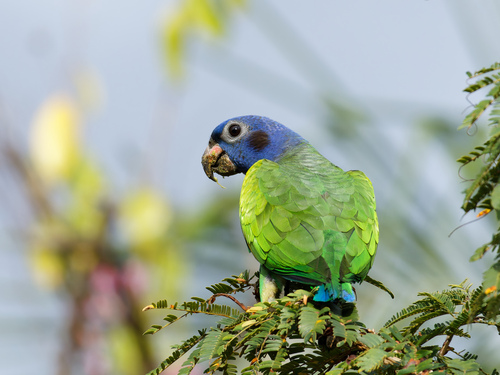 Blue-headed Parrot
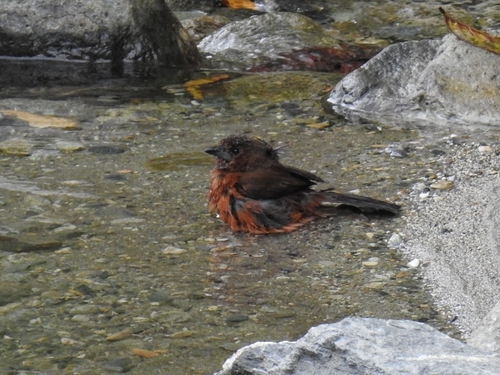 Silver-beaked Tanager
In short
The most reliable field mark separating Blue-headed Parrot from Silver-beaked Tanager is the parrot's blue head and neck contrasting with its green body and red undertail coverts, versus the tanager's deep carmine or velvety blackish plumage and heavy, pale-based bill. Juveniles of the parrot may show less blue and some reddish around the cere, but never the plush, uniform red or blackish tones of the tanager. Structure is also a giveaway: Blue-headed Parrot is a chunky, short-tailed, broad-winged bird with a strong hooked bill, while Silver-beaked Tanager is smaller, slimmer, and has a straight, thick tanager bill. If you see a mostly green bird with a blue head, it's the parrot; if you see a plush, deep red or blackish bird with a heavy, pale-based bill, it's the tanager.
Identification tips
- Head color: Blue-headed Parrot always shows a blue head and neck (less in juveniles, but still bluish), never matched by Silver-beaked Tanager of any age or sex.
- Body color: Parrot is mainly green-bodied with red undertail coverts; tanager is deep carmine, velvety blackish, or reddish-brown, never green.
- Bill shape and color: Parrot has a strong, hooked, mostly black upper mandible with reddish sides; tanager has a thick, straight bill with a silvery white lower mandible (in males) or all dusky (in females), never hooked.
- Size and structure: Parrot is much larger and bulkier, with a short tail and broad wings; tanager is smaller, slimmer, and more delicate.
- Juvenile plumage: Young parrots have less blue on the head and some reddish around the cere, but still show green bodies and red undertail coverts. Immature tanagers resemble adult females (reddish brown), never green or blue.
- Wing and tail pattern: Parrot wings are green with some yellowish on coverts; tanager wings are dusky black with brownish or rufescent edges (females/immatures). No distinctive upperwing panels or flight marks in either, but overall color is diagnostic.
- Undertail coverts: Parrot has bright red undertail coverts; tanager's are black with crimson tinge (male) or brownish (female/immature), never bright red.
- Sexual dimorphism: Parrot sexes are alike; tanager males are much brighter (deep carmine or blackish) than females (reddish brown). If you see a plush, velvety blackish or deep red bird, it's a male tanager; if both sexes look the same, consider parrot.
- Iris and legs: Tanager has reddish brown iris and dark horn-gray legs; parrot's eye and leg color less distinctive in the field.
- Behavior: Parrots are often seen in noisy flocks or roosts, flying strongly and perching upright; tanagers are more solitary or in small groups, foraging lower and less conspicuously.
- Habitat: Parrots are more likely in humid/semi-humid forests or semi-open areas; tanagers are common in edge, secondary, and disturbed habitats.
- Voice: Parrot's high-pitched 'sweenk' is distinctive; tanager's calls are not squeaky or high-pitched.
- Range overlap: Both can occur in Trinidad and much of tropical South America, so range alone is not diagnostic.
- Pitfall: Immature parrots with reduced blue may seem less obvious, but still never approach the plush, uniform red or blackish look of tanager. Female/immature tanagers may look duller, but never green or blue.
- In flight: Parrot's bulk, blue head, and green body are visible even in flight; tanager is smaller, with uniform dark or reddish tones and no blue or green.
Size
Blue-headed Parrot is significantly larger, at about 27–28 cm in length and 245 g in weight [wikipedia][avonet], with a robust, stocky build. Silver-beaked Tanager is much smaller, at 16–17 cm and 21–37.5 g [wikipedia]. In the field, the parrot appears bulkier and more powerful, while the tanager is noticeably lighter and more delicate.
Plumage
Juvenile Blue-headed Parrots have less blue on the head and may show red or pinkish feathers around the cere, but still have a mainly green body and red undertail coverts. These birds gradually acquire the full blue hood over 8–24 months. All ages of Blue-headed Parrot show a green body, blue head/neck, and red undertail coverts, with some yellowish on wing coverts. In contrast, Silver-beaked Tanager males are deep carmine or velvety blackish with a plush look, and females/immatures are rich dark rusty-red to reddish brown, lacking any green or blue. The tanager's flight feathers and tail are dusky black, and both sexes have a heavy, pale-based bill (silvery white on lower mandible in males). No age of tanager shows a blue head or green body. Female and immature tanagers are browner but still lack any green or blue, and their wings are dusky with rufescent brown edges. Subspecific variation in tanager males can affect the shade of red or black, but never approaches the parrot's coloration.
Behaviour
Blue-headed Parrots are noisy, often seen in flocks, and may be observed roosting communally in palms or large trees, sometimes in large numbers at dawn and dusk. They have a strong, direct flight and perch upright, often in the open. Silver-beaked Tanagers are more likely to be seen singly or in small groups, foraging in shrubby or edge habitats, and tend to be less conspicuous in flight. Their movements are more hopping and perching low or mid-level in vegetation.
Habitat
Blue-headed Parrot favors humid or semi-humid forests and semi-open country, including cultivated areas, but is largely restricted to wetter regions (though it can extend into drier areas along rivers). Silver-beaked Tanager is widespread in lowland South America, found in a broad range of habitats including forest edges, secondary growth, gardens, and shrubby areas. Both can occur in human-modified landscapes, but the parrot is more tied to forested or semi-open tracts, while the tanager is common in disturbed and edge habitats.
Voice
Blue-headed Parrot gives light, high-pitched squeaking 'sweenk' calls and is generally noisy, especially in flight or at communal roosts. Silver-beaked Tanager is less noisy, with typical tanager calls that are not described in detail here, but do not resemble the parrot's squeaky, high-pitched notes.
Blue-headed Parrot · Silver-beaked Tanager · My Tricky Birds