
Motmot

Blue-cheeked Bee-eater vs European Bee-eater

Merops persicus versus Merops apiaster

Play a quiz with Blue-cheeked Bee-eater and European Bee-eater
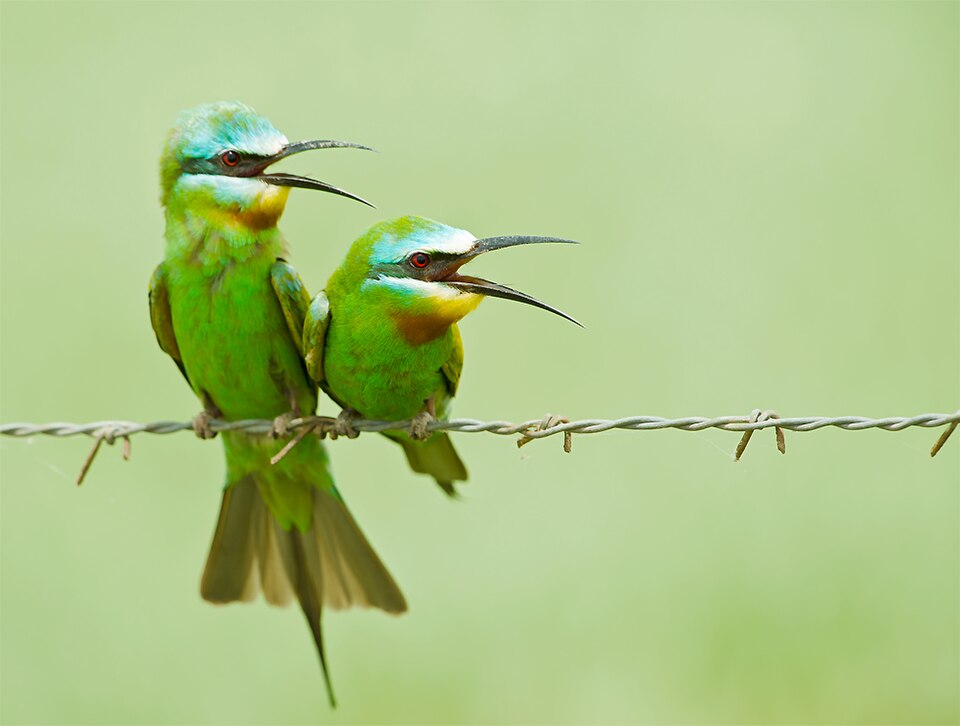
Blue-cheeked Bee-eater (Merops persicus) Blue-cheeked Bee-eater
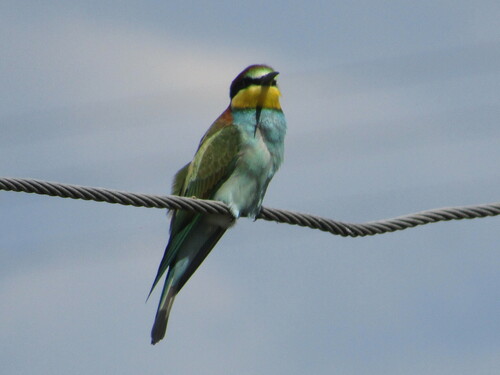
European Bee-eater (Merops apiaster) European Bee-eater

Media

Loading…

In short

The most reliable field mark between Blue-cheeked and European Bee-eater is the face pattern: Blue-cheeked shows bright blue sides to the face and a broad black eye-stripe, while European has a chestnut crown and nape with a yellow throat bordered below by a black line, lacking the blue cheek patch. Both are slender, colorful bee-eaters with long, pointed wings and elongated central tail feathers, but Blue-cheeked is slightly larger and greener overall, while European is more chestnut and yellow above. Juvenile and non-breeding birds can be especially confusing, but the face and throat coloration remain the best clues. In flight, both species look similar, so focus on head and throat color when possible. Habitat overlap is common, especially in migration and at colonies, so context alone is not reliable.

Identification tips

  1. Face pattern is diagnostic: Blue-cheeked shows bright blue cheeks and a broad black eye-stripe; European lacks blue on the face, instead showing a chestnut crown/nape and a yellow throat bordered below by a black line. This works for all ages and seasons.
  2. Throat color: Blue-cheeked has a yellow and brown throat; European has a pure yellow throat with a distinct black border below. This is visible in perched birds and often in flight.
  3. Upperparts color: Blue-cheeked is predominantly green above and below; European has brown and yellow upperparts with green wings. In bright light, Blue-cheeked looks greener overall.
  4. Crown and nape: European Bee-eater has a rich chestnut crown and nape, contrasting with the green back. Blue-cheeked lacks this chestnut, being green right up to the crown.
  5. Juvenile and non-breeding confusion: Juvenile European Bee-eaters are duller, with a blue-green back and no tail streamers, but still lack blue cheeks. Juvenile Blue-cheeked are not described in detail, but blue cheeks are expected to be present. In non-breeding plumage, European is duller but facial pattern remains.
  6. Tail feathers: Both species have elongated central tail feathers in adults, longer in males. European juveniles lack these streamers, which can mislead, but face pattern still separates.
  7. Bill color and shape: Both have black, slightly decurved bills; not useful for separation.
  8. Size and structure: Blue-cheeked is slightly larger and longer-tailed, but this is subtle and unreliable without direct comparison.
  9. Perched jizz: Blue-cheeked may look a bit lankier and longer-tailed, but both are slender and upright.
  10. Flight views: Both show pointed wings and long tails; face and throat color are the best clues even in flight.
  11. Voice: Blue-cheeked calls are 'flatter' and less 'fluty' than European, but this is hard to judge unless familiar with both.
  12. Habitat and context: Both species can occur together, especially at colonies and on migration, so do not rely on habitat or location alone.
  13. Sex differences: Female Blue-cheeked has shorter tail streamers; female European tends to have greener shoulder feathers, but this is subtle.
  14. Colony composition: Both may nest together, so mixed colonies are possible; always check each bird individually.
  15. Pitfalls: Beware of dull juvenile European Bee-eaters lacking tail streamers—focus on the absence of blue cheeks and the presence of a chestnut crown to avoid confusion.

Size

Blue-cheeked Bee-eater averages slightly larger, with a body mass around 49.4 g [wikidata] and a length up to 31 cm (including tail streamers). European Bee-eater averages 52 g but is generally shorter at 27–29 cm, including streamers. The difference is subtle in the field, but Blue-cheeked often appears a bit longer and lankier, especially when perched. Both species are slim and similar in build, so size alone is rarely diagnostic.

Plumage

For all ages, the face and throat pattern is the key: Blue-cheeked Bee-eater has blue cheeks, a broad black eye-stripe, and a yellow and brown throat, while European Bee-eater shows a chestnut crown and nape, yellow throat bordered below by a black line, and no blue cheek patch. In adults, Blue-cheeked is predominantly green above and below, whereas European has brown and yellow upperparts and greener wings. Non-breeding and juvenile European Bee-eaters become duller, with a blue-green back and lack the elongated tail feathers, but still do not show blue cheeks. Juvenile Blue-cheeked are not described in detail, but the blue cheek and facial pattern are expected to be present. Both species have black bills and elongated central tail feathers (shorter in females and absent in juvenile European).

Behaviour

Both species hunt insects on the wing from exposed perches and often gather in loose colonies or mixed groups. Blue-cheeked may prefer telephone wires as perches if available. Both dig nest tunnels in sandy banks or low cliffs and may nest together in mixed colonies. Flight is swift and direct for both, with pointed wings and long tails. No major behavioral differences are noted that aid in field separation.

Habitat

Habitat overlap is extensive. Blue-cheeked Bee-eater breeds in northern Africa, the Middle East, and Central Asia, often in sub-tropical semi-desert with scattered trees, and winters in tropical Africa. European Bee-eater has a broader breeding range across southern and central Europe, parts of Africa, and western Asia, also wintering in tropical Africa. Both use open country, woodland edges, and riverbanks, and both may be found together at migration stopovers or colonies. Habitat is not a reliable separator where ranges overlap.

Voice

Blue-cheeked Bee-eater's call is described as 'flatter' and less 'fluty' than European Bee-eater, but both give rolling, trilled calls in flight. The difference is subtle and may be difficult to judge without direct comparison or experience.

Submit a better description

Use the same sections as the comparison. Your text is published immediately.

The most reliable field mark between Blue-cheeked and European Bee-eater is the face pattern: Blue-cheeked shows bright blue sides to the face and a broad black eye-stripe, while European has a chestnut crown and nape with a yellow throat bordered below by a black line, lacking the blue cheek patch. Both are slender, colorful bee-eaters with long, pointed wings and elongated central tail feathers, but Blue-cheeked is slightly larger and greener overall, while European is more chestnut and yellow above. Juvenile and non-breeding birds can be especially confusing, but the face and throat coloration remain the best clues. In flight, both species look similar, so focus on head and throat color when possible. Habitat overlap is common, especially in migration and at colonies, so context alone is not reliable.

  1. Face pattern is diagnostic: Blue-cheeked shows bright blue cheeks and a broad black eye-stripe; European lacks blue on the face, instead showing a chestnut crown/nape and a yellow throat bordered below by a black line. This works for all ages and seasons.
  2. Throat color: Blue-cheeked has a yellow and brown throat; European has a pure yellow throat with a distinct black border below. This is visible in perched birds and often in flight.
  3. Upperparts color: Blue-cheeked is predominantly green above and below; European has brown and yellow upperparts with green wings. In bright light, Blue-cheeked looks greener overall.
  4. Crown and nape: European Bee-eater has a rich chestnut crown and nape, contrasting with the green back. Blue-cheeked lacks this chestnut, being green right up to the crown.
  5. Juvenile and non-breeding confusion: Juvenile European Bee-eaters are duller, with a blue-green back and no tail streamers, but still lack blue cheeks. Juvenile Blue-cheeked are not described in detail, but blue cheeks are expected to be present. In non-breeding plumage, European is duller but facial pattern remains.
  6. Tail feathers: Both species have elongated central tail feathers in adults, longer in males. European juveniles lack these streamers, which can mislead, but face pattern still separates.
  7. Bill color and shape: Both have black, slightly decurved bills; not useful for separation.
  8. Size and structure: Blue-cheeked is slightly larger and longer-tailed, but this is subtle and unreliable without direct comparison.
  9. Perched jizz: Blue-cheeked may look a bit lankier and longer-tailed, but both are slender and upright.
  10. Flight views: Both show pointed wings and long tails; face and throat color are the best clues even in flight.
  11. Voice: Blue-cheeked calls are 'flatter' and less 'fluty' than European, but this is hard to judge unless familiar with both.
  12. Habitat and context: Both species can occur together, especially at colonies and on migration, so do not rely on habitat or location alone.
  13. Sex differences: Female Blue-cheeked has shorter tail streamers; female European tends to have greener shoulder feathers, but this is subtle.
  14. Colony composition: Both may nest together, so mixed colonies are possible; always check each bird individually.
  15. Pitfalls: Beware of dull juvenile European Bee-eaters lacking tail streamers—focus on the absence of blue cheeks and the presence of a chestnut crown to avoid confusion.

Blue-cheeked Bee-eater averages slightly larger, with a body mass around 49.4 g [wikidata] and a length up to 31 cm (including tail streamers). European Bee-eater averages 52 g but is generally shorter at 27–29 cm, including streamers. The difference is subtle in the field, but Blue-cheeked often appears a bit longer and lankier, especially when perched. Both species are slim and similar in build, so size alone is rarely diagnostic.

For all ages, the face and throat pattern is the key: Blue-cheeked Bee-eater has blue cheeks, a broad black eye-stripe, and a yellow and brown throat, while European Bee-eater shows a chestnut crown and nape, yellow throat bordered below by a black line, and no blue cheek patch. In adults, Blue-cheeked is predominantly green above and below, whereas European has brown and yellow upperparts and greener wings. Non-breeding and juvenile European Bee-eaters become duller, with a blue-green back and lack the elongated tail feathers, but still do not show blue cheeks. Juvenile Blue-cheeked are not described in detail, but the blue cheek and facial pattern are expected to be present. Both species have black bills and elongated central tail feathers (shorter in females and absent in juvenile European).

Both species hunt insects on the wing from exposed perches and often gather in loose colonies or mixed groups. Blue-cheeked may prefer telephone wires as perches if available. Both dig nest tunnels in sandy banks or low cliffs and may nest together in mixed colonies. Flight is swift and direct for both, with pointed wings and long tails. No major behavioral differences are noted that aid in field separation.

Habitat overlap is extensive. Blue-cheeked Bee-eater breeds in northern Africa, the Middle East, and Central Asia, often in sub-tropical semi-desert with scattered trees, and winters in tropical Africa. European Bee-eater has a broader breeding range across southern and central Europe, parts of Africa, and western Asia, also wintering in tropical Africa. Both use open country, woodland edges, and riverbanks, and both may be found together at migration stopovers or colonies. Habitat is not a reliable separator where ranges overlap.

Blue-cheeked Bee-eater's call is described as 'flatter' and less 'fluty' than European Bee-eater, but both give rolling, trilled calls in flight. The difference is subtle and may be difficult to judge without direct comparison or experience.

Discard your changes?

You have unsaved edits. If you leave now, those changes will be lost.

Blue-cheeked Bee-eater · European Bee-eater · My Tricky Birds