

Blue-and-gold Tanager vs Palm Tanager
Bangsia arcaei versus Thraupis palmarum
Play a quiz with Blue-and-gold Tanager and Palm Tanager
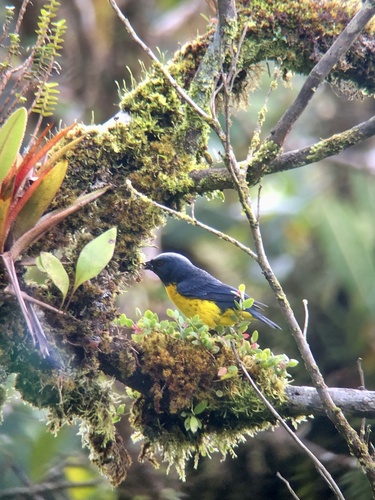 Blue-and-gold Tanager
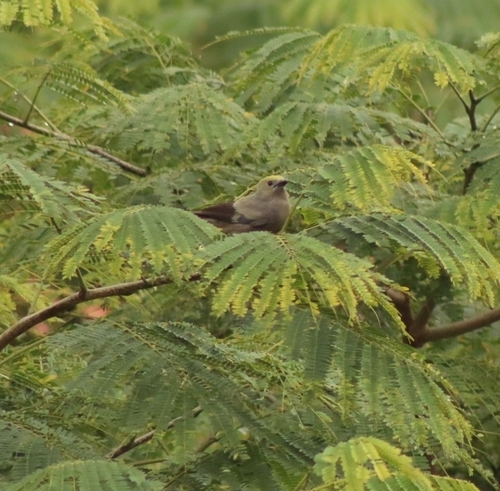 Palm Tanager
In short
The most reliable field mark is the overall color palette: Palm Tanager is a uniform dull olive-green to grayish bird with blackish wings and tail, showing a yellow wingbar in flight, while Blue-and-gold Tanager is much more vividly colored, with strong blue and gold tones. Immature or female Palm Tanagers may appear paler but never show the bright blue or gold of Blue-and-gold Tanager. In flight, Palm Tanager’s yellow wingbar is a key feature, absent in Blue-and-gold. Habitat can also help: Blue-and-gold is restricted to humid montane forests, while Palm Tanager is widespread in lowlands and disturbed areas.
Identification tips
- Overall color: Blue-and-gold Tanager is vividly colored with strong blue and gold (yellow-orange) plumage, never matched by Palm Tanager, which is always dull olive-green to grayish.
- Wingbar in flight: Palm Tanager shows a yellow wingbar in flight, visible as a flash across the wing; Blue-and-gold Tanager lacks any such wingbar.
- Wings and tail: Palm Tanager has blackish wings and a long blackish tail edged with green; Blue-and-gold Tanager’s wings and tail are blue-toned, matching the body.
- Plumage uniformity: Palm Tanager is uniform in color, lacking any sharp contrast or bright patches. Blue-and-gold Tanager shows clear contrast between blue and gold areas.
- Sex and age: Both sexes of both species are similar, but female Palm Tanagers may be paler. Immature Palm Tanagers are also dull olive-green to grayish, not blue or gold.
- Habitat: Blue-and-gold Tanager is found only in humid montane forests; Palm Tanager is common in lowland and disturbed habitats, including urban areas.
- Range: If you are outside the Talamancan or Darién montane forests, you are almost certainly seeing Palm Tanager, not Blue-and-gold.
- Perched vs. flight views: The yellow wingbar of Palm Tanager is most obvious in flight; perched birds may look plainer, but still lack any blue or gold.
- Bill and structure: No strong differences are noted in bill shape or structure; both are typical tanagers.
- Group behavior: Palm Tanager is often seen in pairs or small groups, sometimes in gardens; Blue-and-gold Tanager is more secretive and forest-dependent.
- Pitfalls: In poor light, Palm Tanager can look grayish or slightly yellowish, but never blue or gold. Beware of overexposed photos or distant views.
- No seasonal confusion: Both species have similar plumage year-round; there is no seasonal molt that would cause confusion.
- No vocal clues: The sources do not provide vocalization differences, so do not rely on calls for separation.
- Distribution clues: If you are in a region where Blue-and-gold Tanager is not known to occur, default to Palm Tanager.
- Conservation context: Blue-and-gold Tanager is threatened and local; Palm Tanager is abundant and adaptable.
Size
Palm Tanager is a medium-sized tanager, about 19 cm long and weighing 36 g [wikipedia]. No direct size information is given for Blue-and-gold Tanager, but there is no indication of a dramatic size difference. Both are similar in general tanager proportions, so size is not a reliable separator in the field.
Plumage
- Juvenile/immature/first-winter birds: The notes do not provide details for immature Blue-and-gold Tanager, but Palm Tanager immatures resemble adults, being dull olive-green to grayish with a yellow wingbar visible in flight. No blue or gold is ever present in Palm Tanager of any age.
- Adults: Blue-and-gold Tanager is strikingly colored with blue and gold (yellow-orange) plumage. Palm Tanager adults are uniform dull olive-green to grayish, with blackish wings and tail, and a yellow wingbar in flight. Sexes are similar in both species, though female Palm Tanagers may be paler.
- Flight views: Palm Tanager shows a yellow wingbar in flight, a feature absent in Blue-and-gold Tanager. Blue-and-gold Tanager’s blue and gold tones are visible both perched and in flight.
Behaviour
No specific behavioral differences are noted in the sources. Both species are typical tanagers in their movements and posture. Palm Tanager is often seen in pairs or small groups, sometimes in gardens and urban areas, while Blue-and-gold Tanager is more restricted to forest interiors.
Habitat
Blue-and-gold Tanager is found in humid montane forests of the Talamancan range and Serranía del Darién [wikipedia]. It is a forest specialist and threatened by habitat loss. Palm Tanager, in contrast, is widespread and common in lowlands, open woodlands, gardens, and disturbed habitats from Nicaragua south to southern Brazil and Trinidad [wikipedia, ebird]. If you are in a city park or lowland plantation, Blue-and-gold Tanager is extremely unlikely.