

Black Turnstone vs Prairie Falcon
Arenaria melanocephala versus Falco mexicanus
Play a quiz with Black Turnstone and Prairie Falcon
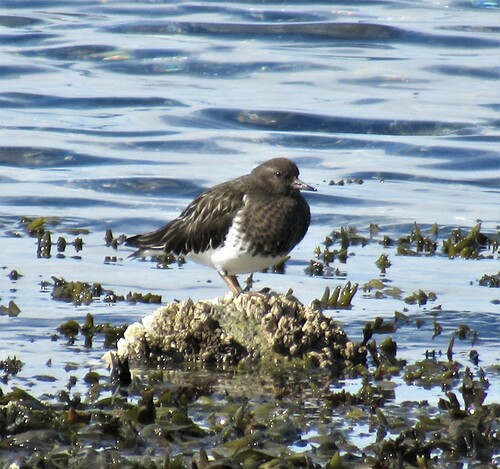 Black Turnstone
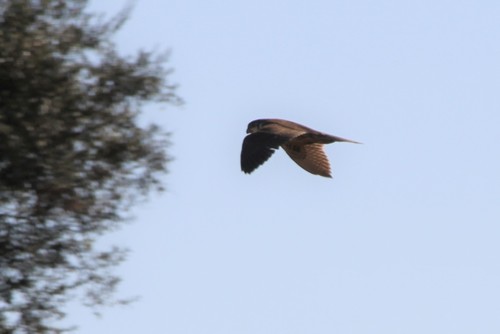 Prairie Falcon
In short
The most reliable field mark is overall structure and flight style: Black Turnstone is a chunky, short-legged shorebird with a stubby, slightly upturned bill, while Prairie Falcon is a long-winged, powerful raptor with pointed wings and a hooked beak. In flight, Black Turnstone (of any age) shows a bold white wingbar and white shoulder patch, while Prairie Falcon (all ages) has dark underwing coverts and axillars, creating a dark 'armpit' effect. Juvenile Prairie Falcons are brown above and lack the crisp barring of adults, but still show the dark underwing. Black Turnstone is always blackish above with white below, never sandy-brown. Habitat is a major clue: Black Turnstone is strictly coastal, Prairie Falcon is inland and never forages on rocks or beaches.
Identification tips
- Flight silhouette: Prairie Falcon is long-winged, pointed, and streamlined; Black Turnstone is compact, short-necked, with broad, rounded wings. This is the fastest separator at a distance.
- Underwing pattern (all ages): Prairie Falcon shows very dark brown underwing coverts and axillars ('dark armpits'), especially obvious in flight. Black Turnstone's underwing is pale, with no dark 'armpit.'
- Upperwing pattern (all ages): Black Turnstone always shows a bold white wingbar and white shoulder patch in flight; Prairie Falcon never shows these.
- Tail pattern: Black Turnstone has a white tail with a broad black subterminal band; Prairie Falcon's tail is barred and lacks this sharp contrast.
- Bill shape: Black Turnstone has a short, slightly upturned, black bill suited for probing; Prairie Falcon has a long, hooked, yellow-based beak typical of falcons.
- Leg color: Black Turnstone's legs are blackish-brown with a reddish tinge; Prairie Falcon's legs are yellow in adults, gray in juveniles (but not blackish).
- Plumage tone: Black Turnstone is blackish above (never sandy or brownish), with white below; Prairie Falcon is warm gray-brown above, pale below with dark streaks or mottling.
- Facial pattern: Prairie Falcon has a thin dark malar stripe and white supercilium; Black Turnstone has a white spot between eye and bill, and a white stripe over the eye, but lacks a falcon's malar stripe.
- Jizz and movement: Black Turnstone moves in quick, short bursts on rocks, often in groups. Prairie Falcon soars, glides, and perches high, moving powerfully and alone or in pairs.
- Habitat: Black Turnstone is found on rocky Pacific coasts, jetties, and beaches; Prairie Falcon is found in arid, open country, cliffs, and canyons, never on the coast.
- Size: Prairie Falcon is much larger and bulkier, with a wingspan up to 1.1 meters; Black Turnstone is small and chunky.
- Juvenile confusion: Juvenile Prairie Falcons are browner above and lack crisp barring, but still show the dark underwing. Juvenile Black Turnstones are browner than adults but still show the white wingbar and shoulder patch.
- Voice: Black Turnstone gives high rattling trills and screeches; Prairie Falcon gives sharp, repeated raptor calls (not detailed here, but very different from shorebirds).
- Feeding behavior: Black Turnstone flips stones and probes for invertebrates; Prairie Falcon hunts birds and mammals, often from the air.
- Perched posture: Prairie Falcon stands upright, often on high perches; Black Turnstone crouches low, often on rocks near water.
Size
Prairie Falcon is dramatically larger: males are 37–38 cm long (females up to 45 cm), with a wingspan up to 1.1 meters and weighing 500–970g depending on sex [wikipedia]. Black Turnstone is much smaller and chunkier, at 22–25 cm long and 100–170g [wikipedia]. Even a small female Prairie Falcon dwarfs a Black Turnstone. In the field, Prairie Falcon appears long-winged and streamlined, while Black Turnstone is compact and short-necked.
Plumage
- Juvenile/immature birds:
- Black Turnstone (juvenile): Brownish-black above with buff fringes to wing-coverts and scapulars, white belly and vent, and a white wingbar and shoulder patch in flight. Tail has a dark grey-brown tip. No rufous or sandy tones. [wikipedia]
- Prairie Falcon (juvenile): Uniformly brown above, lacking the crisp barring of adults; underparts pale with dark mottling. Underwing coverts and axillars are very dark brown, creating a strong 'dark armpit' effect in flight. Skin on legs and cere is grayish, not yellow. [wikipedia]
- Adults:
- Black Turnstone (breeding): Black head and breast with white spot between eye and bill, white supercilium, blackish-brown upperparts with pale fringes, white belly. In flight, always shows a bold white wingbar, white shoulder patch, and white tail with a broad black band. [wikipedia]
- Prairie Falcon (adult): Warm gray-brown above, pale below with dark mottling and vertical streaking on upper breast. Thin dark malar stripe, white line over eye. Underwing coverts and axillars always very dark brown (the key field mark in flight). [wikipedia]
- Key contrast: Black Turnstone never shows the dark underwing 'armpit' of Prairie Falcon, and Prairie Falcon never shows the bold white wingbar and shoulder patch of Black Turnstone.
Behaviour
Black Turnstone is a shorebird, often seen probing among rocks, flipping stones and seaweed with its bill, and moving in short, quick bursts along the water's edge. It is usually in small flocks or loose groups, rarely alone. Prairie Falcon is a raptor, typically seen soaring, gliding, or making fast, direct flights over open country. It hunts birds and small mammals, often from the air, and perches on cliffs or power poles. Its flight is powerful and buoyant, with deep wingbeats and long glides, unlike the low, direct, and rapid flight of a turnstone.
Habitat
Habitat is a major separator. Black Turnstone is strictly coastal in winter, found on rocky Pacific shores, jetties, breakwaters, and sometimes mudflats or beaches. It breeds in wet meadows and sedge marshes near the Alaskan coast. Prairie Falcon is a bird of dry, open country: arid grasslands, deserts, canyons, and cliffs, far from the ocean. It is never found foraging on rocky shores or beaches. If you see a bird on a coastal rock or jetty, it is not a Prairie Falcon; if you see a bird soaring over sagebrush or perched on a cliff, it is not a Black Turnstone.
Voice
Black Turnstone gives a higher, less harsh rattling trill than Ruddy Turnstone, plus loud screeching alarms and soft purring calls to chicks. Prairie Falcon's calls are not described in detail here, but as a falcon, it typically gives sharp, repeated 'kek-kek-kek' or similar raptor calls. In the field, Black Turnstone's calls are more shorebird-like, while Prairie Falcon's are distinctly raptorial.