

Black Turnstone vs Great Knot
Arenaria melanocephala versus Calidris tenuirostris
Play a quiz with Black Turnstone and Great Knot
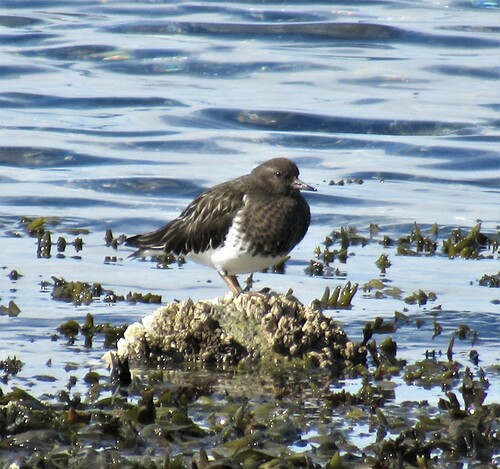 Black Turnstone
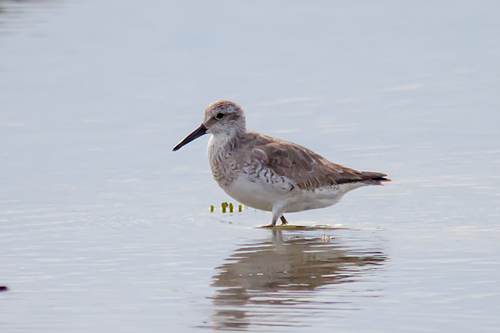 Great Knot
In short
The most reliable separation between Black Turnstone and Great Knot is the strong black-and-white wing and tail pattern shown by Black Turnstone of all ages in flight, versus the plain, unmarked wings and tail of Great Knot. Black Turnstone is a compact, short-legged, blackish and white shorebird with a bold white wingbar, white shoulder patch, and broad black tail band; Great Knot is larger, longer-billed, and lacks these sharp contrasts, appearing mostly greyish above with a plain wing and tail in all plumages. On the ground, Black Turnstone shows a blackish head and breast (with some white facial markings in breeding plumage), while Great Knot is much paler and more uniformly grey, with heavy black spotting on the breast only in breeding plumage. Bill and leg color also differ: Black Turnstone has a short, slightly upturned black bill and dark legs, while Great Knot has a longer, straight, thin dark bill and short dark legs. If you see a boldly patterned black-and-white shorebird on a rocky Pacific coast, it is almost certainly a Black Turnstone; a larger, plain greyish wader with a longer bill on a mudflat or sandy beach is more likely a Great Knot.
Identification tips
- Flight pattern is the best field mark: Black Turnstone of all ages shows a bold white wingbar, white shoulder patch, and white tail with a broad black subterminal band. Great Knot lacks any white in the wing or tail and appears plain greyish in flight.
- Juvenile/immature separation: Even juvenile Black Turnstones show the strong flight pattern, while juvenile Great Knots are plain above with no white wingbar or tail band.
- Bill shape: Black Turnstone has a short, slightly upturned black bill; Great Knot has a longer, thin, straight dark bill. This is visible at medium range.
- Leg color: Black Turnstone's legs are blackish-brown with a reddish tinge; Great Knot's are short and dark, never orange.
- Body shape: Black Turnstone is compact and chunky, with a short neck and tail; Great Knot is longer-bodied, deeper-chested, and bulkier overall.
- Breeding plumage (on ground): Black Turnstone has a black head and breast with white spot between eye and bill, and a white supercilium; Great Knot is pale grey above with a rufous scapular band and heavy black spotting on the face, throat, and breast.
- Nonbreeding (winter) plumage: Black Turnstone becomes dark brown above with little white on head and breast, but still shows a strong blackish-and-white contrast; Great Knot is uniformly pale grey above and below, with no strong head or breast pattern.
- Juvenile plumage: Juvenile Black Turnstone is browner with buff fringes to wing-coverts and scapulars, but still shows the strong flight pattern; juvenile Great Knot is plain greyish above, lacking any white wing or tail markings.
- Habitat: Black Turnstone is almost always on rocky Pacific coasts, jetties, or breakwaters in winter; Great Knot is found on open tidal mudflats and sandy beaches, rarely on rocks.
- Foraging behavior: Black Turnstone often turns over stones and debris with its bill; Great Knot probes or picks food from mud or sand, not flipping objects.
- Size: In direct comparison, Great Knot is larger and bulkier, but beware overlap—use in combination with other marks.
- Facial pattern: Black Turnstone in breeding plumage shows a white spot between eye and bill and a white supercilium; Great Knot lacks these, but may show black spotting on the face in breeding plumage.
- Tail pattern (perched): Black Turnstone's tail is white with a broad black band; Great Knot's tail is plain greyish.
- Voice: If heard, Black Turnstone's rattling trill is higher and less harsh than Ruddy Turnstone, but not compared directly to Great Knot here; vocalization not a primary separator for these two.
- Geographic context: Black Turnstone is a Pacific North American species, Great Knot is Old World (Asia/Australia); vagrancy is rare, so location is a strong clue except in exceptional circumstances.
Size
Great Knot is distinctly larger than Black Turnstone, with a body mass averaging around 165 g [wikidata] compared to Black Turnstone's 100–170 g range [wikipedia]. Great Knot measures 26–30 cm in length, while Black Turnstone is 22–25 cm. Great Knot also has a proportionally longer wingspan (56–66 cm vs. not specified for Black Turnstone, but smaller). In the field, Great Knot appears longer-bodied and bulkier, with a longer, thinner bill and deeper chest, while Black Turnstone is more compact and chunky.
Plumage
The best field mark is in flight: Black Turnstone of all ages shows a bold white wingbar, a white shoulder patch, and a white tail with a broad black subterminal band. There is also a white patch from lower back to upper tail-coverts, interrupted by a dark rump bar. Juvenile Black Turnstones are similar to winter adults but browner, with buff fringes to the wing-coverts and scapulars, and a grey-brown tail tip, but still show the same strong flight pattern. Great Knot, by contrast, lacks any white wingbar or tail pattern in all plumages; its wings and tail are plain greyish, and in flight it appears much less contrasting. On the ground, Black Turnstone in breeding plumage has a black head and breast with white facial markings, while Great Knot in breeding plumage is pale grey above with a rufous scapular band and heavy black spotting on the face, throat, and breast. In nonbreeding (winter) plumage, Black Turnstone becomes dark brown above with little white on the head and breast, while Great Knot is uniformly pale grey above and lacks strong head or breast pattern. Leg color is also useful: Black Turnstone has blackish-brown legs with a reddish tinge, while Great Knot has short, dark legs (not orange). Bill shape is diagnostic: Black Turnstone's bill is short, slightly upturned, and black; Great Knot's is longer, thin, and straight.
Behaviour
Black Turnstone is often seen turning over stones, algae, and debris with its bill, especially on rocky shores and man-made structures. It is usually found singly or in small groups, often very close to breaking waves. Great Knot is more often seen probing or picking food from mudflats and sandy beaches, usually in larger flocks, and does not show the same stone-turning behavior. Both species feed mainly on invertebrates, but Black Turnstone is more specialized for rocky habitats, while Great Knot is a typical mudflat and beach forager.
Habitat
Black Turnstone is strongly associated with rocky Pacific coasts in winter, but can also be found on beaches, mudflats, and man-made structures like jetties and breakwaters. It breeds in wet meadows with sedges in western Alaska. Great Knot is a long-distance migrant breeding in eastern Siberia and wintering on mudflats and beaches in southern Asia and Australia. In the nonbreeding season, Great Knot is found almost exclusively on open tidal mudflats and sandy beaches, rarely on rocky shores. Thus, habitat can be a strong clue: a turnstone on a rocky North American coast is almost certainly Black Turnstone; a large, plain grey wader on an Asian or Australian mudflat is likely Great Knot.
Voice
Black Turnstone gives a variety of calls, most notably a rattling trill that is higher and less harsh than that of Ruddy Turnstone. Other calls include a loud, screeching alarm and a soft purring call to chicks. Great Knot's calls are not described in the provided notes, so vocalization is not a reliable separation point between these two species.