

Black-throated Diver vs White-billed Diver
Gavia arctica versus Gavia adamsii
Play a quiz with Black-throated Diver and White-billed Diver
 Black-throated Diver
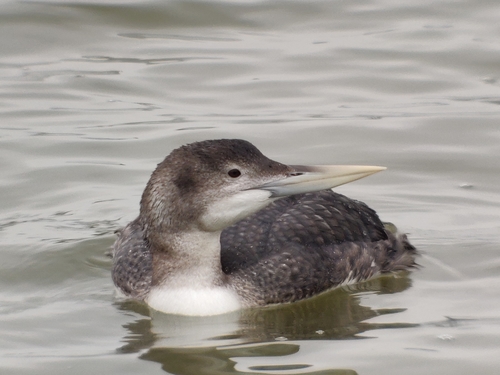 White-billed Diver
In short
The most reliable field mark between Black-throated Diver and White-billed Diver is bill color: White-billed Diver always shows a striking pale ivory or yellowish bill, while Black-throated Diver has a black bill. In adult breeding plumage, Black-throated Diver features a black throat with fine white vertical lines, whereas White-billed Diver has a black head and neck but lacks the intricate throat pattern. Size is also a strong clue—White-billed Diver is much bulkier and longer than Black-throated Diver. In non-breeding or immature plumages, bill color remains the best separator, as plumage differences become less obvious. Both species can appear similar at a distance, especially in poor light or when not in full breeding plumage, but careful attention to bill color and overall size will usually resolve confusion.
Identification tips
- Bill color is the single most reliable field mark: White-billed Diver always has a pale, ivory or yellowish bill, visible even at a distance; Black-throated Diver's bill is black. This works for all ages and plumages.
- Size and bulk: White-billed Diver is much larger and heavier, with a longer neck and bigger head; Black-throated Diver is noticeably smaller and slimmer. Size can be hard to judge without direct comparison but is useful when birds are side by side or with known species.
- Breeding plumage throat pattern: Black-throated Diver shows a black throat with a soft purple gloss and a necklace of fine white vertical lines; White-billed Diver has a black head and neck but lacks the fine white throat stripes. This is only visible in adults in breeding plumage.
- Upperparts pattern: In breeding plumage, Black-throated Diver has white squares on the mantle and scapulars and small white spots on the upperwing coverts; White-billed Diver has a more extensive chequered black-and-white mantle. This is subtle and best seen at close range.
- Non-breeding and juvenile plumage: Both species become duller, losing most head and throat pattern, but White-billed Diver's bill remains pale and Black-throated Diver's bill remains dark. Juveniles of both are browner, but bill color is still diagnostic.
- Head and neck color: In breeding plumage, Black-throated Diver has a grey head and hindneck; White-billed Diver's head and neck are black. In non-breeding plumage, both become paler, so this is less useful then.
- Flank color: Black-throated Diver shows white flanks in breeding plumage, which can help separate it from White-billed Diver, which has more extensive black on the sides.
- Bill shape: White-billed Diver's bill is not only pale but also heavier and more upturned, while Black-throated Diver's bill is slimmer and straighter. This is subtle but can help at close range.
- Underwing pattern: Both species have pale underwings with white coverts, so this is not a strong separator.
- Leg and foot color: Both have dark legs, but Black-throated Diver's legs and bill are black, while White-billed Diver's bill is pale; leg color is not a reliable field mark.
- Iris color: Both have dark reddish-brown irises; not a useful separator.
- Habitat context: If seen breeding on large Arctic lakes, White-billed Diver is more likely; on smaller northern lakes, Black-throated Diver is more likely. In winter, both may overlap on coasts.
- Behavior: Both species dive for fish and swim low in the water; White-billed Diver may appear more ponderous due to its size, but this is subtle.
- Voice: Not diagnostic in the field for separation between these two.
- Pitfalls: In poor light or at distance, bill color may be hard to judge; always try to confirm with multiple features, especially size and bill shape if possible.
Size
White-billed Diver is substantially larger and heavier than Black-throated Diver. White-billed Diver measures 76–97 cm in length with a wingspan of 135–160 cm and an average mass around 5 kg [wikidata], making it the largest loon. Black-throated Diver is notably smaller, at 58–73 cm length and a wingspan of 100–130 cm, with a mass of 1.3–3.4 kg [wikipedia]. In the field, White-billed Diver appears bulkier and longer-necked, with a heavier build and longer bill, while Black-throated Diver looks more streamlined and compact.
Plumage
Juvenile and non-breeding birds of both species can be confusing, as both show duller, less patterned plumage and lose much of the breeding throat and head pattern. However, the bill color remains diagnostic at all ages: White-billed Diver always has a pale, ivory or yellowish bill, while Black-throated Diver's bill is black. In adult breeding plumage, Black-throated Diver shows a grey head and hindneck, a black throat with a purple gloss, and a necklace of fine white lines, plus white flanks and a checkered upperwing with white squares on the mantle and scapulars. White-billed Diver in breeding plumage is black and white overall, with a black head and neck, white underparts, and a bold chequered black-and-white mantle, but lacks the fine throat stripes. In non-breeding plumage, both species lose much of the head and throat pattern, but White-billed Diver retains its pale bill and appears larger and heavier, while Black-throated Diver is smaller and keeps a darker bill. Juveniles of both are duller, but again, bill color is the best separator.
Behaviour
Both species are aquatic and dive for fish, often seen swimming low in the water. White-billed Diver, being larger, may appear more ponderous and less agile than Black-throated Diver. Both species can be seen singly or in pairs during breeding, and may gather in small groups in winter. There are no strong behavioral differences in the field that reliably separate the two, so behavior is not diagnostic.
Habitat
Black-throated Diver breeds on freshwater lakes in northern Europe and Asia and winters along sheltered, ice-free coasts of the north-east Atlantic and Pacific. White-billed Diver breeds in the high Arctic, preferring large, deep lakes or tundra pools, and winters mainly along northern and northwestern Pacific coasts. In overlapping wintering areas, both may be found offshore or in coastal waters, but White-billed Diver is more strictly associated with large, open water bodies, while Black-throated Diver is more flexible. Habitat is not always diagnostic, especially in winter.