
Black Tern vs Common Tern
Chlidonias niger versus Sterna hirundo
Play a quiz with Black Tern and Common Tern
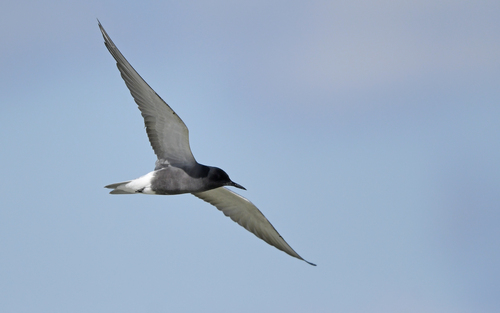 Black Tern
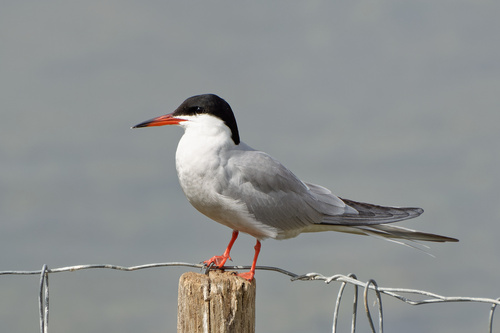 Common Tern
In short
The most reliable way to separate Black Tern from Common Tern is by overall structure and plumage, especially in flight. Black Tern is compact and dark, with a short bill and legs, and shows a distinctive dark body and underwing in breeding plumage, while Common Tern is longer, sleeker, and much paler, with a pointed orange-red bill and long tail streamers. Juvenile and non-breeding birds can be trickier, but Black Tern never shows the clean white underparts and long tail of Common Tern. Pay close attention to bill color, wing shape, and the presence or absence of a dark carpal bar or trailing edge in flight.
Identification tips
- Juvenile/immature upperwing: Juvenile Common Tern shows a distinct dark carpal bar on the upperwing and pale underparts; Black Tern juveniles lack a strong carpal bar and are overall duskier with smudgy breast sides. 2. Adult breeding plumage: Black Tern is unmistakably dark with a black head, neck, and belly, and a dark grey back; Common Tern is pale grey above, white below, with a black cap and a bright orange-red bill with a black tip. 3. Bill shape and color: Black Tern has a short, slender, blackish bill; Common Tern has a longer, pointed, orange-red bill with a black tip (except in some subspecies). 4. Leg color and length: Black Tern's legs are short and dark; Common Tern's legs are longer and bright red. 5. Tail shape: Black Tern has a short, square tail; Common Tern has long, deeply forked tail streamers, especially obvious in flight and when perched. 6. Flight style: Black Tern flies with quick, erratic, buoyant wingbeats, often low over water; Common Tern has a more direct, powerful flight with stiffer, more triangular wings. 7. Body shape: Black Tern appears compact and hunched, with a short neck and bill; Common Tern is longer, sleeker, and stands more upright. 8. Non-breeding plumage: Black Tern becomes drabber grey but retains a darker, less clean look than Common Tern, which becomes paler with a dark eye-stripe and white underparts. 9. Facial pattern: Black Tern (all ages) may show a dark triangular patch in front of the eye and, in juveniles, a broad white collar; Common Tern has a cleaner white face with a black cap in breeding, and a dark eye-stripe in non-breeding. 10. Habitat context: Black Tern is much more likely in marshy, inland freshwater habitats; Common Tern is common on coasts, large lakes, and rivers. 11. Vocalizations: Listen for Black Tern's high, thin 'kik' versus Common Tern's harsh, rolling 'kreee'. 12. Feeding behavior: Black Tern rarely plunge-dives, instead picking prey from the surface or in flight; Common Tern often plunge-dives for fish. 13. Group behavior: Black Tern often forms dense, noisy flocks over marshes; Common Tern is more often seen singly or in loose groups, especially along coasts. 14. Seasonal context: In Europe and North America, Black Tern is mostly a summer breeder inland; Common Tern is present longer on coasts and migrates later in the season. 15. Pitfall: Hybrids between Black Tern and White-winged Tern can show mixed features, but will not closely resemble Common Tern in structure or tail shape.
Size
Black Tern is slightly smaller and more compact than Common Tern. Black Tern averages about 60 g in body mass [wikidata], with a length of 25 cm and a wingspan of 61 cm [wikipedia]. Common Tern is similar in length but appears longer and more slender due to its proportionally longer wings, tail, and legs. In the field, Common Tern often looks more elegant and elongated, especially when perched or in flight.
Plumage
Juvenile and immature Black Terns are overall darker than Common Terns of the same age, with a dusky body and smudgy breast sides, and never show the clean white underparts of Common Tern. Black Tern juveniles have a broadish white collar and a dark triangular patch in front of the eye, with greyish-brown smudges on the sides of the breast. In contrast, juvenile Common Terns are paler, with a more defined dark carpal bar on the upperwing and a whiter face. In adult breeding plumage, Black Tern is strikingly dark: black head, neck, and belly, with a dark grey back and pale forewing, while Common Tern is mostly pale grey above and white below, with a black cap and a bright orange-red bill with a black tip. Non-breeding Black Terns lose most of the black except the cap, becoming drabber grey above and below, but still never as clean and white as Common Tern. Common Tern in non-breeding plumage has a blackish eye-stripe and a paler, greyer crown, but retains a much whiter appearance overall.
Behaviour
Black Tern forages by picking insects and small prey from the water surface or in flight, often over marshes and freshwater habitats, with erratic, buoyant flight and quick, agile wingbeats. Common Tern is more likely to plunge-dive for fish, especially in coastal or open water, and has a more direct, powerful flight with stiffer wingbeats. When perched, Black Tern appears hunched and short-legged, while Common Tern stands taller and more upright, often showing off its long tail streamers.
Habitat
Black Tern is strongly associated with inland freshwater marshes and lakes during breeding, rarely venturing far from these habitats. In migration and winter, it moves to coastal areas but still prefers sheltered waters. Common Tern is much more flexible, breeding along coasts, large lakes, and rivers, and is often seen far out to sea or along exposed shorelines during migration and winter. If you see a tern inland over marshy pools, especially in a flock, Black Tern is more likely; on open coastlines or large lakes, Common Tern predominates.
Voice
Black Tern gives a high-pitched, sharp 'kik' call, which can be repeated rapidly and is described as 'deafening' in large flocks. Common Tern has a more varied repertoire, but its most frequent call is a harsh, rolling 'kreee' or 'kee-arr', often given in flight or when alarmed. Black Tern's call is higher and thinner, while Common Tern's is louder and more grating.