

Black-tailed Godwit vs Long-billed Dowitcher
Limosa limosa versus Limnodromus scolopaceus
Play a quiz with Black-tailed Godwit and Long-billed Dowitcher
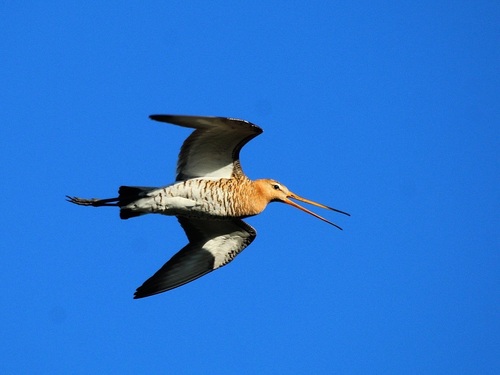 Black-tailed Godwit
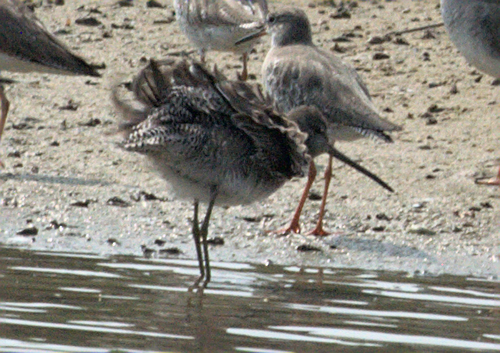 Long-billed Dowitcher
In short
The most reliable field mark between Black-tailed Godwit and Long-billed Dowitcher is the bold black-and-white wingbar and white rump of the godwit, visible in all ages and especially striking in flight. Juvenile and non-breeding birds can be confusing on the ground, but godwits are taller, longer-legged, and have a longer, straighter bill. Dowitchers are stockier, with a shorter, straight bill and a distinctive white rump patch that extends up the back, but lack the godwit's wingbar. Both species can show orange or rufous tones in breeding plumage, but their structure and flight patterns are quite different. Careful attention to wing and rump pattern, bill length and shape, and overall size will separate them in most situations.
Identification tips
- Wing pattern in flight (all ages): Black-tailed Godwit shows a bold white wingbar and white rump with a black tail; Long-billed Dowitcher lacks a wingbar and instead has a large white rump that extends up the back, but the wings are uniformly dark.
- Size and structure: Godwits are much larger, taller, and longer-legged, with a longer neck and bill. Dowitchers are compact, shorter-legged, and stockier.
- Bill shape and length: Godwit's bill is very long, straight, and slightly upturned at the tip, often with a pink or orange base (breeding) or pinkish base (winter). Dowitcher's bill is long but shorter than godwit's, straight, and more needle-like, with a black tip and yellowish or olive base.
- Leg color: Godwit legs are dark grey to black; dowitcher legs are yellowish.
- Breeding plumage color: Godwit males are bright orange on the head, neck, and chest; females are paler. Dowitchers have a rufous head and underparts with black and white barring on the breast and flanks.
- Non-breeding plumage: Godwit is uniform brown-grey above and below; dowitcher is drab grey above with a paler belly and a faint supercilium.
- Juvenile plumage: Godwit juveniles have a pale orange wash to the neck and breast. Dowitcher juveniles have a gray breast, chestnut-fringed upperparts, and tertials with narrow buff edges and dull internal markings.
- Face pattern: Dowitcher always shows a whitish supercilium and dark loral stripe through the eye; godwit lacks this strong facial pattern.
- Feeding behavior: Dowitchers feed with a rapid, repeated 'sewing machine' motion; godwits probe more deliberately.
- Posture: Godwits stand upright and tall; dowitchers are more horizontal and squat.
- Tail pattern: Godwit's tail is black with a white rump; dowitcher's tail is barred black and white, with black bars wider than white.
- Habitat preference: Godwits favor open, flooded meadows and shallow lakes; dowitchers are more likely in muddy, vegetated freshwater marshes.
- Flock structure: Dowitchers often feed in tight groups; godwits are more dispersed.
- Voice: Not diagnostic here, but dowitchers are best separated from similar species by call in winter.
- Pitfalls: In dull light or at distance, both can look similar in color, but godwit's size, upright stance, and wingbar in flight are decisive. Always check for the wingbar and rump pattern when birds flush.
Size
Black-tailed Godwit is much larger and heavier (body mass ~290g) than Long-billed Dowitcher (~104g). Godwits stand taller with longer legs and a proportionally longer neck and bill. Dowitchers are medium-sized, stocky shorebirds, noticeably smaller and more compact in direct comparison. Even at a distance, the godwit's longer legs and upright stance are apparent when both species are present.
Plumage
- Juvenile/immature birds in flight: Black-tailed Godwit of all ages shows a bold black-and-white wingbar, white rump, and black tail, which are absent in dowitcher. Long-billed Dowitcher has a large white rump that extends up the back, but its wings are uniformly dark with no wingbar.
- Breeding plumage: Both species can show orange or rufous on the head, neck, and underparts, but godwit is more extensively orange, especially on the head and chest, with a paler back. Dowitcher has a rufous head and underparts with black barring on the breast and white barring on the flanks, and a darker, mottled back.
- Non-breeding/winter plumage: Both species become drabber. Godwit is uniform brown-grey above and below, while dowitcher is grey above with a paler white belly and a more gradual transition from breast to chin. Dowitcher always retains a whitish supercilium and dark loral stripe.
- Juvenile: Godwit juveniles have a pale orange wash to the neck and breast; dowitcher juveniles are paler than adults but still show a gray breast and chestnut-fringed upperparts. Dowitcher juveniles also have distinctive tertial feather patterns (dark gray with narrow buff edges, dull internal markings).
Behaviour
Black-tailed Godwits are often seen wading in deeper water, standing tall and moving deliberately. In flight, they are strong and direct, with long legs trailing behind. Long-billed Dowitchers feed with a rapid 'sewing machine' motion, probing repeatedly in mud or shallow water, often in flocks. Their flight is fast and direct, but they appear more compact and less elongated than godwits. Dowitchers are more likely to be seen in tight, active feeding groups, while godwits are often more dispersed.
Habitat
Black-tailed Godwits prefer open wetlands, flooded meadows, and shallow lakes, often in more open country. Long-billed Dowitchers are more closely associated with freshwater marshes, ponds, and muddy edges, sometimes in slightly more vegetated or enclosed settings. Both species can overlap in migration, but godwits tend to select broader, more open habitats, while dowitchers are more likely in smaller, muddy pools or marshy areas.
Black-tailed Godwit · Long-billed Dowitcher · My Tricky Birds