

Black-tailed Godwit vs Eurasian Woodcock
Limosa limosa versus Scolopax rusticola
Play a quiz with Black-tailed Godwit and Eurasian Woodcock
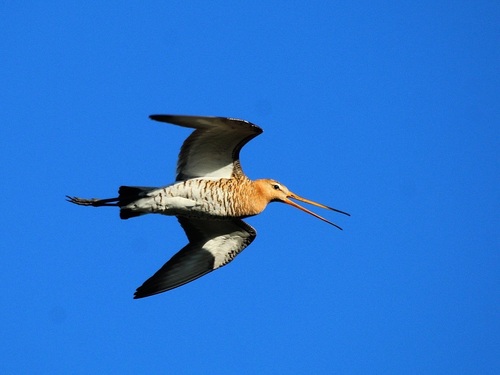 Black-tailed Godwit
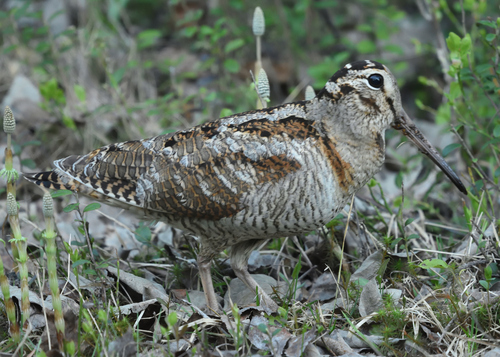 Eurasian Woodcock
In short
The most reliable field mark to separate Black-tailed Godwit from Eurasian Woodcock is the godwit's bold black-and-white wingbar and white rump, visible on birds of all ages in flight; woodcock lacks any such pattern, showing instead rounded, intricately mottled wings and cryptic upperparts. On the ground, Black-tailed Godwit stands much taller, with very long legs and a long, straight bill, while Eurasian Woodcock is shorter, stockier, and has a shorter, straight bill with a distinctive large-eyed, rounded-headed look. Godwits are open-country shorebirds, often in flocks, whereas woodcock are solitary, secretive, and strictly woodland birds. If you see a large, upright wader with a striking wingbar in flight, it's a godwit; if you find a chunky, cryptic bird shuffling through leaf litter, it's a woodcock.
Identification tips
- In flight, look for the bold black-and-white wingbar and white rump of Black-tailed Godwit (all ages); woodcock never shows this, instead displaying rounded, mottled wings and a plain, cryptic back.
- On the ground, godwit stands tall on long, dark legs with a long, straight bill (7.5–12 cm); woodcock is squat, with short legs and a shorter (6–8 cm), straight bill.
- Godwit has a plain, upright posture and often feeds in open, muddy areas; woodcock crouches low, shuffles, and blends into leaf litter in dense woodland.
- Godwit's breeding plumage is orange on the head, neck, and chest (especially in males); woodcock is always earth-toned and intricately patterned, with black bars across the crown.
- Juvenile godwits show a pale orange wash on the neck and breast; woodcock juveniles are not separable by plumage from adults in the field.
- Godwit's bill is longer and appears more slender and straight; woodcock's bill is shorter, but still straight, and looks thicker at the base.
- Godwit has a long neck and legs, giving a lanky, upright look; woodcock is compact, with a short neck and legs, and a rounded, almost ball-like body.
- Godwit's upperparts are plain brown-grey in winter; woodcock always shows complex reddish-brown and buff mottling.
- Godwit is usually seen in groups, especially outside the breeding season; woodcock is solitary and rarely seen except when flushed.
- Godwit is found in open wetlands, flooded fields, and mudflats; woodcock is strictly in dense, damp woodland.
- Godwit flies with strong, direct wingbeats and long legs trailing; woodcock's flight is rapid, erratic, and low, with rounded wings and no trailing legs visible.
- Woodcock's eyes are set far back and high on the head, giving a distinctive profile; godwit's eyes are more typical of shorebirds.
- If you hear a dusk 'roding' display (orr, orr, orr, pist) in woodland, it's woodcock; godwit does not display this way.
- Godwit is much heavier (about 290 g) and longer-winged than woodcock.
- If you flush a bird from dense woodland and it flies off in a zigzag, low to the ground, it's almost certainly a woodcock, not a godwit.
Size
Black-tailed Godwit is a much larger, taller bird: about 42 cm long with a 70–82 cm wingspan and a typical mass of 289.5 g [wikidata]. Eurasian Woodcock is shorter and more compact, 33–38 cm long with a 55–65 cm wingspan. Godwit is long-legged and stands upright, while woodcock is squat, with short legs and a rounded body. Even though woodcock males are larger than females, they never approach the godwit's size or lanky proportions.
Plumage
- Juvenile and non-breeding plumage: Black-tailed Godwit of all ages shows a bold black-and-white wingbar and white rump in flight, with juveniles having a pale orange wash to the neck and breast. Eurasian Woodcock, regardless of age, has intricately patterned reddish-brown upperparts and buff underparts, with no contrasting wingbar or rump; its cryptic plumage is designed for woodland camouflage.
- Breeding plumage: Adult godwits develop a bright orange head, neck, and chest, especially in males, while woodcock remains cryptic and earth-toned year-round. Godwit's upperparts are plain in winter, while woodcock always shows complex mottling and black barring on the head.
- Flight: Godwit in flight is instantly recognized by its white wingbar and rump; woodcock shows rounded wings with no white, and its flight is more fluttery and erratic.
Behaviour
Black-tailed Godwit is typically seen wading in open wetlands, marshes, or flooded fields, often in groups, walking with a deliberate, upright gait and probing with its long bill. In flight, it is strong and direct, with obvious black-and-white wing patterns. Eurasian Woodcock is solitary, secretive, and crepuscular, shuffling quietly through dense woodland leaf litter or sitting motionless, relying on camouflage. Its flight is fast, low, and erratic, with rounded wings and a dumpy silhouette. Woodcock is rarely seen in the open, except when flushed.
Habitat
Black-tailed Godwit is an open-country shorebird, found in wet meadows, marshes, and mudflats, often in exposed, treeless areas. Eurasian Woodcock is strictly a woodland species, favoring dense, damp forests and thickets with plenty of ground cover. You will almost never find woodcock in open wetlands or godwit in dense woods, so habitat is a strong clue.
Voice
Black-tailed Godwit is generally quiet, but may give sharp, high-pitched calls in flight or alarm. Eurasian Woodcock males perform a distinctive 'roding' display flight at dusk in spring, with a repeated 'orr, orr, orr, pist' call, but are otherwise mostly silent and elusive. If you hear roding at dusk in woodland, it's woodcock; godwits do not display in this way.