

Motmot

Black Storm-Petrel vs Least Storm-Petrel

Hydrobates melania versus Hydrobates microsoma

Play a quiz with Black Storm-Petrel and Least Storm-Petrel
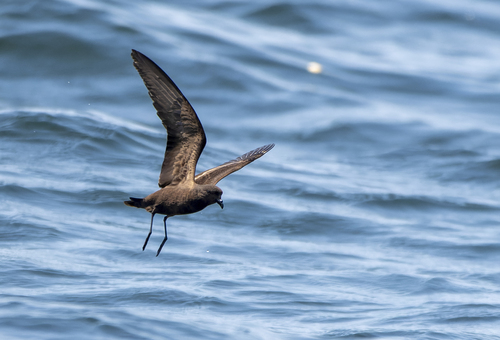
Black Storm-Petrel (Hydrobates melania) Black Storm-Petrel
Least Storm-Petrel (Hydrobates microsoma) Least Storm-Petrel

Media

Loading…

In short

The most reliable way to separate Black Storm-Petrel from Least Storm-Petrel is by size: Black is much larger and bulkier, with a notably longer wingspan and heavier build. In the field, Black Storm-Petrel appears almost twice the length of Least, which is the smallest storm-petrel in the world. Both species are all-dark at a distance, but structural differences—especially in flight—are striking: Black Storm-Petrel shows broader wings and a more languid, gliding flight, while Least Storm-Petrel is tiny, with narrow wings and a rapid, bat-like flutter. If you’re unsure, focus on overall size and proportions before looking for subtle plumage details.

Identification tips

  1. Size is the single most reliable field mark: Black Storm-Petrel is nearly twice the length of Least, with a much longer wingspan and heavier build. Use this as your first check, especially when birds are seen together or with other storm-petrels.
  2. Flight style differs markedly: Black Storm-Petrel has slow, deep wingbeats and often glides between flaps, giving a steady, purposeful impression. Least Storm-Petrel has very rapid, fluttery wingbeats and rarely glides, appearing more like a bat or swallow.
  3. Wing shape and proportions: Black Storm-Petrel shows broad, long wings relative to its body, while Least Storm-Petrel’s wings are narrow and short, matching its tiny size.
  4. Bulk and jizz: Black Storm-Petrel looks robust and elongated, with a more substantial body and longer tail. Least Storm-Petrel appears dainty, compact, and short-tailed.
  5. Plumage is not a strong separator: Both are uniformly dark above and below, with no distinctive pale panels, white rump, or wing bars in any age or season according to available sources.
  6. Bill and head: No clear differences are described in the sources, but Black Storm-Petrel may appear to have a slightly heavier bill due to its size; this is subtle and unreliable at sea.
  7. Context and season: Least Storm-Petrel is most likely offshore of southern California in late summer and autumn. Black Storm-Petrel can be present over a broader range and season, but both overlap widely.
  8. Mixed flocks: When both species are present, the size gap is obvious—look for the smallest, most fluttery individuals for Least, and the largest, gliding birds for Black.
  9. On land: Both are rarely seen walking, but Least Storm-Petrel is especially awkward, limited to shuffling to its burrow. This is not a useful field mark at sea.
  10. No age-specific wing patterns: Neither species shows distinctive juvenile or immature upperwing marks, so age is not a factor in separation.
  11. No sexual dimorphism: Males and females look alike in both species, so sex does not aid identification.
  12. No vocal field marks: The sources do not describe any diagnostic calls or flight calls for separation at sea.
  13. Pitfall—distance and light: In poor light or at great distance, both species can appear as small, dark birds. Always use size and flight style as your primary clues.
  14. Pitfall—solo birds: When only one bird is seen, judge size by comparing to known species or by the bird’s flight style and proportions, not just darkness.
  15. Summary tip: In almost all field situations, start with size and flight style—if the bird looks tiny, fluttery, and bat-like, it is Least Storm-Petrel; if it is larger, gliding, and steady, it is Black Storm-Petrel.

Size

Black Storm-Petrel is significantly larger: 23 cm long with a 46–51 cm wingspan and a body mass of about 61.5 g [wikipedia][wikidata]. Least Storm-Petrel is tiny by comparison, only 13–15 cm in length with a 32 cm wingspan, and is the smallest member of its order [wikipedia]. When seen together or with other storm-petrels, Black appears much bulkier and longer-winged, while Least is noticeably petite and delicate. This size difference is often obvious even at a distance or in mixed flocks.

Plumage

Both species are generally dark overall, lacking strong contrasting plumage marks according to the available notes. No age-specific or upperwing pattern differences are described in the sources for either species—both are uniformly dark above and below, with no mention of pale panels, white rump, or contrasting wing bars in juveniles or adults. Therefore, plumage alone is not a reliable separator in most field situations; observers should rely more on size and structure.

Behaviour

Black Storm-Petrel typically shows a steadier, more buoyant flight with longer glides and slower, deeper wingbeats, reflecting its larger size. Least Storm-Petrel, being much smaller, has a rapid, fluttery, almost bat-like flight, often close to the water surface. Both species feed by picking food from the water while in flight, but Least often appears more frenetic and agile, while Black seems more measured and less erratic. On land, both are awkward walkers, but this is rarely observed at sea.

Habitat

Both species are pelagic and can be seen offshore, especially off the Pacific coast of North America. Least Storm-Petrel breeds on islands off Baja California and the Gulf of California, and is most often seen off southern California in late summer and autumn [wikipedia]. Black Storm-Petrel has a similar range but is generally more widespread and may be seen farther north. Both are colonial nesters on islands, but these details are unlikely to help with at-sea identification.

Submit a better description

Use the same sections as the comparison. Your text is published immediately.

The most reliable way to separate Black Storm-Petrel from Least Storm-Petrel is by size: Black is much larger and bulkier, with a notably longer wingspan and heavier build. In the field, Black Storm-Petrel appears almost twice the length of Least, which is the smallest storm-petrel in the world. Both species are all-dark at a distance, but structural differences—especially in flight—are striking: Black Storm-Petrel shows broader wings and a more languid, gliding flight, while Least Storm-Petrel is tiny, with narrow wings and a rapid, bat-like flutter. If you’re unsure, focus on overall size and proportions before looking for subtle plumage details.

  1. Size is the single most reliable field mark: Black Storm-Petrel is nearly twice the length of Least, with a much longer wingspan and heavier build. Use this as your first check, especially when birds are seen together or with other storm-petrels.
  2. Flight style differs markedly: Black Storm-Petrel has slow, deep wingbeats and often glides between flaps, giving a steady, purposeful impression. Least Storm-Petrel has very rapid, fluttery wingbeats and rarely glides, appearing more like a bat or swallow.
  3. Wing shape and proportions: Black Storm-Petrel shows broad, long wings relative to its body, while Least Storm-Petrel’s wings are narrow and short, matching its tiny size.
  4. Bulk and jizz: Black Storm-Petrel looks robust and elongated, with a more substantial body and longer tail. Least Storm-Petrel appears dainty, compact, and short-tailed.
  5. Plumage is not a strong separator: Both are uniformly dark above and below, with no distinctive pale panels, white rump, or wing bars in any age or season according to available sources.
  6. Bill and head: No clear differences are described in the sources, but Black Storm-Petrel may appear to have a slightly heavier bill due to its size; this is subtle and unreliable at sea.
  7. Context and season: Least Storm-Petrel is most likely offshore of southern California in late summer and autumn. Black Storm-Petrel can be present over a broader range and season, but both overlap widely.
  8. Mixed flocks: When both species are present, the size gap is obvious—look for the smallest, most fluttery individuals for Least, and the largest, gliding birds for Black.
  9. On land: Both are rarely seen walking, but Least Storm-Petrel is especially awkward, limited to shuffling to its burrow. This is not a useful field mark at sea.
  10. No age-specific wing patterns: Neither species shows distinctive juvenile or immature upperwing marks, so age is not a factor in separation.
  11. No sexual dimorphism: Males and females look alike in both species, so sex does not aid identification.
  12. No vocal field marks: The sources do not describe any diagnostic calls or flight calls for separation at sea.
  13. Pitfall—distance and light: In poor light or at great distance, both species can appear as small, dark birds. Always use size and flight style as your primary clues.
  14. Pitfall—solo birds: When only one bird is seen, judge size by comparing to known species or by the bird’s flight style and proportions, not just darkness.
  15. Summary tip: In almost all field situations, start with size and flight style—if the bird looks tiny, fluttery, and bat-like, it is Least Storm-Petrel; if it is larger, gliding, and steady, it is Black Storm-Petrel.

Black Storm-Petrel is significantly larger: 23 cm long with a 46–51 cm wingspan and a body mass of about 61.5 g [wikipedia][wikidata]. Least Storm-Petrel is tiny by comparison, only 13–15 cm in length with a 32 cm wingspan, and is the smallest member of its order [wikipedia]. When seen together or with other storm-petrels, Black appears much bulkier and longer-winged, while Least is noticeably petite and delicate. This size difference is often obvious even at a distance or in mixed flocks.

Both species are generally dark overall, lacking strong contrasting plumage marks according to the available notes. No age-specific or upperwing pattern differences are described in the sources for either species—both are uniformly dark above and below, with no mention of pale panels, white rump, or contrasting wing bars in juveniles or adults. Therefore, plumage alone is not a reliable separator in most field situations; observers should rely more on size and structure.

Black Storm-Petrel typically shows a steadier, more buoyant flight with longer glides and slower, deeper wingbeats, reflecting its larger size. Least Storm-Petrel, being much smaller, has a rapid, fluttery, almost bat-like flight, often close to the water surface. Both species feed by picking food from the water while in flight, but Least often appears more frenetic and agile, while Black seems more measured and less erratic. On land, both are awkward walkers, but this is rarely observed at sea.

Both species are pelagic and can be seen offshore, especially off the Pacific coast of North America. Least Storm-Petrel breeds on islands off Baja California and the Gulf of California, and is most often seen off southern California in late summer and autumn [wikipedia]. Black Storm-Petrel has a similar range but is generally more widespread and may be seen farther north. Both are colonial nesters on islands, but these details are unlikely to help with at-sea identification.

Discard your changes?

You have unsaved edits. If you leave now, those changes will be lost.

Black Storm-Petrel · Least Storm-Petrel · My Tricky Birds