

Black-legged Kittiwake vs Sabine's Gull
Rissa tridactyla versus Xema sabini
Play a quiz with Black-legged Kittiwake and Sabine's Gull
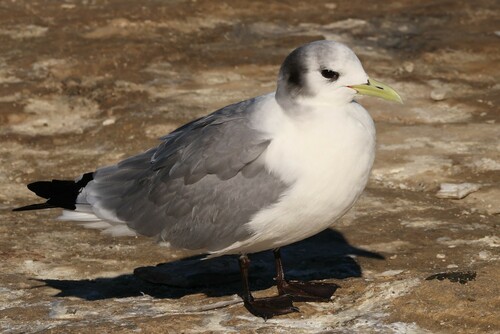 Black-legged Kittiwake
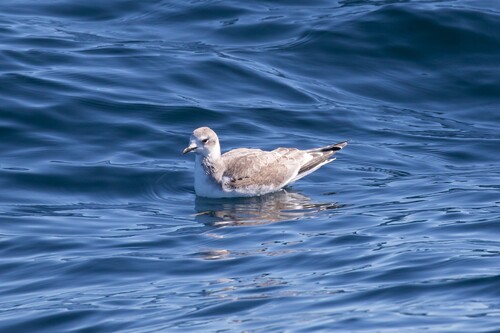 Sabine's Gull
In short
The most reliable way to separate Black-legged Kittiwake from Sabine's Gull, especially in flight and among juveniles, is by the upperwing pattern: juvenile kittiwakes show a bold black 'W' across the wings, while juvenile Sabine's Gulls have a tricolored wing with brown replacing grey and a black tail band. Adults are more easily separated by bill color and structure, as well as wingtip and tail shape. Kittiwakes are larger, heavier, and have a more robust, straight bill, while Sabine's Gulls are daintier, with a shorter, black-and-yellow-tipped bill and a distinctly forked tail. Both species can be confused at a distance, especially immature birds, but careful attention to wing pattern, tail shape, and bill details will resolve most field identifications.
Identification tips
- Juvenile wing pattern: Look for the bold black 'W' across the upperwing in juvenile Black-legged Kittiwake; Sabine's Gull juvenile lacks this, instead showing a tricolored wing with brown and a sharply defined black tail band.
- Tail shape: Sabine's Gull of all ages has a distinctly forked tail, especially obvious in flight; kittiwake's tail is square or slightly rounded, never deeply forked.
- Bill color and shape: Adult kittiwake has a straight, yellow bill (dusky in winter), while Sabine's Gull has a shorter, finer bill with a black base and yellow tip. Juvenile kittiwake's bill is solid black; Sabine's juvenile bill is also dark but shorter and more delicate.
- Leg color: Kittiwake has black legs (rarely pinkish), Sabine's Gull's legs are dark but may appear slightly paler; not always visible in flight.
- Adult wing pattern: Adult kittiwake shows uniform grey upperwings with solid black wingtips; Sabine's Gull adult has a striking tricolored wing: black outer primaries, white inner primaries/secondaries, and pale grey coverts.
- Head pattern (breeding): Sabine's Gull adult in breeding plumage has a dark grey hood with a thin black collar; kittiwake's head is pure white in summer, with no hood or collar.
- Head pattern (non-breeding): Winter kittiwake shows a dusky smudge behind the eye and faint grey hind-neck collar; Sabine's Gull loses the hood and appears plainer-headed.
- Size and structure: Kittiwake is much bulkier and longer-winged; Sabine's Gull is petite, with long, thin wings and a more tern-like jizz.
- Flight style: Kittiwake flies with deep, steady wingbeats; Sabine's Gull is more buoyant and agile, often recalling a tern.
- Tail band: Both juveniles have a black tail band, but Sabine's is narrower and the tail is forked; kittiwake's is broader and tail is square.
- Moult timing: Sabine's Gull retains juvenile plumage into autumn and moults on wintering grounds; kittiwake moults gradually, with partial and full moults at different times.
- Habitat context: Kittiwake is more likely near sea cliffs or coastal waters; Sabine's Gull is more pelagic or seen as a rare inland migrant.
- Vocalization: Kittiwake's call is loud and nasal; Sabine's is high-pitched and squeaky—useful if heard.
- Mouth color (close views): Kittiwake has a rich red mouth lining, sometimes visible in close encounters or courtship; Sabine's Gull lacks this feature.
- Age progression: Kittiwake takes four years to reach adult plumage, with gradual loss of black markings; Sabine's Gull matures in two years, with a faster transition from juvenile to adult appearance.
Size
Black-legged Kittiwake is significantly larger and heavier (average 418 g) than Sabine's Gull (average 185 g). Kittiwakes measure 37–41 cm in length with a wingspan of 91–105 cm, while Sabine's Gulls are 27–33 cm long with an 81–87 cm wingspan. In the field, kittiwakes appear bulkier and longer-winged, while Sabine's Gulls look petite and more delicate, with proportionally longer, thinner wings for their size.
Plumage
- Juvenile/First-year birds: Juvenile Black-legged Kittiwake shows a bold black 'W' across the upperwings, a black hind-neck collar, solid black bill, and a black terminal band on the tail. Juvenile Sabine's Gull has a tricolored wing (brown instead of grey), a black terminal tail band, but lacks the strong 'W'—instead, the wing pattern is more sharply demarcated with contrasting pale and dark areas. Both have black tail bands, but the kittiwake's is broader and the Sabine's tail is distinctly forked.
- Second-year Kittiwake: Still shows black on coverts and tail, but bill turns greenish. Sabine's Gull takes two years to reach adult plumage, gradually losing juvenile marks.
- Adults: Adult kittiwake has a white head and body, grey back, solid black wingtips, black legs, and a yellow bill. In winter, a dusky smudge appears behind the eye and a faint grey hind-neck collar. Sabine's Gull adult has a pale grey back, white underparts, strikingly patterned wings (black outer primaries, white inner primaries/secondaries), and a black bill with a yellow tip. In breeding plumage, Sabine's Gull shows a dark grey hood with a thin black collar; in non-breeding, the hood fades. The forked tail of Sabine's is always a good mark.
Behaviour
Kittiwakes are classic cliff-nesting, oceanic gulls, often seen in large, noisy colonies or feeding offshore. Their flight is strong and purposeful, with deep wingbeats. Sabine's Gull is more buoyant and tern-like in flight, often seen picking food from the water's surface or flying with quick, agile movements. Sabine's is less likely to be seen in dense flocks and is more pelagic outside the breeding season.
Habitat
Both species are pelagic outside the breeding season, but Black-legged Kittiwake breeds on sea cliffs and is more likely to be seen near coastal colonies. Sabine's Gull breeds in high Arctic tundra and migrates long distances, often seen offshore during migration and winter. Sabine's is more likely to be encountered far out at sea or as a rare migrant inland, while kittiwake is more coastal.
Voice
Black-legged Kittiwake is named for its shrill, nasal 'kittee-wa-aaake' call, which is loud and distinctive in colonies. Sabine's Gull has a high-pitched, squeaking call, much less raucous and more delicate than kittiwake. In most field situations, calls are unlikely to be confused, but Sabine's is generally quieter and higher-pitched.