

Black-headed Weaver vs Yellow-crowned Bishop
Ploceus melanocephalus versus Euplectes afer
Play a quiz with Black-headed Weaver and Yellow-crowned Bishop
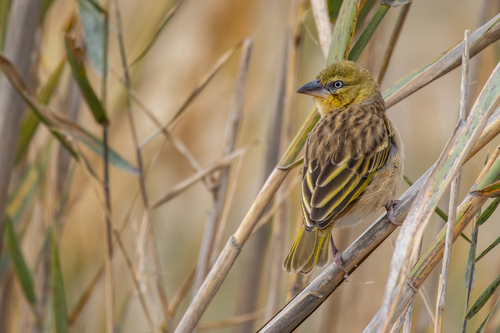 Black-headed Weaver
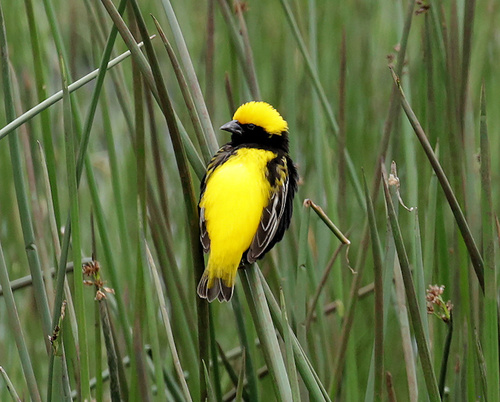 Yellow-crowned Bishop
In short
The most reliable field mark is the male's head pattern in breeding season: Black-headed Weaver males have a solid black head with a yellow collar, while Yellow-crowned Bishop males show a brilliant yellow crown and nape with a sharply defined black face, throat, and underparts. Outside the breeding season, both species become trickier, as females and non-breeding males are drab and streaky, but the Bishop always lacks the Weaver's dark eye and bill. In flight or at rest, the Bishop is smaller and more compact, with a shorter tail and a more rounded, finch-like jizz, while the Weaver appears longer and more slender. Juvenile and non-breeding birds are most often confused, but careful attention to head color, bill, and underpart tone will separate them.
Identification tips
- Breeding male head pattern: Black-headed Weaver males have a solid black head and face with a yellow collar, while Yellow-crowned Bishop males have a bright yellow crown and nape with a sharply defined black face and underparts. This is the single most reliable field mark in breeding season.
- Underpart color in breeding males: Weaver males have pale yellow underparts with some chestnut wash; Bishop males have black underparts.
- Back and mantle: Weaver shows a plain greenish mantle; Bishop has a yellow rump and back but brown wings and tail.
- Bill color (seasonal): In breeding season, Bishop males have a black bill; in non-breeding and in females, the bill is horn-colored. Weaver females and non-breeding males have a darker bill year-round.
- Eye color: Female and non-breeding Weaver have a noticeably dark eye, while Bishop's is less striking.
- Breast and underparts in non-breeding/female: Weaver shows buffy breast plumage; Bishop is off-white below with fine dark streaks.
- Facial pattern in non-breeding/female: Bishop has a paler eyebrow and more pronounced facial contrast; Weaver is plainer-faced.
- Size and structure: Bishop is smaller, more compact, with a shorter tail and a rounder, finch-like shape. Weaver is larger, longer-tailed, and more elongated.
- Flight style: Bishop's flight is bouncy and direct, often in tight flocks over grassland. Weaver is more likely to fly between trees or over water, with steadier wingbeats.
- Habitat context: If seen in open grassland or agricultural fields, especially away from trees, Bishop is more likely. If seen near water or in Acacia trees, especially in colonies, Weaver is favored.
- Upperwing pattern (juveniles/immatures): No distinctive upperwing marks are noted for either species, so rely on structure and subtle plumage cues in young birds.
- Leg and foot color: Bishop has pinkish brown legs and feet, which can be a subtle supporting mark if seen well.
- Nesting behavior: Weaver is often seen weaving nests in trees over water, which is never shown by Bishop.
- Pitfalls: Non-breeding males and females of both species are streaky and brown, but Bishop is paler below and has a more pronounced pale eyebrow; Weaver is buffier and plainer-faced with a darker bill and eye.
- Seasonal confusion: Outside the breeding season, both species lose their bold colors, so focus on bill color, eye color, underpart tone, and habitat for separation.
Size
Yellow-crowned Bishop is distinctly smaller and lighter than Black-headed Weaver. The Bishop averages about 14.5 g in body mass [wikidata], and is only 95–105 mm in length [wikipedia], giving it a noticeably more compact, finch-like appearance. The Weaver is larger and more elongated, with a longer tail and a heavier build, though exact measurements are not provided here. In mixed flocks or side-by-side, the size difference is usually apparent, especially in flight.
Plumage
- Breeding males:
- Black-headed Weaver: Striking black head and face with a yellow nuchal collar (back of neck), plain greenish mantle, and pale yellow underparts variably suffused with chestnut. No yellow on the crown or forehead. [wikipedia]
- Yellow-crowned Bishop: Brilliant yellow crown, forehead, and hindcrown, with a sharply defined black lower face, throat, breast, and belly. Wide black collar on the back of the neck, yellow patch on shoulder, yellow rump and back, brown wings and tail. [wikipedia]
- Females and non-breeding males:
- Black-headed Weaver: Lack black head; resemble female masked weaver but have dark eyes and a darker bill. Buffy breast plumage, plain greenish upperparts. [wikipedia]
- Yellow-crowned Bishop: Pale brown upperparts with darker streaking, paler eyebrow, off-white underparts with fine dark streaks on breast and flanks. Bill is horn-colored, legs and feet pinkish brown. [wikipedia]
- Juveniles/immatures:
- Both species are streaky and brownish, but the Bishop is paler below and has a more pronounced pale eyebrow. The Weaver's darker bill and eye, and buffier breast, are subtle but useful.
Behaviour
Yellow-crowned Bishop is more likely to be seen in open grasslands, often perching conspicuously on grass stems or flying in tight, bouncing flocks. Their flight is bouncy and direct, with rapid wingbeats and short tail. Black-headed Weaver is more arboreal, often seen in or near Acacia trees, especially near water, and is less likely to be found in open grassland. Weavers tend to move more deliberately and may be seen weaving nests in colonies.
Habitat
Black-headed Weaver prefers damp savanna, often near water and frequently nesting in trees (especially Acacia) that are situated over water or away from land to deter predators. Yellow-crowned Bishop is more often found in grasslands, marsh edges, weedy fields, and agricultural areas like wheat and sorghum fields. Bishops are less tied to trees and more likely to be seen in open, grassy habitats.
Black-headed Weaver · Yellow-crowned Bishop · My Tricky Birds