
Black-headed Gull vs Caspian Gull
Chroicocephalus ridibundus versus Larus cachinnans
Play a quiz with Black-headed Gull and Caspian Gull
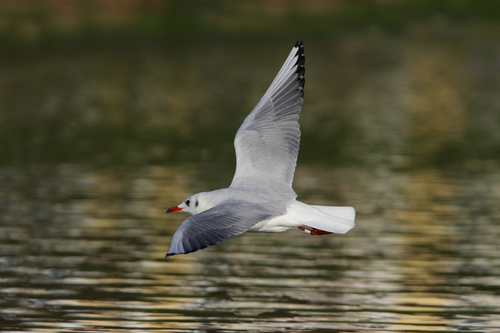 Black-headed Gull
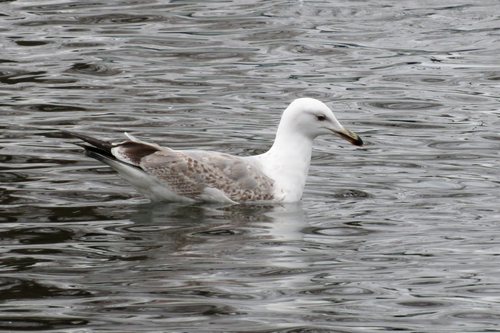 Caspian Gull
In short
The most reliable field mark between Black-headed Gull and Caspian Gull, especially in flight, is size and structure: Caspian Gull is much larger and bulkier, with a long, slender bill and proportionally longer legs, wings, and neck. For immatures, focus on the upperwing pattern: Black-headed Gull (juvenile/first-winter) shows a brown carpal bar and a black tail band, while Caspian Gull (first-winter) has pale lines across the wing formed by whitish tips to the coverts, and a paler, streaked head. Adults are also easily separated by size, structure, and head color in summer. Misidentifications often happen with distant or lone birds, so use multiple features, especially when viewing immatures.
Identification tips
- Size is decisive: Caspian Gull is about four times heavier and much longer-winged than Black-headed Gull. If you see both together, the difference is unmistakable; if alone, compare to nearby gulls or waterfowl for scale.
- Bill structure: Caspian Gull has a long, slender bill with a sloping forehead, giving a distinctive long-faced look. Black-headed Gull has a much shorter, finer bill, often reddish in adults.
- Legs and neck: Caspian Gull has proportionally longer legs and neck, appearing tall and upright when standing. Black-headed Gull is compact, with shorter legs and neck.
- Juvenile/first-winter upperwing: Black-headed Gull shows a strong brown carpal bar and black tail band; Caspian Gull has pale lines across the wing from whitish-tipped coverts and lacks the carpal bar and tail band.
- Head pattern (immatures): First-winter Caspian Gull has a pale head with dark streaking on the nape; Black-headed Gull immatures have a plainer face, sometimes with a hint of a dark ear spot.
- Adult head pattern (summer): Black-headed Gull has a chocolate-brown hood (not truly black) in breeding plumage; Caspian Gull never shows a hood, always having a pale head.
- Adult head pattern (winter): Black-headed Gull loses the hood, leaving two dark spots behind the eye; Caspian Gull remains plain-headed.
- Flight pattern (adults): Black-headed Gull in flight shows a white leading edge to the outer wing and dark undersides to the inner primaries; Caspian Gull has a large white tip and a white 'tongue' on the outermost primary but not the same sharp contrast.
- Tail pattern (immatures): Black-headed Gull immatures have a clear black tail band; Caspian Gull immatures do not.
- Leg color: Adult Black-headed Gull has red legs; Caspian Gull legs are pale pink to pale yellowish.
- Eye color: Caspian Gull often has a small, dark eye; Black-headed Gull's eye is less striking.
- Habitat context: In small inland flocks, especially urban parks, Black-headed Gull is much more likely; Caspian Gull prefers larger lakes, rivers, or coastal settings.
- Behavior: Black-headed Gull is more likely to be seen in large, noisy flocks, often with head-bobbing walks; Caspian Gull is less gregarious and more stately in movement.
- Seasonal context: Black-headed Gull's hood is only present March–July; outside that, rely on structure and wing/tail pattern.
- Pitfall: Distant Black-headed Gulls can look larger in flight, especially when alone; always check bill and leg length, and look for the carpal bar or hood for confirmation.
Size
Caspian Gull is dramatically larger than Black-headed Gull. Adult Caspian Gulls average about 1154 g in body mass, compared to just 280.5 g for Black-headed Gull—a fourfold difference. Caspian Gull is also much longer (56–68 cm vs. 34–39 cm) and has a much broader wingspan (137–155 cm vs. 100–110 cm). Even at a distance, Caspian Gull appears long-winged and heavy, while Black-headed Gull is dainty and compact. There is no overlap in size, so any direct comparison is decisive.
Plumage
For juveniles and first-winter birds, Black-headed Gull shows a distinctive brown carpal bar on the inner wing, blackish secondaries, and a black tail band. The rest of the upperparts are mottled brown, fading to a grey back by first-winter. In contrast, first-winter Caspian Gull has a pale head with dark streaking on the nape, pale underparts, and a greyish back. Its greater and median coverts have whitish tips, forming two pale lines across the wing—these lines are absent in Black-headed Gull. Caspian Gull immatures lack the strong carpal bar and black tail band of Black-headed Gull. In adults, Black-headed Gull in summer has a chocolate-brown hood (not truly black), which is lost in winter to leave two dark ear spots; Caspian Gull never shows a hood, instead having a plain pale head with a long, sloping profile. In flight, adult Black-headed Gull shows a white leading edge to the outer wing and dark undersides to the inner primaries, while Caspian Gull adults have a large white tip and white 'tongue' on the outermost primary, but not the same sharp contrast as Black-headed Gull.
Behaviour
Black-headed Gull is much more gregarious, often forming large flocks in winter, especially at inland lakes, marshes, and even urban parks. It is not pelagic and rarely seen far out to sea. Caspian Gull, while also social, is less likely to be found in dense inland flocks and is more often seen singly or in small groups, often at larger water bodies or coastal areas. Black-headed Gull displays both head-bobbing and non-bobbing walking, but this is not a useful field mark for separation.
Habitat
Black-headed Gull is abundant across much of Europe and Asia, breeding in colonies in reed beds, marshes, and on islands in lakes, and is common in urban and agricultural areas in winter. Caspian Gull is more restricted, breeding mainly in eastern Europe and Central Asia, and is typically associated with larger lakes, rivers, and coastal habitats. In areas of overlap, Black-headed Gull is much more likely at small inland water bodies and urban sites, while Caspian Gull prefers larger, more open habitats.