

Black Grouse vs Rock Partridge
Lyrurus tetrix versus Alectoris graeca
Play a quiz with Black Grouse and Rock Partridge
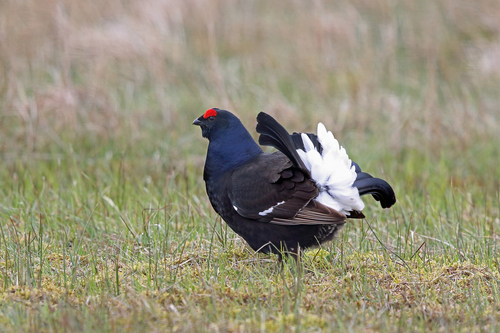 Black Grouse
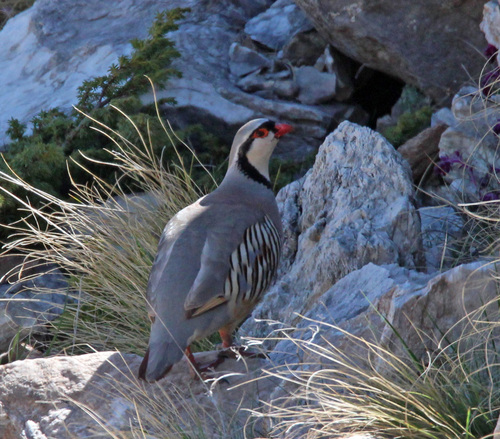 Rock Partridge
In short
The most reliable field mark to separate Black Grouse from Rock Partridge is the male Black Grouse’s striking black-and-deep-blue plumage with a lyre-shaped, outwardly curving tail and bold white wing markings, versus the Rock Partridge’s rotund shape, pale brown back, grey breast, and sharply defined black gorget on a white face. Female Black Grouse are much drabber but still lack the Rock Partridge’s facial pattern and streaked flanks. Black Grouse are significantly larger and longer-tailed, often seen displaying in open moorland or perched in trees, while Rock Partridge prefers running on rocky slopes and only flies short distances. If you see a large, blackish bird with a fancy tail, it’s Black Grouse; a smaller, round, pale bird with a black-and-white face is Rock Partridge.
Identification tips
- Tail shape (all ages, especially males): Black Grouse males have long, lyre-shaped outer tail feathers that curve outward; females have a more conventional but still relatively long tail. Rock Partridge has a short, rounded tail with no lyre shape.
- Wing pattern in flight (all ages): Black Grouse shows a bold white wing bar (especially males), visible both perched and in flight; Rock Partridge’s wings are plain and rounded with no white bar.
- Facial pattern (all ages): Rock Partridge has a white face with a sharply defined black gorget (neck band); Black Grouse of any age/sex never shows this pattern.
- Body shape: Black Grouse is large and elongated, especially in males, with a long tail; Rock Partridge is compact, rotund, and short-tailed.
- Plumage color (adult males): Black Grouse males are glossy black with deep blue gloss, white undertail coverts, and red skin above the eye; Rock Partridge is pale brown, grey, and buff with rufous flank streaks and red legs.
- Female/immature confusion: Female Black Grouse is brown and barred, lacking the Rock Partridge’s facial pattern and streaked flanks; Rock Partridge of both sexes always shows the black gorget and white face.
- Leg color: Rock Partridge has red legs; Black Grouse legs are feathered and not red.
- Behavior when flushed: Black Grouse will fly strongly and can perch in trees; Rock Partridge prefers to run and only flies short distances, rarely perching above ground.
- Display behavior: Only Black Grouse males display at leks, fanning their tails and showing white wing markings; Rock Partridge does not lek or display in this way.
- Habitat context: Black Grouse is found in moorland, forest edge, and sometimes perched in trees; Rock Partridge is found on rocky, open slopes and hillsides, rarely in dense forest or trees.
- Vocalization: Listen for the bubbling coo of Black Grouse versus the loud, chattering 'chakera' song of Rock Partridge.
- Size in binoculars: Black Grouse is much larger and bulkier than Rock Partridge; if the bird seems pigeon-sized or smaller, it is not a Black Grouse.
- Sexual dimorphism: Only male Black Grouse is glossy black and blue with lyre tail; Rock Partridge sexes are similar, both showing the black gorget and white face.
- Seasonal context: Black Grouse may be seen displaying in spring (leks), perched in trees in winter; Rock Partridge is more likely seen running on rocky slopes year-round.
- Common pitfalls: Female Black Grouse can be mistaken for a large, drab gamebird, but always lacks the Rock Partridge’s bold facial pattern and streaked flanks; Rock Partridge never shows a lyre tail or white wing bar.
Size
Black Grouse is much larger and bulkier, with an average mass of 1050 g (males up to 1250 g, sometimes even 2100 g), while Rock Partridge averages 632.5 g. Black Grouse males reach about 60 cm in length, females about 45 cm, both longer than Rock Partridge. The Grouse’s tail is especially long and lyre-shaped in males, making them appear even bigger and more elongated, compared to the compact, round-bodied Rock Partridge with a short tail and rounded wings.
Plumage
For all ages and sexes, Black Grouse and Rock Partridge differ dramatically in plumage. Adult male Black Grouse are glossy black with deep blue gloss, bold white wing bars, and pure white undertail coverts; their outer tail feathers are long and curve outward, forming a lyre shape. Females are cryptically barred brown and lack any bold facial pattern. Rock Partridge of both sexes is pale brown above, with a grey breast, buff belly, and rufous-streaked flanks. The face is white with a sharply defined black gorget (neck band), and the legs are red. No age or sex of Black Grouse ever shows the Rock Partridge’s facial pattern or streaked flanks. In flight, Black Grouse shows a broad white wing stripe (especially males), while Rock Partridge’s wings are plain and rounded. Juvenile/immature plumages are not described in detail for either species, but the key contrasts (tail shape, wing bar, facial pattern) apply to all ages.
Behaviour
Black Grouse is often seen perched in trees, especially in winter, or displaying on open ground (leks) in spring, fanning its tail and showing off its white wing markings. They are strong fliers, capable of sustained flight. Rock Partridge, by contrast, prefers to run when disturbed and only flies short distances on rounded wings, usually hugging the ground. Its flight is rapid but brief, and it rarely perches in trees. The Grouse’s display behavior (lekking, tail fanning) is unique and never shown by Rock Partridge.
Habitat
Black Grouse favors moorland, steppe, and forest edge habitats, often near wooded areas, and spends winters in dense coniferous forests. Rock Partridge is native to rocky slopes and open hillsides of southern Europe, avoiding dense forests. If you find the bird in open moorland or perched in a tree, it’s likely Black Grouse; on rocky, brushy slopes, especially in southern Europe, it’s more likely Rock Partridge.
Voice
Black Grouse males give a long, bubbling coo or murmur during their display, quite unlike the Rock Partridge’s noisy, repeated 'ga-ga-ga-ga-chakera-chakera-chakera'. The Grouse’s song is softer and more drawn out, while the Partridge’s is loud and chattering. These vocalizations are distinctive and diagnostic if heard.