

Black Drongo vs Scaly-breasted Munia
Dicrurus macrocercus versus Lonchura punctulata
Play a quiz with Black Drongo and Scaly-breasted Munia
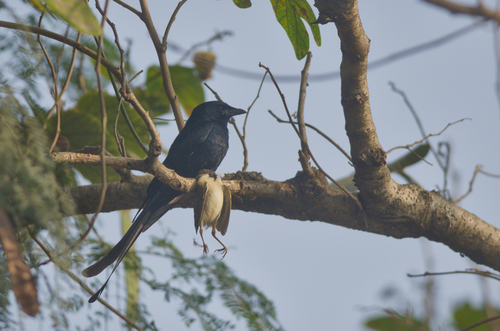 Black Drongo
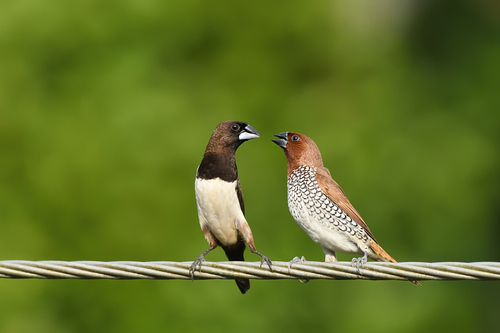 Scaly-breasted Munia
In short
The most reliable way to separate Black Drongo from Scaly-breasted Munia is by overall color and structure: Black Drongo is a glossy all-black, medium-sized bird with a deeply forked tail, while Scaly-breasted Munia is a much smaller, brown finch with a short, conical bill and distinctive scale-like markings on its white underparts. Juvenile Black Drongos can show some white barring or speckling below, but never the neat scale pattern of the munia. In flight or perched, the drongo’s long, forked tail and upright stance are unmistakable compared to the munia’s short tail and squat, flocking jizz. Even at a distance, the size difference is striking: drongo is nearly three times the length and much heavier than the munia.
Identification tips
- Size and shape: Black Drongo is nearly three times the length of Scaly-breasted Munia and much bulkier. If the bird looks sparrow-sized, it is not a drongo.
- Tail shape: Drongo always shows a long, deeply forked tail in all plumages and ages; munia has a short, square tail. In flight, the drongo’s tail is a key field mark.
- Bill structure: Drongo has a slender, pointed bill suited for insect-catching; munia has a short, thick, conical bill for eating seeds. Bill shape is diagnostic at close range.
- Overall color: Adult drongo is glossy black all over, sometimes with a small white spot at the gape. Munia is never all-black—adults have brown upperparts, a dark brown head, and white underparts with dark scaling.
- Underpart pattern: Munia adults have crisp, scale-like markings on the white belly and breast. Drongo never shows this pattern; juvenile drongos may have some white barring or speckling, but it is patchy and not scale-like.
- Juvenile confusion: Juvenile drongos are brownish with some white below, but still show a forked tail and upright posture. Juvenile munias are pale brown above and buff below, lack the dark head and scaling, but retain the short, thick bill and flocking behavior.
- Perched posture: Drongo sits upright and alone or in pairs, often on exposed perches. Munias are squat, often in groups, and perch side by side.
- Flight style: Drongo flies with strong, direct wingbeats and can perform aerobatic maneuvers; munias fly weakly in short bursts, usually as a flock.
- Social behavior: Drongo is solitary or in pairs, aggressive, and may mob larger birds. Munia is highly social, rarely alone, and non-aggressive.
- Habitat context: Drongo is often seen in open country, on wires or bare branches, sometimes following livestock or ploughs. Munia is found in grassy fields, reeds, and gardens, usually low to the ground.
- Vocalizations: Drongo’s calls are loud, metallic, and varied; munia’s are soft, whistled, and chipping, often heard as background flock noise.
- Iris color: Drongo has a dark brown iris; ashy drongo (not in this pair) has crimson, but this is not a confusion risk with munia.
- Aggressive behavior: If you see a small bird chasing or mobbing crows or raptors, it is almost certainly a drongo, not a munia.
- Moult and seasonal variation: Drongo may show some variation in gloss or small white spots at the gape, but never approaches the munia’s scale pattern.
- Pitfalls: Do not mistake juvenile drongos’ patchy white below for the neat scaling of munia; check for tail shape, bill, and overall size to confirm.
Size
Black Drongo is a medium-sized passerine, about 28 cm (11 in) long, while Scaly-breasted Munia is sparrow-sized at only 11–12 cm (4.3–4.7 in) and weighs around 14 g [wikidata]. The drongo is not only much longer but also bulkier and more robust, with a longer tail and wings. In the field, the drongo appears sleek and prominent on perches, often alone or in pairs, while munias are tiny, compact, and usually seen in tight flocks.
Plumage
- Juveniles: Juvenile Black Drongos are brownish with some white barring or speckling towards the belly and vent, and first-year birds have white tips to the feathers of the belly, but these marks are diffuse and never form the crisp, regular scale pattern of the munia. Juvenile Scaly-breasted Munias lack the adult's dark head and scale pattern, appearing pale brown above and buff below, but still show a short, thick bill and never the drongo's forked tail or glossy black plumage.
- Adults: Adult Black Drongo is glossy black all over, sometimes with a small white spot at the base of the gape, and a wide, deeply forked tail. Adult Scaly-breasted Munia has brown upperparts, a dark brown head, and white underparts with neat dark scale-like markings. The sexes are similar in both species, but male munias have slightly darker scaling and throat.
- Flight views: Black Drongo’s long, forked tail is obvious in flight, and the bird appears entirely dark. Munia shows a short, square tail and pale underparts with scaling (if adult), and the wings are much shorter and rounder.
Behaviour
Black Drongo is typically seen singly or in pairs, perched upright and conspicuously on wires, bare branches, or even on grazing animals, and is notably aggressive—often chasing much larger birds. It flies with strong, direct wingbeats and is highly maneuverable when catching insects. Scaly-breasted Munia is highly social, almost always in flocks (sometimes up to 100), moving in tight groups between grass or seed heads, and perching side by side. Munias flick their tails and wings while hopping and rarely show aggression; instead, they engage in allopreening and communal roosting.
Habitat
Both species are widespread in tropical Asia, but Black Drongo prefers open country, fields, and edges where it can perch high and sally for insects, often following ploughs or fires. Scaly-breasted Munia is more often found in grassy areas, reeds, agricultural fields, and gardens, especially where there are abundant seeds. Munias are rarely seen alone and tend to stay low in vegetation, while drongos are conspicuous and often perch in the open.
Voice
Black Drongo has a varied repertoire, but a common call is a sharp, two-note 'tee-hee' reminiscent of a shikra. Its calls are loud and can be harsh or metallic. Scaly-breasted Munia gives soft, short whistles, 'kitty-kitty-kitty' variations, and sharp chipping alarm notes. Munia calls are much softer and less varied than the drongo’s, and are often heard as background chatter in flocks.