

Black Drongo vs Ashy Drongo
Dicrurus macrocercus versus Dicrurus leucophaeus
Play a quiz with Black Drongo and Ashy Drongo
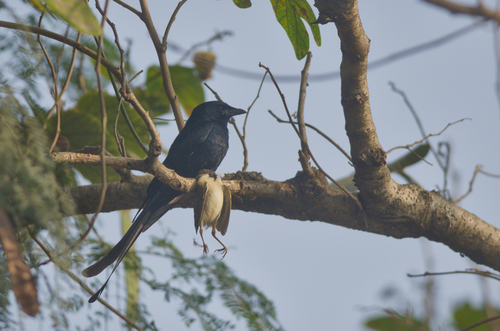 Black Drongo
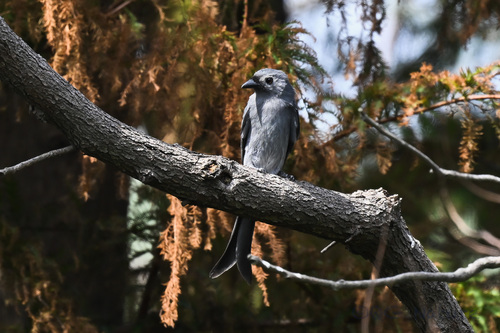 Ashy Drongo
In short
The most reliable field mark between Black Drongo and Ashy Drongo is overall color and gloss: Black Drongo is a glossy, jet-black bird with a broad, deeply forked tail, while Ashy Drongo is a dark grey, less glossy bird, sometimes with white facial markings and a slimmer, longer, less splayed tail. Juveniles of both species can be brownish, but Black Drongo young show white barring or speckling on the belly and vent, while Ashy Drongo juveniles are dull brownish-grey overall. Iris color is also diagnostic in good light: Black Drongo has a dark brown iris, Ashy Drongo a crimson one. Subtle differences in structure and habitat preference can help, but beware of very dark Ashy Drongos (especially ssp. longicaudatus) which can closely resemble Black Drongo.
Identification tips
- Gloss and color (adults): Black Drongo is glossy, jet-black; Ashy Drongo is dark grey without gloss, sometimes very dark but never with the same sheen. Works best in good light.
- Tail shape: Black Drongo has a wide, deep fork in the tail; Ashy Drongo's tail is long, deeply forked but slimmer and less splayed. This is most noticeable when perched or in flight.
- White facial marks: Ashy Drongo (some subspecies) may show white patches on the head or around the eye; Black Drongo never does. If present, this is instantly diagnostic for Ashy.
- Iris color: Black Drongo has a dark brown iris; Ashy Drongo's iris is crimson. This can be seen in close views or good photos.
- Rictal spot: Black Drongo usually shows a small white spot at the base of the gape; Ashy Drongo lacks this.
- Juvenile/immature plumage: Black Drongo juveniles are brownish with white barring/speckling on the belly and vent, and first-year birds have white tips on belly feathers. Ashy Drongo juveniles are dull brownish-grey overall, lacking these white marks.
- Structure: Ashy Drongo is slimmer overall, with a longer, less splayed tail; Black Drongo is chunkier and more compact.
- Habitat: Black Drongo is much more likely in open country, fields, wires, and agricultural land; Ashy Drongo prefers tall forest or hilly areas, especially outside migration.
- Behavior: Black Drongo is highly aggressive, often chasing or mobbing larger birds, and perches conspicuously in open; Ashy Drongo is less aggressive, perches higher in trees, and is more often solitary or in small groups.
- Voice: Black Drongo gives a two-note 'tee-hee' call; Ashy Drongo's calls are more nasal/twangy, sometimes imitative. Use with caution unless familiar with both.
- Migration and context: Ashy Drongo is more migratory and may appear in new areas seasonally, especially in hill forests; Black Drongo is a resident in much of its range.
- Pitfall – very dark Ashy Drongo: Subspecies longicaudatus of Ashy Drongo can be almost as dark as Black Drongo but is still less glossy and slimmer, with a crimson iris and no white gape spot.
- Pitfall – juvenile confusion: Juvenile Black Drongo can be mistaken for juvenile Ashy Drongo, but look for white barring/tipping on the belly/vent in Black, absent in Ashy.
- Perching style: Both perch upright, but Black Drongo is more likely to be seen on wires or low perches in open country; Ashy Drongo usually perches higher in trees.
- No sexual dimorphism: Sexes look alike in both species; do not use sex as a separator.
Size
Direct size comparison is limited by available data. Black Drongo is about 28 cm in length [wikipedia], while Ashy Drongo's mass is about 38 g [wikidata], with no direct length given. Both are medium-sized drongos, but Ashy Drongo tends to appear slimmer and longer-tailed, especially in flight or when perched upright. In practice, size is not a reliable separator unless both are side by side.
Plumage
- Juvenile/immature birds: Black Drongo juveniles are brownish with white barring or speckling on the belly and vent; first-year birds show white tips on belly feathers, and second-year birds restrict these white tips to the vent. Ashy Drongo juveniles are dull brownish-grey overall, lacking the belly barring and white tips of Black Drongo. No distinctive upperwing pattern is noted for either species at any age.
- Adults: Black Drongo is glossy black all over, with a small white spot at the base of the gape (rictal spot) and a wide, deep fork in the tail. Ashy Drongo adults are dark grey (sometimes very dark in ssp. longicaudatus), with a long, deeply forked but slimmer and less splayed tail, and lack the glossy sheen of Black Drongo. Some Ashy Drongo subspecies show white patches on the head or around the eye, which Black Drongo never shows. The iris is dark brown in Black Drongo, crimson in Ashy Drongo. Both sexes are similar in each species.
Behaviour
Both species perch upright and sally for insects, but Black Drongo is notably aggressive and fearless, often attacking much larger birds and even landing on raptors to mob them. It frequently perches on wires, thorny bushes, or grazing animals and is highly conspicuous in open country. Ashy Drongo is less aggressive, typically found singly or in small groups, and often perches high in trees, especially in forested or hilly areas. During migration, Ashy Drongo may be seen in small flocks. Both species are active aerial insectivores, but Black Drongo is more likely to be seen in open fields, especially near fires or ploughed land.
Habitat
Black Drongo favors open country, fields, edges, and human-altered landscapes, often perching on wires or exposed perches in agricultural areas. Ashy Drongo prefers taller forest habitats, especially in hills, and is less likely to be found in open farmland. During migration, Ashy Drongo may appear in a wider range of wooded habitats, but is still less tied to open country than Black Drongo. Overlap can occur, especially in edge habitats, but context can help: a drongo in a city park or field is more likely Black, while one in mature forest or hill country is more likely Ashy.
Voice
Both species are vocal, but their calls differ subtly. Black Drongo's typical call is a two-note 'tee-hee' reminiscent of a shikra, while Ashy Drongo's calls are described as more nasal and twangy, often rendered as 'drangh gip' or 'gip-gip-drangh.' Ashy Drongo is also capable of imitating other birds, including the common iora. Voice can be helpful if you are familiar with both, but is not always diagnostic in the field.