

Black-billed Cuckoo vs Northern Mockingbird
Coccyzus erythropthalmus versus Mimus polyglottos
Play a quiz with Black-billed Cuckoo and Northern Mockingbird
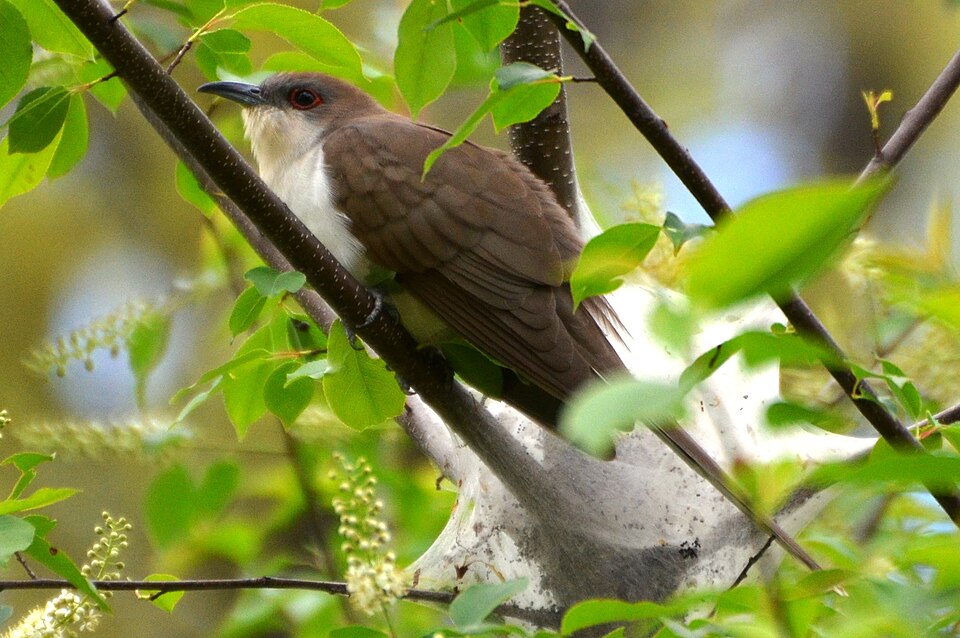 Black-billed Cuckoo
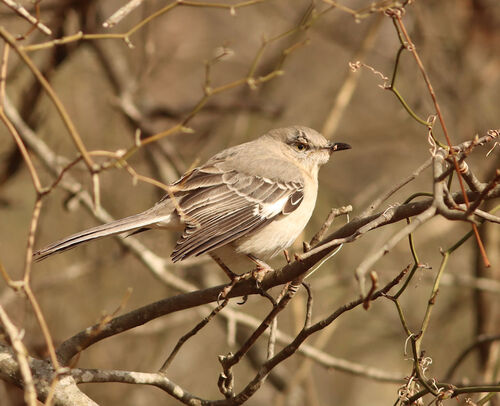 Northern Mockingbird
In short
The most reliable field mark to separate Black-billed Cuckoo from Northern Mockingbird is the presence of bold white wing patches and outer tail feathers in the mockingbird, especially obvious in flight or when the bird flashes its wings—features entirely absent in the cuckoo. Juvenile mockingbirds also show distinctive streaking on the back and chest, while juvenile cuckoos are drabber with some rufous in the wing and a yellow orbital ring. Structurally, the cuckoo is slimmer, with a longer, graduated brown tail and a black, slightly downcurved bill, compared to the mockingbird’s straighter bill and proportionally longer legs. Both species have pale underparts, but the mockingbird is generally grayer above and the cuckoo browner. If you see a bird with white in the wings or tail, it is a mockingbird; if the tail is all brown and the bill is black and downcurved, it is a cuckoo.
Identification tips
- White wing patches and tail edges (mockingbird only): In any age or season, if you see bold white patches in the wings or white outer tail feathers, especially in flight or during wing-flashing, you are looking at a Northern Mockingbird. Black-billed Cuckoo never shows white in these areas.
- Juvenile plumage: Juvenile mockingbirds have noticeable streaks and spots on the back and chest, and a grayish iris. Juvenile cuckoos are plainer, with some rufous in the wing and a yellow orbital ring. If you see a streaky juvenile, it is a mockingbird.
- Bill shape and color: Black-billed Cuckoo has a slender, entirely black, slightly downcurved bill. Mockingbird’s bill is straighter, black with a brownish base, and appears heavier at the base. Bill shape is best seen at close range or in good light.
- Tail shape and color: Cuckoo’s tail is long, graduated (steps down in length), and uniformly brown. Mockingbird’s tail is long but squarer at the tip, black in the center with white outer feathers visible in flight or when fanned.
- Orbital ring color: Adult cuckoos have a narrow red orbital ring; juveniles have yellow. Mockingbirds have a pale green-yellow or yellow iris, sometimes orange, but lack a colored orbital ring.
- Upperpart color: Cuckoo is brown above; mockingbird is gray. This is subtle but can help in good light.
- Underpart color: Both are pale below, but mockingbird is more consistently whitish-gray, while cuckoo is white.
- Leg length and posture: Mockingbirds have longer legs and often stand upright or run on the ground. Cuckoos perch more horizontally and rarely come to the ground.
- Behavior: Mockingbirds are bold, often in the open, and perform wing-flashing. Cuckoos are secretive, foraging quietly in dense foliage and rarely displaying.
- Habitat: Mockingbirds are common in open, suburban, or urban areas; cuckoos are more likely in dense woods or thickets, especially during caterpillar outbreaks.
- Flight style: Mockingbirds have a bounding, direct flight with frequent wingbeats and show white flashes. Cuckoos fly more directly and quietly, with no white visible in the wings or tail.
- Nestlings and fledglings: Not usually relevant in the field, but cuckoo chicks have sparse white down and odd creamy mouth structures, while mockingbird fledglings are streaky and begin perching and flying within two weeks.
- Vocalization: Not described here, but mockingbirds are famous for loud, varied, and persistent singing, while cuckoos are much quieter and less vocal in general.
- Seasonal context: Mockingbirds are resident year-round in much of their range; cuckoos are migratory and more likely in woodlands during spring and summer.
- Multiple marks: Always use a combination of marks—white in wing/tail and bold behavior point to mockingbird, while a brown, secretive bird with a black downcurved bill and no white in the wings or tail is a cuckoo.
Size
Northern Mockingbird is slightly heavier on average (adult mass around 48 g [wikidata]), but both species are similar in overall size and length, with the mockingbird measuring 20.5–28 cm in length and a wingspan of 31–38 cm [wikipedia]. The cuckoo’s measurements are not specified here, but structurally it is more slender and has a longer, more graduated tail, while the mockingbird appears bulkier with a proportionally longer leg and shorter, squarer tail. In the field, size alone is not a strong separator, but the mockingbird often looks more robust and upright, especially when perched.
Plumage
Juvenile mockingbirds are marked by streaks and spots on the back and chest, and a gray or grayish-green iris. In contrast, juvenile Black-billed Cuckoos are drabber, with some rufous in the wing and a yellow orbital ring. Adult mockingbirds are gray above and white or whitish-gray below, with bold white wing patches and white outer tail feathers visible in flight or when wing-flashing. The adult Black-billed Cuckoo is brown above, white below, with a long, graduated brown tail and a narrow red orbital ring. The cuckoo lacks any white in the wings or tail. The mockingbird’s bill is black with a brownish base, while the cuckoo’s bill is entirely black and slightly downcurved. In all plumages, the mockingbird’s white wing and tail markings are diagnostic and never shown by the cuckoo.
Behaviour
Northern Mockingbirds are often conspicuous, perching in open view, singing, and performing wing-flashing displays that reveal their white wing patches. They also spend time on the ground, running and hopping, and are territorial and aggressive, especially during breeding season. Black-billed Cuckoos are more secretive, foraging quietly in shrubs or trees and rarely coming to the ground. Their movements are more deliberate and less bold; they are less likely to be seen in open spaces or performing display behaviors. Cuckoos may adopt an erect, motionless posture when threatened, especially as juveniles.
Habitat
Northern Mockingbirds are common in open areas, suburban parks, gardens, and edges, often near human habitation across North America, the Caribbean, and Hawaii [wikipedia]. Black-billed Cuckoos prefer denser, more forested habitats and are more often found in woodlands or shrubby areas, especially where there are outbreaks of caterpillars. Mockingbirds are much more likely in urban or suburban settings, while cuckoos are typically encountered in quieter, less disturbed woodland or thicket environments.
Black-billed Cuckoo · Northern Mockingbird · My Tricky Birds