

Black-bellied Starling vs Meves's Starling
Notopholia corusca versus Lamprotornis mevesii
Play a quiz with Black-bellied Starling and Meves's Starling
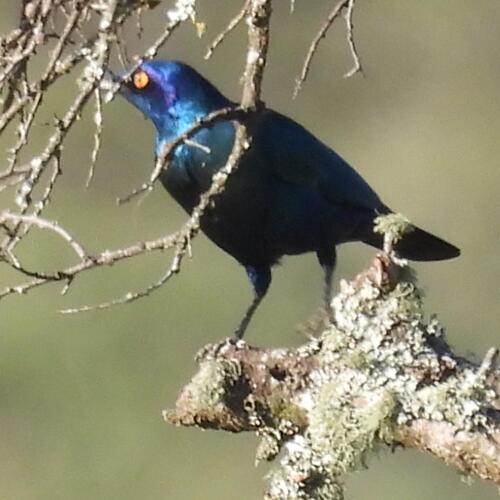 Black-bellied Starling
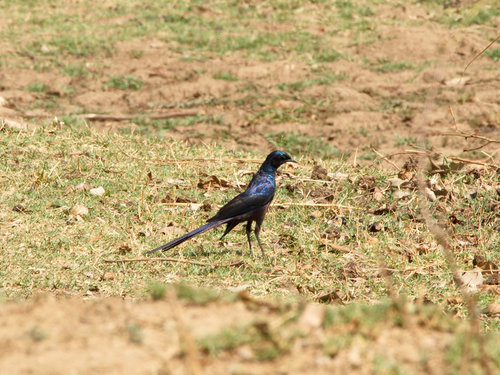 Meves's Starling
In short
The most reliable field mark to separate Black-bellied Starling from Meves's Starling is the tail: Meves's Starling has a much longer, strongly graduated tail, while Black-bellied Starling has a shorter tail. In good light, Meves's Starling shows strong iridescent gloss (often green, blue, or violet depending on subspecies), while Black-bellied Starling is less glossy and has a dark belly. Eye color is also helpful: Meves's Starling has dark eyes, while Black-bellied Starling's iris can change color with mood or behavior. Both species can overlap in southern Africa, so careful attention to tail shape and gloss is essential.
Identification tips
- Tail length and shape: Meves's Starling has a very long, strongly graduated tail, with the central feathers much longer than the outer ones. This is the single most reliable field mark, visible both perched and in flight. Black-bellied Starling's tail is shorter and less graduated.
- Iridescent gloss: Meves's Starling is intensely iridescent in good light, with gloss color varying by subspecies (green-blue, violet-purple, or duller brownish). Black-bellied Starling is less glossy and appears darker overall, especially on the belly.
- Belly color: Black-bellied Starling has a distinctively dark (blackish) belly, which is not present in Meves's Starling. This mark is best seen when the bird is perched or in good light.
- Eye color: Meves's Starling has consistently dark eyes. Black-bellied Starling's iris can change color depending on mood or behavior, so a pale or changing iris may indicate Black-bellied Starling, but this is not always reliable in the field.
- Size and structure: Meves's Starling is larger and more elongated, with a noticeably longer tail and overall lankier appearance. Black-bellied Starling is more compact.
- Flight silhouette: In flight, Meves's Starling's long tail is obvious and gives a stretched, almost magpie-like look. Black-bellied Starling appears shorter-tailed and more starling-like.
- Gloss color by region: If you are in southwestern Angola, look for duller, browner Meves's Starling (subspecies benguelensis). In northern Namibia and south-central Angola, Meves's Starling may show a violet-purple gloss (subspecies violacior). In southeastern Angola, northeastern Namibia, Botswana, southeastern Zambia, southern Malawi, and northeastern South Africa, expect intensely green-and-blue gloss (subspecies mevesii).
- Habitat context: If you are in mopane woodland or along a river basin, especially in areas that flood seasonally, Meves's Starling is more likely. Black-bellied Starling is less tied to these habitats.
- Flocking behavior: Meves's Starling is often seen in small flocks, especially in its preferred habitats. Black-bellied Starling's flocking habits are less described, but it may be seen singly or in smaller groups.
- Geographic overlap: Both species occur in Mozambique, South Africa, and Zimbabwe. Use structural and plumage marks rather than range alone for identification in these areas.
- Juvenile/immature birds: No distinctive upperwing or flight pattern differences are described for immatures, so rely on tail length and overall glossiness for separation.
- Perched vs. flight views: Tail length and graduation are visible in both perched and flight views, but are often easiest to judge when the bird is perched with the tail spread or hanging below the branch.
- Lighting conditions: Both species can look dark in poor light, but Meves's Starling will show more iridescence in bright light. Black-bellied Starling's belly remains dark regardless of lighting.
- Potential pitfalls: In dull light, Meves's Starling can appear almost black, which may cause confusion with Black-bellied Starling. Always check tail length and belly color if possible.
- Iris color as a secondary mark: While Black-bellied Starling's iris can change color, this is not always visible or reliable in the field. Use it as supporting evidence, not as a primary field mark.
Size
Meves's Starling is the larger of the two, with a body mass around 79.6g [wikidata]. It is also noticeably longer overall (30–36 cm), largely due to its very long tail. Black-bellied Starling is smaller and more compact, with a shorter tail and a less elongated appearance. In the field, Meves's Starling will generally appear lankier and more stretched out, especially when perched or in flight.
Plumage
-
Adults: Meves's Starling is highly iridescent, with the gloss color varying by subspecies (green-and-blue, violet-purple, or duller brownish with less gloss). Its tail is long and graduated, with the central feathers much longer than the outer ones. The eyes are dark. Black-bellied Starling, in contrast, is less glossy overall and has a distinctive dark (blackish) belly, which gives the species its name. Its tail is shorter and less graduated.
-
Immatures/Juveniles: No specific juvenile or first-winter upperwing or flight pattern differences are described in the sources for these two species. Therefore, separation in immature plumage relies mostly on structure (tail length and shape) and overall glossiness, which is reduced in young Meves's Starling but still longer-tailed than Black-bellied Starling.
-
In flight: Meves's Starling's long, graduated tail is obvious, while Black-bellied Starling appears more compact and short-tailed. Both species can look dark in dull light, but Meves's Starling will show more iridescence in good light.
Behaviour
Meves's Starling is typically found in small flocks, often in mopane woodland and along river basins, and is known to frequent areas that flood in the rainy season. Its long tail can make its flight appear more buoyant and elongated. Black-bellied Starling's behavior is less described in the sources, but it does not have the same association with mopane woodland or the pronounced flocking behavior of Meves's Starling. Both species are social, but the context of habitat and flock structure may help with identification.
Habitat
Meves's Starling prefers mopane woodland, especially along river basins and in regions that flood seasonally. It is widespread in southern-central Africa, including Angola, Botswana, Malawi, Mozambique, Namibia, South Africa, Zambia, and Zimbabwe. Black-bellied Starling is found in a broader range of habitats across Eswatini, Kenya, Mozambique, Somalia, South Africa, Tanzania, and Zimbabwe. While both can be found in Mozambique, South Africa, and Zimbabwe, Meves's Starling is more tied to mopane woodland and riverine habitats, whereas Black-bellied Starling is less habitat-specific in the sources.