

Black-bellied Starling vs Burchell's Starling
Notopholia corusca versus Lamprotornis australis
Play a quiz with Black-bellied Starling and Burchell's Starling
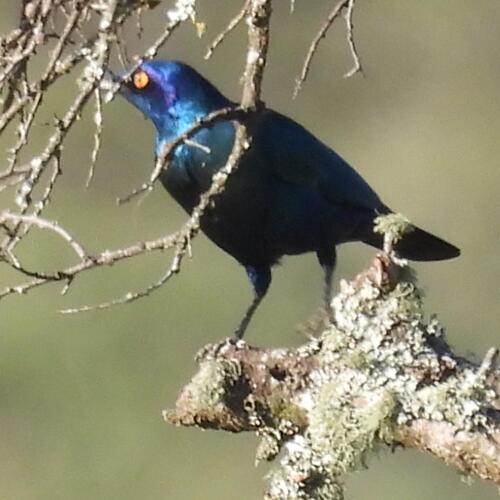 Black-bellied Starling
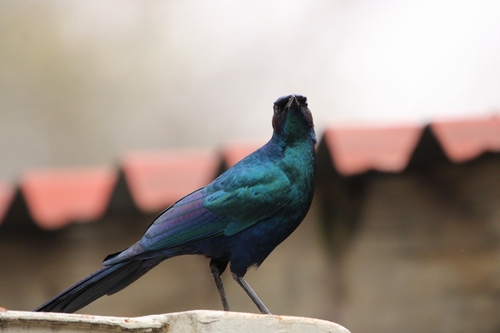 Burchell's Starling
In short
The most reliable way to separate Black-bellied Starling from Burchell's Starling in the field is by focusing on plumage: Black-bellied Starling shows a distinctive dark belly, while Burchell's Starling is glossy and lacks this feature. Structural differences are subtle but Burchell's is notably heavier. Both species occur in southern Africa, but habitat preferences may help: Black-bellied is more widespread in East Africa, while Burchell's is tied to drier woodlands and savannah. Iris color in Black-bellied Starling can shift with mood, which is not seen in Burchell's. Use belly color and overall gloss as your first checks, especially when birds are perched.
Identification tips
- Belly color is the single most reliable field mark: Black-bellied Starling has a distinctly dark or black belly, while Burchell's Starling is glossy throughout with no dark belly patch. This is visible on perched birds and often even in flight if you get a good ventral view.
- Overall gloss and color: Burchell's Starling is more uniformly metallic blue-green or purple, lacking the contrasting belly of Black-bellied. In strong light, Burchell's can appear almost entirely iridescent.
- Iris color (Black-bellied only): Black-bellied Starling's iris can change color with mood or behavior due to blood flow changes. If you notice a bird with a shifting or unusual iris color, it is likely Black-bellied. Burchell's does not show this trait.
- Size and build: Burchell's Starling is heavier and bulkier (about 80g), while Black-bellied is lighter and more slender. This is most useful when you see both species together or are familiar with their typical jizz.
- Habitat context: In dry, open woodlands or savannahs of southern Africa, Burchell's is expected. Black-bellied is more likely in a wider range of habitats, including moister areas and further north/east.
- No distinctive age-specific wing or flight marks: Neither species is described as having unique juvenile or immature upperwing patterns, so do not rely on wing panels or flight marks for separation.
- Plumage pitfalls: Both are glossy starlings and can look similar at a distance or in poor light. Always try to get a clear view of the belly and underparts.
- Perched vs. flight views: The belly color is easiest to see on perched birds or when the bird is facing you. In flight, look for the underbody contrast if possible.
- Sexes similar: No sexual dimorphism is noted for either species, so all field marks apply to both males and females.
- Seasonal variation not diagnostic: No seasonal plumage changes are described for either species that would affect identification.
- Voice not described: If you hear a starling and are unsure, rely on visual marks rather than calls for this pair.
- Iris color as a behavioral clue: If you see a starling with a noticeably pale or changing iris, especially if it seems to shift with agitation, this supports Black-bellied Starling.
- Geographic overlap: In southern Africa, both species can occur, so do not rely solely on location—always check the belly color.
- Gloss pattern: If the bird appears uniformly glossy from head to vent, suspect Burchell's; if the gloss abruptly ends at a dark belly, it's Black-bellied.
- Group size and behavior: Both species can be seen in pairs or small groups; flocking behavior is not a reliable separator.
Size
Burchell's Starling is significantly heavier (about 80g) than Black-bellied Starling, which is not given a mass here but is generally lighter and more slender in build. In the field, Burchell's may appear bulkier and more robust, especially when seen side by side or in similar habitat. However, size alone can be hard to judge unless you have direct comparison.
Plumage
The key plumage difference is the belly: Black-bellied Starling has a dark, almost black belly contrasting with its iridescent upperparts, while Burchell's Starling is uniformly glossy without a contrasting dark belly. Both species are generally glossy and metallic, but Burchell's is more uniformly blue-green or purple across the body. No age-specific wing or flight pattern differences are described for either species, and both are typical glossy starlings as adults. There is no mention of distinctive juvenile or immature upperwing marks for either species in the available notes.
Behaviour
Both species are typical starlings in behavior, often seen in pairs or small groups. Burchell's Starling is described as monogamous and likely sedentary, suggesting it may be less likely to form large, mobile flocks than some other starlings. Black-bellied Starling's behavior is not detailed, but nothing in the notes suggests a dramatic behavioral difference between the two in the field.
Habitat
Black-bellied Starling is found across a broad range in eastern and southern Africa (Eswatini, Kenya, Mozambique, Somalia, South Africa, Tanzania, Zimbabwe), while Burchell's Starling is native to southern Africa and is especially associated with dry and mesic woodlands and savannah. If you are in a dry, open woodland or savannah in southern Africa, Burchell's is more likely; in more humid or varied habitats, or further north/east, Black-bellied is possible. However, ranges overlap in parts of southern Africa, so habitat is only a supporting clue.
Black-bellied Starling · Burchell's Starling · My Tricky Birds