

Black-backed Puffback vs Common Bulbul
Dryoscopus cubla versus Pycnonotus barbatus
Play a quiz with Black-backed Puffback and Common Bulbul
 Black-backed Puffback
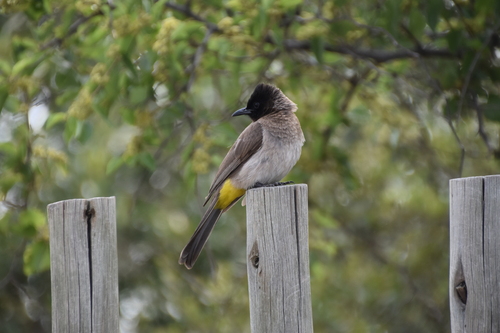 Common Bulbul
In short
The most reliable field mark to separate Black-backed Puffback from Common Bulbul is the Puffback's bold black-and-white contrast, especially the glossy black upperparts and pure white underparts in adult males, versus the Bulbul's overall brown and grey coloration with yellow undertail coverts in some subspecies. Immature Puffbacks are greyer and buffier but still show a sharper contrast than any Bulbul. Structurally, Puffbacks are smaller, more compact, and have a distinctly shrike-like jizz, while Bulbuls are larger, longer-tailed, and more thrush-like. Both species can be active in the canopy, but their movement style and social behavior differ. Vocalizations are not similar and are unlikely to cause confusion.
Identification tips
- Upperpart color (all ages): Puffbacks always have darker upperparts (black in males, grey in females/immatures) than any Bulbul, which is brown above.
- Underpart contrast (all ages): Puffbacks show white or buffy underparts with a sharp contrast to the upperparts; Bulbuls are dull grey below, blending into the brown upperparts.
- Adult male Puffback: Look for glossy blue-black back, black cap, and pure white underparts. No Bulbul shows this pattern.
- Adult female Puffback: Note the black loral stripe, white supraloral, pale ear coverts, and sometimes a supercilium. Bulbuls have a plain brown face without strong pattern.
- Immature Puffback: Greyer above and buffier below than adults, but still show more contrast than Bulbul immatures, which resemble adults.
- Wing markings: Puffbacks (especially males and some races) have white edging to remiges and a white scapular bar, visible in perched birds and sometimes in flight. Bulbuls lack any white in the wing or scapular area at all ages.
- Iris color: Adult Puffbacks have red or orange irides (depending on race), while Bulbuls have dark brown eyes with a dark eye-ring (not readily visible). Immature Puffbacks have brown irides.
- Bill shape: Puffbacks have a shrike-like, slightly heavier bill, while Bulbuls have a short, thin, slightly downcurved bill.
- Tail shape and length: Bulbuls have a longer, more graduated tail, giving a stretched appearance; Puffbacks have a shorter, more squared tail.
- Overall structure: Puffbacks are more compact and stocky; Bulbuls are longer, heavier, and more thrush-like.
- Behavior: Puffbacks flick wings and tail, move abruptly, and may puff out back feathers; Bulbuls hop and perch more openly, often in groups.
- Habitat context: In gardens, parks, or disturbed areas, expect Bulbul; in natural woodland or forest edge, especially south of the equator, check for Puffback.
- Vocalization: The Bulbul's loud, repetitive call is distinctive; Puffback calls are not similar and are unlikely to be confused.
- Sex differences: Puffbacks show sexual dimorphism (males and females separable), while Bulbuls do not.
- Subspecies variation: Some Puffback races have broader or narrower white wing markings and different iris colors; Bulbul subspecies differ mainly in undertail covert color (yellow in some), but never approach Puffback's black-and-white pattern.
Size
Black-backed Puffback is smaller and lighter (26.0 g) than Common Bulbul (35.05 g). Puffback is about 17 cm in length, while Bulbul is slightly longer at 18–20 cm. The Puffback appears more compact and less elongated, with a shorter tail and a stockier build. In the field, Bulbul's longer tail and heavier body give it a more stretched, thrush-like silhouette compared to the Puffback's bushshrike proportions.
Plumage
-
Juvenile/Immature birds: Immature Puffbacks resemble females but are even greyer above, with buffier underparts and wing edges, brownish bills, and brown irides. They still show a contrast between paler underparts and darker upperparts, but it's less stark than in adults. Immature Bulbuls look like adults: brown upperparts, dull grey underparts, and yellow undertail coverts in some subspecies, with no sharp contrast or wing markings.
-
Adult males: Puffback males have deep blue-black glossy upperparts, a black cap, red or orange irides (depending on subspecies), and pure white underparts. The white scapular bar and white edging to remiges are prominent in some races. Bulbuls never show this black-and-white contrast; their head is dark brown, upperparts brown, and underparts dull grey, with yellow undertail coverts in some forms.
-
Adult females: Puffback females are greyer above, with a black loral stripe, white supraloral, pale ear coverts, and sometimes a prominent supercilium. Underparts are white to buffy. Bulbul females are not separable from males in the field and share the same brown/grey/yellow pattern. Puffback females may show a more contrasting face pattern and paler underparts than any Bulbul.
-
Wing pattern in flight: Puffbacks (especially males and some races) show white edging to remiges and a white scapular bar, visible in perched and sometimes in flight views. Bulbuls lack any white in the wing or scapular area.
Behaviour
Puffbacks are restless, moving singly, in pairs, or family groups, and tend to stay higher in the canopy, often flicking their tails and wings. Their movements are more abrupt and shrike-like, sometimes puffing out their back feathers. Bulbuls are also active but move in a more relaxed, hopping manner, often in loose groups, and are less likely to flick their wings or tail in the same way. Bulbuls often perch more openly and sing from conspicuous spots, while Puffbacks are more likely to be partially hidden in foliage.
Habitat
Both species can be found in wooded habitats, but Puffbacks are more strictly associated with various wooded environments south of the equator and are sedentary. Bulbuls are much more widespread, occurring throughout most of Africa (except very arid areas) and even into southern Spain. Bulbuls are common in gardens, parks, and secondary growth, while Puffbacks are more typical of bush, woodland, and forest edge. In southern Africa, finding a Puffback in a dense, natural woodland is more likely, whereas Bulbuls are abundant in disturbed or cultivated areas.
Voice
The Puffback's calls are not described in the notes, but are not similar to the Bulbul's. The Common Bulbul has a loud, repetitive 'doctor-quick doctor-quick be-quick be-quick' call, which is distinctive and unlikely to be confused with any Puffback vocalization.