

Black-backed Puffback vs Black-crowned Tchagra
Dryoscopus cubla versus Tchagra senegalus
Play a quiz with Black-backed Puffback and Black-crowned Tchagra
 Black-backed Puffback
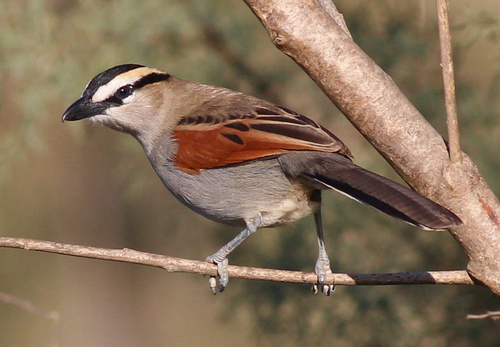 Black-crowned Tchagra
In short
The most reliable way to separate Black-backed Puffback and Black-crowned Tchagra is by head and wing pattern: Puffback males have a glossy black cap and upperparts with white underparts, while Tchagra shows a bold black crown and eye-stripe divided by a broad white supercilium, plus chestnut wings and a black tail with a white tip. Immature Puffbacks lack the solid black crown and have brownish bills and eyes, while young Tchagras have a brown cap and pale yellow bill. In flight or perched, Tchagra’s chestnut wing panel and striking facial pattern are unique, while Puffback is more cleanly black-and-white. Both are bushshrikes, but Tchagra is larger and longer-tailed, and their behavior and preferred habitat differ.
Identification tips
- Head pattern: Tchagra has a bold black crown and eye-stripe separated by a broad white supercilium—this is visible at all ages and sexes. Puffback males have a glossy black cap, but females and immatures lack a solid black crown and show a black loral stripe or brownish tones.
- Facial contrast: Tchagra’s face is strikingly patterned with the black-and-white head, while Puffback is plainer-faced, especially in females and immatures.
- Wing color: Tchagra’s folded wings are chestnut, contrasting with the black-and-white wings of Puffback. This is visible both perched and in flight.
- Tail pattern: Tchagra has a black tail with a white tip, easily seen when the bird fans or flicks its tail. Puffback’s tail is black without a white tip.
- Underparts: Puffback has pure white (male) or off-white to buffy (female/immature) underparts, while Tchagra’s are pale grey.
- Bill color: Immature Puffbacks have a brownish bill; young Tchagras have a pale yellow bill. Adults of both species have black bills.
- Iris color: Puffback adults have red or orange irides (depending on subspecies); immatures are brown-eyed. Tchagra iris color is variable by subspecies but not as distinctive in the field.
- Size and shape: Tchagra is longer and more slender, with a longer tail; Puffback is more compact and rounded.
- Behavior: Puffback is more active, often in the canopy, and moves restlessly. Tchagra is more likely to perch quietly in a bush or low tree.
- Habitat: Puffback prefers denser woodland; Tchagra is more often in open scrub, semi-desert, or cultivated areas.
- Response to playback: Tchagra often approaches when its song is imitated; Puffback’s response is not described.
- Sex differences: Puffback males are glossier and more contrasting than females; Tchagra sexes are similar.
- Juvenile confusion: Young Puffbacks are duller and browner than adults but never show the Tchagra’s bold facial pattern or chestnut wings. Young Tchagras retain the supercilium and chestnut wing, even with a brown cap.
- Subspecies variation: Puffback subspecies vary in the amount of white on wings and back; Tchagra subspecies differ in back and underpart color, but the facial pattern and chestnut wing remain diagnostic.
- Voice: If you hear a descending whistled song, it is Tchagra. Puffback’s song is not described here, so use this only for positive Tchagra ID.
Size
Black-crowned Tchagra is noticeably larger, at 19–22 cm in length, compared to the Black-backed Puffback’s 17 cm. Puffback is also lighter (body mass 26 g), with a more compact, rounded appearance, while Tchagra appears longer and more slender, especially in the tail. This difference is most apparent when both are seen side by side or when perched in the open.
Plumage
-
Juvenile/immature birds: Young Puffbacks resemble females with brownish bills and brown irides, greyer upperparts, and buffy underparts and wing edges. They lack the solid black cap of adult males. Young Tchagras have a brown cap (not black) and a pale yellow bill, but still show the broad white supercilium and chestnut wings, making them distinct from Puffback at all ages.
-
Adult males: Puffback males are deep blue-black above with a glossy cap, pure white underparts, and black-and-white upperparts. Tchagra adults have a black crown and black eye-stripe, separated by a broad white supercilium, pale grey underparts, pale brown upperparts, chestnut wings, and a black tail tipped white.
-
Adult females: Puffback females are similar to males but with a black loral stripe, white supraloral feathering, pale ear coverts, and greyer backs. Tchagra females are similar to males, retaining the bold facial pattern and chestnut wings.
-
Wings and tail: Puffback’s wings are black with variable white edging (depending on subspecies), and the tail is black without a white tip. Tchagra’s folded wings are chestnut, and the tail is black with a white tip—this is a key field mark when the bird is perched or in flight.
Behaviour
Black-backed Puffback is restless, moving singly, in pairs, or family groups, and usually forages high in tree canopies. It is more active and less likely to sit exposed for long. Black-crowned Tchagra hunts from a perch in a bush, often less conspicuous than true shrikes, but can be drawn into view by imitating its song. Tchagra also performs a switchback display flight. Puffback’s movement is more energetic and arboreal, while Tchagra is more deliberate and bush-dwelling.
Habitat
Puffback is found in various wooded habitats south of the equator, typically in denser woodland and forest edge, and is sedentary. Tchagra occupies a broader range, including scrub, open woodland, semi-desert, and cultivated areas, and is found across most of Africa and the Arabian Peninsula. If the bird is in open scrub or semi-desert, Tchagra is more likely; in dense woodland or forest edge, Puffback is favored.
Voice
Tchagra has a distinctive descending whistling song ("chee-chee chee cheroo cheroo") and is responsive to playback, often approaching the source. Puffback’s vocalizations are not described in the provided notes, so voice is only a strong separator if the Tchagra’s song is heard.
Black-backed Puffback · Black-crowned Tchagra · My Tricky Birds