

Black-and-white Mannikin vs Swee Waxbill
Spermestes bicolor versus Coccopygia melanotis
Play a quiz with Black-and-white Mannikin and Swee Waxbill
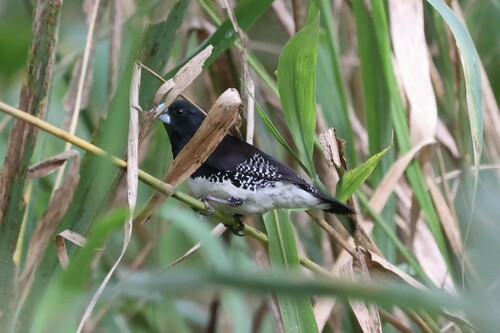 Black-and-white Mannikin
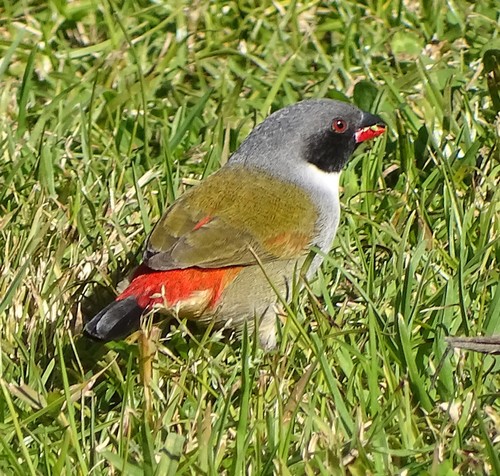 Swee Waxbill
In short
The most reliable field mark to separate Black-and-white Mannikin from Swee Waxbill is overall plumage pattern: mannikins show a sharply contrasting black-and-white body, while Swee Waxbills have a grey head and breast, pale yellow belly, olive wings, and a red rump. Juvenile Swee Waxbills are duller and have an all-black bill, which can cause confusion with mannikins, but the mannikin never shows the Swee's olive and yellow tones or red rump. Both are small estrildid finches, but Swee Waxbill is slightly smaller and slimmer. Habitat and flocking behavior can also help: mannikins are more likely in moist savanna and forest, often in larger groups, while Swee Waxbills prefer upland shrubland and open forest, usually in small parties.
Identification tips
- Plumage contrast: Adult Black-and-white Mannikin always shows a sharply defined black-and-white pattern with no olive, yellow, or red tones. Swee Waxbill adults are more colorful, with a grey head, olive wings, yellow belly, and a red rump. This is the most reliable mark for adults.
- Red rump: Only Swee Waxbill (adult and some immatures) shows a red lower back and rump, visible when perched or in flight. Mannikin never shows red on the rump.
- Face pattern and sex: Male Swee Waxbill has a black face, female has a grey face; mannikin always has a black head and breast, regardless of sex. If you see a grey-faced bird with olive and yellow, it's a female Swee Waxbill.
- Bill color in juveniles: Juvenile Swee Waxbill has an all-black bill, which can resemble mannikin, but look for overall duller, less contrasting plumage and lack of red rump. Mannikin juveniles do not show olive/yellow tones.
- Underparts color: Swee Waxbill has a pale yellow belly, while mannikin underparts are white. In poor light, this can be subtle, but yellowish tones point to Swee Waxbill.
- Upperparts and wings: Swee Waxbill shows olive on the back and wings, while mannikin is uniformly dark above. In flight, Swee Waxbill may flash a red rump, mannikin remains dark and plain.
- Tail color: Swee Waxbill has a black tail contrasting with the red rump; mannikin's tail is less distinct from the rest of the upperparts.
- Size and structure: Swee Waxbill is slightly smaller and slimmer, but this is subtle and best used alongside plumage marks.
- Flocking behavior: Mannikins are often in larger, tighter flocks, while Swee Waxbills are in small, loose parties.
- Habitat: Mannikin prefers moist savanna and forest; Swee Waxbill is more likely in upland shrubland, open forest, or large gardens in southern Africa.
- Voice: If you hear a soft 'swee, swee', it's Swee Waxbill. Lack of this call does not confirm mannikin.
- Sex differences: Only Swee Waxbill shows clear sexual dimorphism in face color; mannikin sexes are similar.
- Juvenile confusion: Both species' juveniles are duller, but Swee Waxbill juveniles are especially plain and lack the mannikin's sharp black-and-white contrast. Bill color is not enough alone—look for overall color and rump.
- Perched vs. flight views: In flight, watch for the Swee Waxbill's red rump; mannikin remains dark above with no color flash.
- Pitfalls: In poor light or brief views, juvenile Swee Waxbill can look like mannikin due to the all-black bill and dull plumage. Always check for olive/yellow tones and rump color when possible.
Size
Swee Waxbill is slightly smaller and lighter than Black-and-white Mannikin, with an adult mass of about 7.8 grams [wikidata]. Both are small finches, but Swee Waxbill tends to look more delicate and slim, while mannikins are stockier. In the field, size difference is subtle and best used in combination with plumage and structure.
Plumage
Adult Black-and-white Mannikin shows a bold black-and-white pattern: black head and breast, white underparts, and dark upperparts, lacking any olive, yellow, or red. Swee Waxbill adults have a grey head and breast, pale yellow belly, olive back and wings, and a distinctive red lower back and rump with a black tail. Males have a black face, females a grey face. Juvenile Swee Waxbills are much duller, lacking the red rump and olive tones, and have an all-black bill, which can superficially resemble mannikins, but still show a more uniform, less sharply contrasting pattern. Black-and-white Mannikin juveniles also lack the adult's sharp contrast but do not show olive or yellow tones or a red rump at any age. In flight, the Swee's red rump may be visible, while mannikin shows a more uniform dark upperwing and back.
Behaviour
Black-and-white Mannikins are often seen in larger flocks, especially outside the breeding season, and are more likely to be encountered in groups. Swee Waxbills are typically found in small parties and are described as tame, often foraging quietly in low vegetation. Swee Waxbills do not form large flocks. Both species are active and social, but flock size and group cohesion can be a clue.
Habitat
Black-and-white Mannikin is widespread in sub-Saharan Africa, favoring moist savanna and tropical or subtropical moist lowland forest [wikipedia]. Swee Waxbill is native to Southern Africa and prefers upland dry shrubland and open forest, though some subspecies occur in lowlands and large gardens [wikipedia]. Thus, Swee Waxbill is more likely in drier, higher elevation habitats, while mannikin prefers wetter, lower areas. Overlap can occur, but context helps.
Voice
Swee Waxbill gives a soft, high-pitched 'swee, swee' call [wikipedia]. There is no vocal description for Black-and-white Mannikin in the provided notes, so voice is only useful for confirming Swee Waxbill if heard, not for ruling out mannikin.