

Bewick's Swan vs Whooper Swan
Cygnus columbianus versus Cygnus cygnus
Play a quiz with Bewick's Swan and Whooper Swan
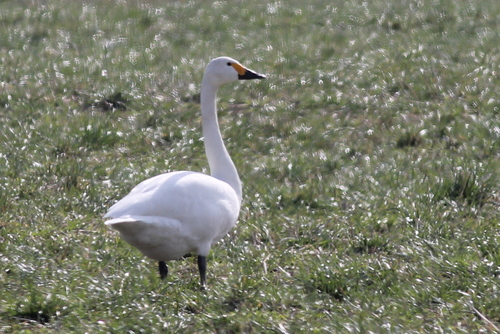 Bewick's Swan
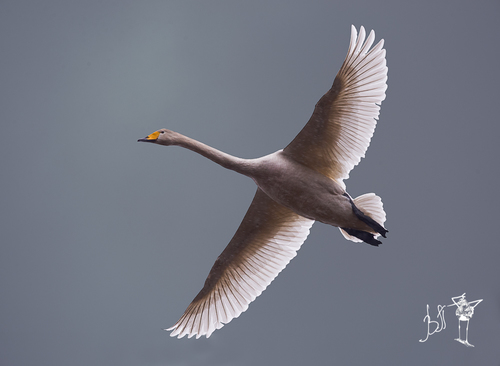 Whooper Swan
In short
The most reliable field mark between Bewick's Swan and Whooper Swan is the bill pattern: Bewick's Swan always shows more black than yellow on the bill, with a blunt front edge to the yellow patch, while Whooper Swan shows more yellow than black, with the yellow patch pointed forward. Whooper Swan is also much larger and longer-necked, with a more angular head, compared to the compact, short-necked, rounded-headed Bewick's. Both species are pure white as adults, but juveniles are pale grey and best separated by structure and bill pattern. In flight or at rest, size and neck length are strong clues, but always check the bill carefully for the most definitive separation.
Identification tips
- Bill pattern is the single most reliable field mark: Bewick's Swan always shows more black than yellow on the bill, with the yellow patch blunt at the front edge; Whooper Swan always has more yellow than black, with the yellow patch pointed forward. This works for all ages, though juvenile bills are duller.
- Size and structure: Whooper Swan is much larger and heavier, with a noticeably longer neck and bigger body. In direct comparison or mixed flocks, Bewick's looks small and short-necked, almost goose-like.
- Head shape: Bewick's has a rounded head profile, while Whooper's is more angular or wedge-shaped. This is visible both at rest and in flight.
- Neck length: Whooper Swan's neck is proportionally longer and often held straighter; Bewick's neck is shorter and can appear slightly kinked or S-shaped.
- Bill details: Each Bewick's Swan has a unique bill pattern, but always with more black than yellow. Whooper's yellow patch is more extensive and pointed. In Bewick's, the yellow never extends as far toward the bill tip as in Whooper.
- Juvenile separation: Both species' juveniles are pale grey, but bill pattern and structure (as above) are still the best clues. Juvenile Whooper's bill is pinkish and yellowish, but the yellow is more extensive than in Bewick's.
- Feet color: Both have black feet, but rare Bewick's may show yellowish feet; this is not a reliable separator.
- Tail shape: Both have rounded tails, but this is not a strong separator between these two (more useful against Mute Swan).
- Plumage: Both are pure white as adults, sometimes stained rusty on the head/neck from water. Immatures are pale grey, with no strong upperwing pattern to separate them.
- Flight jizz: In flight, Whooper Swan looks longer and heavier, with a longer neck and more powerful wingbeats. Bewick's is more compact and agile.
- Behavior: Whooper Swans are more likely to display obvious pre-flight signaling (head bobs, shakes, wing flaps) in flocks; Bewick's do this less noticeably.
- Vocalizations: Whooper's call is lower-pitched and more resonant, but both are loud and bugling; use with caution.
- Habitat and context: Where both occur, Whooper is more likely in larger flocks and on bigger waterbodies, but habitat overlap is extensive.
- Sex and season: Males are slightly larger in both species, but this is not diagnostic in the field. Seasonal variation does not affect the main ID marks.
- Pitfalls: Do not rely on overall whiteness, leg color, or tail shape. Focus on bill pattern and structure for the most reliable separation, especially in poor light or at distance.
Size
Whooper Swan is substantially larger and heavier than Bewick's Swan. Adult Whooper Swans average about 11,375 g, with lengths of 140–165 cm and wingspans of 205–275 cm. Bewick's Swan averages 6,781.5 g, with lengths of 115–150 cm and wingspans of 168–211 cm. Even at a distance, Whooper Swans appear bulkier, with longer bodies and necks. In mixed flocks, Bewick's will look notably smaller and shorter-necked, sometimes recalling a large white goose among the Whoopers.
Plumage
Juvenile and immature birds of both species are pale grey to grey-brown, lacking strong patterning on the upperwing or body, so wing pattern is not a reliable separator at any age. Both species are pure white as adults, though both can show rusty or golden staining on the head and neck from iron-rich water. The key difference is in the bill: adult Bewick's Swans have mostly black bills with variable yellow at the base (always less yellow than Whooper), and each individual's pattern is unique; Whooper Swans have mostly yellow bills with a pointed yellow patch extending forward. Juvenile bills are duller, with pinkish replacing yellow and blackish-grey replacing black, but the overall pattern (more black in Bewick's, more yellow in Whooper) still applies. Feet are black in both, but rare Bewick's may show yellowish feet.
Behaviour
Both species are highly social and often seen in family groups or flocks, especially in winter. Whooper Swan is noted for its frequent and conspicuous signaling before flight (head bobs, shakes, wing flaps), which is less emphasized in Bewick's. In flight, Whooper Swans appear longer-necked and heavier, while Bewick's have a more compact, goose-like jizz. Both species feed by upending in shallow water and graze in fields, but Whooper Swans may dominate in mixed flocks due to their size.
Habitat
Both species breed in arctic or subarctic wetlands and winter in temperate lowland wetlands, lakes, and flooded fields. Their ranges overlap in parts of Eurasia, especially in winter. In western Europe, Bewick's is more likely in smaller flocks and sometimes on smaller waterbodies, while Whooper Swan is more widespread and often found in larger groups. However, habitat is not a reliable separator where both occur.
Voice
Both species are very vocal, with loud, bugling calls. Whooper Swan's call is described as more resonant and lower-pitched (kloo-kloo-kloo in groups of three or four), while Bewick's is higher-pitched and slightly less resonant. In practice, the difference is subtle and not always diagnostic in the field, especially at distance or in mixed flocks.