

Basra Reed Warbler vs Clamorous Reed Warbler
Acrocephalus griseldis versus Acrocephalus stentoreus
Play a quiz with Basra Reed Warbler and Clamorous Reed Warbler
 Basra Reed Warbler
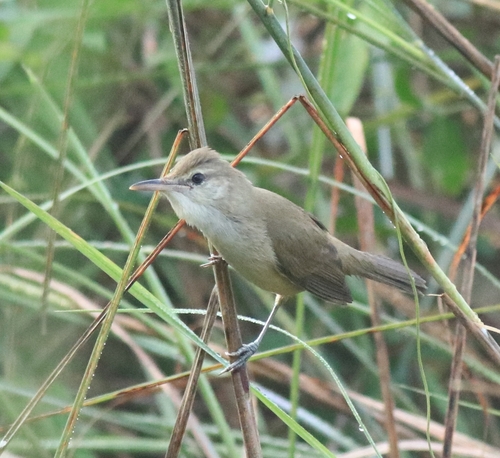 Clamorous Reed Warbler
In short
To separate Basra Reed Warbler from Clamorous Reed Warbler, focus first on bill shape and underpart color: Basra has a noticeably narrower, longer, and more pointed bill, and its underparts are whiter. Clamorous is bulkier overall, with a strong, pointed bill and a more robust, thrush-like appearance. Both are plain brown above and pale below, but Basra is smaller and more delicate, with a less powerful jizz. Voice can help: Basra gives a deeper, gruffer 'chaar' call, while Clamorous has a loud, chattering song. Habitat overlap is possible, but Basra is much more localized and specialized in dense reedbeds of the Tigris–Euphrates system.
Identification tips
- Bill shape: Basra Reed Warbler has a noticeably narrower, longer, and more pointed bill than Clamorous, which has a strong, thick, and pointed bill. This is often the most reliable structural difference at close range.
- Underpart color: Basra shows distinctly whiter underparts, especially on the belly and flanks, compared to the more subdued whitish (but not pure white) underparts of Clamorous. This is easiest to judge in good light and on perched birds.
- Size and jizz: Clamorous is larger and bulkier, with a thrush-like presence, while Basra is smaller, more slender, and delicate. In mixed flocks or with a size reference, this can be helpful, but beware lone birds.
- Head and forehead: Clamorous has a flattened forehead and a heavier head profile, while Basra's head is finer and less blocky.
- Upperparts: Both are plain brown above, but Clamorous can show richer or darker brown tones in some subspecies (northern and Sri Lankan forms), while Basra is more uniform and lacks strong color saturation.
- No distinctive wing pattern: Neither species shows a strong age-specific wing panel, triangle, or contrasting edge in flight or at rest, so do not rely on upperwing pattern for separation.
- Sexes similar: Both species have little to no sexual dimorphism in plumage, so sex is not a useful field mark.
- Voice: Listen for Basra's deep, gruff 'chaar' call, which is lower-pitched and less musical than Clamorous's loud, chattering, and varied song. Use this especially in dense cover or poor light.
- Habitat and range: If in the Tigris–Euphrates system or recently colonized Israeli wetlands, Basra is much more likely, especially in extensive papyrus and reedbeds. Clamorous is widespread across a much larger area and can be found in a broader range of reedbed habitats.
- Behavior: Both skulk in reeds, but Basra may appear more agile and less ponderous than the heavier Clamorous. This is subtle and best used as supporting evidence.
- Migration and vagrancy: Basra is a rare vagrant in Europe and winters in East Africa, while Clamorous is resident or migratory over a much wider area. Out of range, Clamorous is far more likely.
- Plumage pitfalls: Both can be confused with Great Reed Warbler, but Basra is smaller and whiter below, while Clamorous is more robust and less richly colored than Great Reed.
- Juvenile/immature birds: No distinctive juvenile or immature wing or plumage marks are described for either species, so use structure and underpart color for all ages.
- Context: If you have a clear view of the bill and underparts, prioritize these features. In poor views, rely on voice and overall size/jizz, but be cautious of overlap.
- Subspecies variation: Clamorous shows some regional variation in upperpart color, but this does not overlap with Basra's range or appearance.
Size
Clamorous Reed Warbler is the larger of the two, described as song thrush-sized (18–20 cm), with a bulkier build and stronger bill. Basra Reed Warbler is smaller and more slender, though exact measurements are not provided in the notes. In direct comparison, Basra will look more delicate and less robust, with a finer head and bill structure.
Plumage
There are no age-specific upperwing or flight pattern differences described for either species in the notes. Both are unstreaked brown above and pale below, but Basra Reed Warbler has distinctly whiter underparts, while Clamorous Reed Warbler's underparts are whitish but not as clean or bright. Basra's bill is narrower, longer, and more pointed, while Clamorous has a strong, pointed bill and a flattened forehead. No mention of seasonal or age-dependent plumage variation for either species, but Clamorous shows some subspecific variation in upperpart color (northern birds richer brown, Sri Lanka birds darkest), which is not a factor for Basra.
Behaviour
Both species are typical Acrocephalus warblers, moving through dense reeds and aquatic vegetation. Clamorous, being larger and more robust, may appear slower and heavier in movement, while Basra is likely to seem more agile and delicate. Both can be found in thickets and bushland during migration or winter, so behavior alone is not highly diagnostic.
Habitat
Basra Reed Warbler is highly localized, breeding almost exclusively in the Tigris–Euphrates river system (southwestern Iran, eastern/southern Iraq, Kuwait, and recently Israel), and is extremely rare elsewhere. It is tied to extensive beds of papyrus and reeds in shallow, fresh or brackish water. Clamorous Reed Warbler has a much broader range, from Egypt through South Asia to Southeast Asia, and is not as restricted to a specific river system. Both use dense reedbeds, but Basra is more specialized and less likely outside its core range.
Voice
Basra Reed Warbler gives a gruff 'chaar' call, which is deeper than the similar Common Reed Warbler. Clamorous Reed Warbler's song is loud and far-carrying, described as a slow, chattering 'kereet-kereet-kereet' with whistles and mimicry, but less raucous than Great Reed Warbler. In the field, Basra's call is more abrupt and lower-pitched, while Clamorous is more musical and varied.
Basra Reed Warbler · Clamorous Reed Warbler · My Tricky Birds