

Barnacle Goose vs Whooper Swan
Branta leucopsis versus Cygnus cygnus
Play a quiz with Barnacle Goose and Whooper Swan
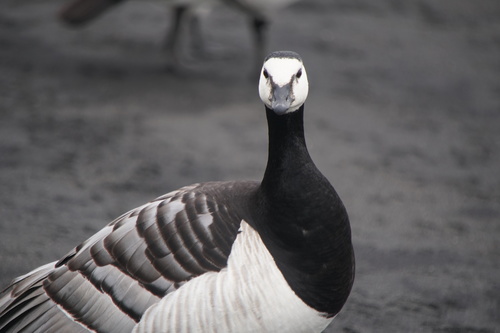 Barnacle Goose
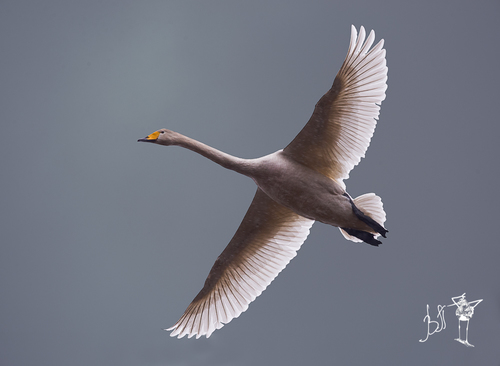 Whooper Swan
In short
The most reliable way to separate Barnacle Goose from Whooper Swan is by size and structure: Whooper Swan is vastly larger, with a long neck and massive yellow-and-black bill, while Barnacle Goose is a compact, medium-sized goose with a short black bill and distinctive black-and-white plumage. In flight, Barnacle Goose shows a silvery-grey upperwing with black-and-white bars and a bold white rump patch, while Whooper Swan is entirely white (except for possible rusty staining on head/neck) with no dark wing markings. Juvenile Barnacle Geese closely resemble adults but have slightly rounder mantle and flank feathers, whereas juvenile Whooper Swans are uniform pale grey. Even at a distance or in poor light, the swan’s sheer bulk, long neck, and all-white wings will stand out against the smaller, more patterned goose.
Identification tips
- Size is the most obvious clue: Whooper Swan is nearly seven times heavier than Barnacle Goose. If you see a bird that looks swan-sized, it is not a Barnacle Goose.
- Neck length and posture: Whooper Swan has a very long, straight neck, often held upright or outstretched in flight. Barnacle Goose has a much shorter, stubbier neck, typical of geese.
- Bill shape and color: Whooper Swan has a long, wedge-shaped bill that is mostly yellow with a black tip. Barnacle Goose has a short, stubby black bill.
- Plumage pattern (adults): Barnacle Goose shows a white face, black head/neck/breast, silvery-grey back with black-and-white bars, and a white belly. Whooper Swan is pure white (sometimes rusty-stained on head/neck), with no black or grey patterning.
- Juvenile plumage: Juvenile Barnacle Geese are still black, white, and grey, with rounded mantle/flank feathers. Juvenile Whooper Swans are uniform pale grey or greyish-brown, lacking any black or white face pattern.
- Flight pattern and wing markings: In flight, Barnacle Goose shows a bold white rump, silvery-grey underwings, and black-and-white barred upperwing. Whooper Swan is all white in flight, with no contrasting wing markings.
- Tail shape: Whooper Swan has a short, rounded tail (not long and pointed like Mute Swan). Barnacle Goose has a short tail, but this is less distinctive than the swan’s.
- Leg color: Barnacle Goose has black legs; Whooper Swan’s legs are also black but are usually not visible unless the bird is walking or standing.
- Voice: Whooper Swan gives deep, resonant trumpeting calls; Barnacle Goose gives higher-pitched, barking or yapping calls. If you hear a bugling 'kloo-kloo-kloo', it is a swan.
- Feeding behavior: Whooper Swans often feed with their heads and necks submerged in water; Barnacle Geese graze on land more like typical geese.
- Habitat context: Large, open water with big white birds is likely to hold Whooper Swans; grassy meadows or saltmarshes with smaller, patterned geese are more likely to have Barnacle Geese.
- Group composition: Whooper Swans are often in family groups with clear size differences between adults and cygnets; Barnacle Geese flocks are more uniform in size and structure.
- Bill pattern in juveniles: Juvenile Whooper Swans have pink and blackish-grey bills, not the yellow-and-black of adults; Barnacle Goose juveniles have the same black bill as adults.
- Face pattern: Only Barnacle Goose has a white face with black head/neck; Whooper Swan’s face is all white (except for possible rusty staining).
- When in doubt: If the bird is all white and swan-sized, it is a Whooper Swan. If it is smaller, with a white face and black neck, it is a Barnacle Goose.
Size
Whooper Swan is one of the heaviest flying birds, averaging over 11 kg for males and 8–9 kg for females, with a length of 140–165 cm and a wingspan up to 275 cm. Barnacle Goose is much smaller, weighing around 1.7 kg, with a length of 55–70 cm and a wingspan of 120–145 cm. The size difference is dramatic: a Whooper Swan dwarfs a Barnacle Goose, appearing nearly swan-sized even at a distance, while Barnacle Goose is only slightly larger than a mallard. If seen together, there is no overlap in size.
Plumage
- Juvenile/immature birds: Juvenile Barnacle Geese look like adults but can be told by their rounded mantle and flank feathers; their plumage is still black, white, and grey, with the same bold face and wing pattern. Juvenile Whooper Swans are uniform pale grey to greyish-brown all over, lacking any black or white face pattern, and have a duller bill (pink and blackish-grey rather than yellow and black).
- Adults: Barnacle Goose adults show a striking white face, black head, neck, and upper breast, white belly, and silvery-grey upperparts with black-and-white bars. In flight, look for the V-shaped white rump and silvery underwing linings. Whooper Swan adults are pure white overall (sometimes with rusty staining on head/neck from feeding), with no dark markings on the wings or body. The bill is long and mostly yellow with a black tip.
- Flight views: Barnacle Goose in flight shows strong contrast between dark and pale areas, especially the white rump and barred upperwing. Whooper Swan is all white in flight, with no contrasting patches except possible staining on the head/neck.
Behaviour
Whooper Swans are often seen in family groups or large flocks, especially during migration and winter, and display a variety of signaling movements (head bobs, shakes, wing flaps) before taking flight. They are powerful, steady fliers with deep wingbeats and long necks outstretched. Barnacle Geese also form flocks but appear more compact and agile, with shorter necks and a more direct, rapid flight. Swans often feed with their heads and necks submerged, while Barnacle Geese graze more like typical geese.
Habitat
Both species can be found in wetlands, lakes, and estuaries during migration and winter, but Whooper Swans prefer larger, deeper bodies of water and open landscapes, while Barnacle Geese are more often seen grazing on grasslands, saltmarshes, and coastal meadows. Overlap is possible in wintering areas, but the swan’s preference for open water and the goose’s for grassy fields can help separate them in context.
Voice
Whooper Swan is very vocal, with a loud, resonant trumpeting call described as 'kloo-kloo-kloo' in groups of three or four, lower-pitched and more resonant than Bewick’s Swan. Barnacle Goose has a higher-pitched, barking or yapping call, quite different from the swan’s deep bugling. Voice alone is usually enough to separate them if heard well.