

Bar-throated Apalis vs Rudd's Apalis
Apalis thoracica versus Apalis ruddi
Play a quiz with Bar-throated Apalis and Rudd's Apalis
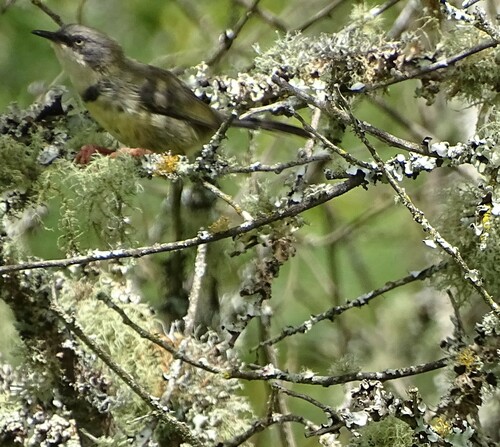 Bar-throated Apalis
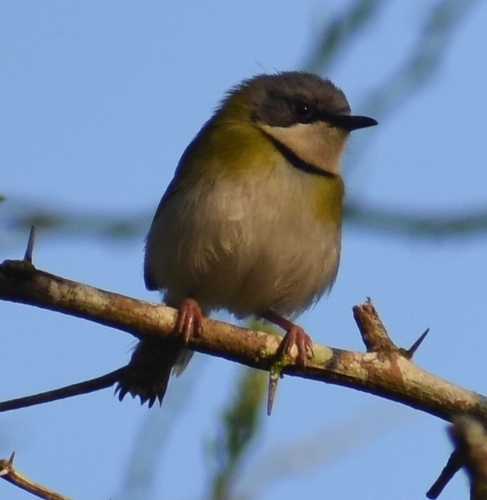 Rudd's Apalis
In short
The most reliable field mark to separate Bar-throated Apalis from Rudd's Apalis is the presence of a narrow black breast band on all Bar-throated Apalis, which is absent in Rudd's Apalis. Bar-throated Apalis also shows white outer tail feathers and a distinctly pale eye, while Rudd's Apalis lacks these features in the available descriptions. Juvenile Bar-throated Apalis can show a buffier underside and an incomplete breast band, which may cause confusion, but even then, the hint of a breast band is helpful. Both species are slender, long-tailed cisticolids, but Bar-throated Apalis tends to show more variation in upperpart color (grey or green) and underpart tone (white or pale yellow), while Rudd's Apalis is less variable in the available notes. Habitat can help: Bar-throated Apalis is widespread in eastern and southern Afrotropics, while Rudd's is more localized to Mozambique and adjacent regions.
Identification tips
- Breast band is key: Bar-throated Apalis always shows a narrow black breast band (though it may be incomplete or faint in juveniles and narrower in females); Rudd's Apalis lacks this feature. Always check for a breast band on the front of the bird.
- Juvenile confusion: Juvenile Bar-throated Apalis can have buffier underparts and an incomplete breast band, but even a hint of a band favors Bar-throated. Rudd's juveniles are not described as having any breast band.
- Tail pattern: Bar-throated Apalis has white outer tail feathers, which can be seen in flight or when the tail is fanned; Rudd's Apalis is not noted to have this feature.
- Eye color: Bar-throated Apalis has a pale eye, which can be a useful mark at close range. Eye color for Rudd's Apalis is not specified, so a distinctly pale eye supports Bar-throated.
- Bill shape: Bar-throated Apalis has a fairly long, slender, slightly curved black bill. Rudd's Apalis is similar in structure but check for subtle differences if seen well.
- Upperpart color: Bar-throated Apalis can be grey or green above, depending on subspecies; Rudd's Apalis is not described in detail but is likely less variable. If the bird shows greenish tones above, Bar-throated is more likely.
- Underpart color: Bar-throated Apalis can be white or pale yellow below; Rudd's Apalis is not described, so strong yellow or white underparts do not rule out either, but variation favors Bar-throated.
- Sex differences: Female Bar-throated Apalis has a narrower breast band than the male, but still present. Rudd's Apalis does not show this feature in either sex.
- Range: If you are outside Mozambique, southern Malawi, or adjacent South Africa/Eswatini, Rudd's Apalis is unlikely. Bar-throated is much more widespread.
- Habitat: In dry forest or moist shrubland in the Rudd's Apalis core range, consider both species, but always check for the breast band.
- Structure: Both are slender and long-tailed, so do not rely on overall shape to separate them.
- Flight views: No distinctive upperwing or flight marks are described for either species, so focus on tail pattern and underpart features if seen in flight.
- Plumage pitfalls: Subspecific variation in Bar-throated Apalis can cause confusion (grey vs green above, white vs yellow below), but the breast band remains consistent.
- Abundance: Bar-throated Apalis is generally more common and widespread; Rudd's is local and less likely except in its core range.
- Vocalization: No diagnostic differences are provided in the available notes; do not rely on voice for separation with current information.
Size
Bar-throated Apalis has a measured body mass of 10.5g [wikidata], but there is no direct measurement available for Rudd's Apalis. Both are small, slender birds of similar structure and likely similar size, so size alone is not a reliable separator in the field.
Plumage
Bar-throated Apalis of all ages shows a narrow black breast band (though this can be incomplete or faint in juveniles), white outer tail feathers, and a pale eye. The upperparts can be grey or green, and the underparts white or pale yellow, with some subspecific variation. Females resemble males but have a narrower breast band. Juveniles are buffier below and may have only a partial breast band. Rudd's Apalis, by contrast, is not described as having a breast band, white outer tail feathers, or a pale eye in the available notes. Thus, the presence or absence of the breast band is the most consistent plumage difference, especially in perched birds or those seen well from the front. No distinctive age-specific upperwing or flight marks are described for either species.
Behaviour
Both species are described as slender and long-tailed, typical of the genus Apalis, and are likely to be active and agile in foliage. No distinctive behavioral differences are noted in the available sources.
Habitat
Bar-throated Apalis is widespread in the eastern and southern Afrotropics and occupies a range of habitats. Rudd's Apalis is more restricted, found primarily in Mozambique, southern Malawi, and adjacent parts of South Africa and Eswatini, favoring subtropical or tropical dry forest and moist shrubland. If seen outside the core range of Rudd's Apalis, Bar-throated is far more likely. Habitat overlap is possible in southern Africa, so habitat alone is not diagnostic, but range can be a strong supporting clue.