

Bar-headed Goose vs Rosy-billed Pochard
Anser indicus versus Netta peposaca
Play a quiz with Bar-headed Goose and Rosy-billed Pochard
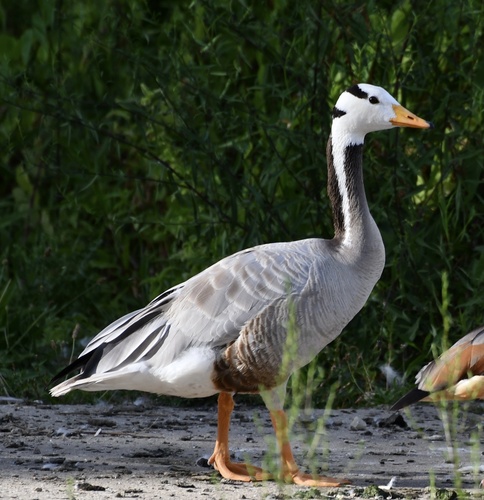 Bar-headed Goose
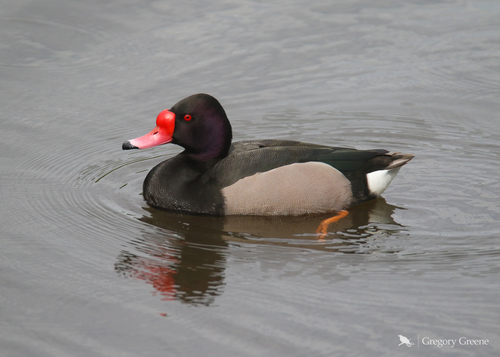 Rosy-billed Pochard
In short
The most reliable field mark between Bar-headed Goose and Rosy-billed Pochard is the Bar-headed Goose’s distinctive pale head with two bold black bars, which is never matched by the Pochard. In flight, Rosy-billed Pochard (especially males) shows a striking white wing stripe only visible with wings outstretched, while Bar-headed Goose lacks this feature. Structurally, Bar-headed Goose is a much larger, longer-necked, and heavier bird, with a plain, pale bill, compared to the Pochard’s compact body and (in males) a bright red bill with a prominent knob. Females and immatures of Rosy-billed Pochard are dull brown and lack the male's red bill, but still show the white crissum and wing stripe. Both species may be found in open wetland habitats, but their ranges do not overlap naturally.
Identification tips
- Head pattern: Bar-headed Goose always shows a white head with two bold black bars across the back of the head (adults and immatures); Rosy-billed Pochard never shows this pattern.
- Bill color and shape: Male Rosy-billed Pochard has a bright red bill with a large rounded knob at the base, fading to pink with a black tip. Females have a bluish-gray bill with a black tip. Bar-headed Goose has a plain, pale (yellowish or orange) bill with no knob.
- Wing pattern in flight: Rosy-billed Pochard of all ages and sexes shows a broad white stripe on the primaries and secondaries, visible only with wings fully outstretched or in flight. Bar-headed Goose lacks any white wing stripe.
- Body size and structure: Bar-headed Goose is much larger and longer-necked, with a bulkier body. Rosy-billed Pochard is compact, with a short neck and lower profile.
- Plumage color: Bar-headed Goose is pale gray with a white head and black bars. Male Rosy-billed Pochard is dark purplish-black on head, neck, and breast, with gray sides and a white crissum; females/juveniles are dull brown with a white crissum.
- Sexual dimorphism: Only male Rosy-billed Pochard has the bright red bill and knob; females and juveniles are dull brown and lack the knob, but still show the white crissum and wing stripe.
- Crissum (under-tail): Both sexes of Rosy-billed Pochard have a contrasting white crissum; Bar-headed Goose does not have a sharply contrasting under-tail area.
- Flight style: Bar-headed Goose flies with steady, powerful wingbeats and a long neck outstretched; Rosy-billed Pochard has rapid wingbeats and a compact silhouette.
- Takeoff behavior: Pochards require a running start and have trouble taking off; Bar-headed Goose takes off more directly and powerfully.
- Leg placement: Rosy-billed Pochard’s legs are set farther back, making walking awkward; Bar-headed Goose walks easily on land.
- Habitat context: Consider location—Bar-headed Goose is native to Asia, Rosy-billed Pochard to South America. In captivity or vagrancy, check for other marks.
- Voice: Both species honk, but Pochard’s call is deeper and quieter; not a strong field mark.
- Group behavior: Bar-headed Goose often in large, grazing flocks; Rosy-billed Pochard may be in smaller groups, often on water.
- Seasonal context: Bar-headed Goose is migratory, seen in Asia in summer and South Asia in winter; Rosy-billed Pochard migrates within South America.
- Juvenile confusion: Juvenile Rosy-billed Pochard resembles adult female (dull brown, white crissum, white wing stripe in flight); Bar-headed Goose juveniles still show pale head and dark bars.
Size
Bar-headed Goose is substantially larger, with an average body mass of 2367.5 g compared to the Rosy-billed Pochard's 1092.5 g [wikidata]. The goose is also longer-necked and bulkier overall, giving a more imposing presence both on water and in flight. Rosy-billed Pochard is more compact, with a shorter neck and a lower profile on water. If seen together, the size difference is obvious, but in isolation, look for the goose’s long neck and larger body as clues.
Plumage
No age-specific upperwing patterns are described for Bar-headed Goose, but Rosy-billed Pochard of all ages and sexes shows a broad white stripe on the primaries and secondaries, only visible in flight or with wings fully outstretched [wikipedia]. This is a key mark for flying or stretching birds. Bar-headed Goose is pale gray overall with a white head and two bold black bars across the back of the head (adults and immatures). Rosy-billed Pochard males have a purplish-black head, neck, and breast, gray sides, and a white crissum (under the tail), with a bright red bill and knob; females and juveniles are dull brown with a bluish-gray bill and also show a white crissum. The Pochard never shows the Bar-headed Goose’s black head bars or overall pale coloration.
Behaviour
Bar-headed Goose is a strong, high-flying migrant, often seen grazing on land or swimming in open water, and is comfortable walking on land. Rosy-billed Pochard, though classified as a diving duck, often feeds like a dabbling duck and is less adept at walking, with legs set farther back for swimming. Pochards require a running start to take off, with rapid wingbeats, while Bar-headed Goose takes off more powerfully and steadily. In flight, the goose appears longer-necked and more direct, while the Pochard is more compact and rapid-winged.
Habitat
Bar-headed Goose breeds in high-altitude lakes of Central Asia and winters in lowland South Asia, often in cultivated fields or open wetlands [wikipedia]. Rosy-billed Pochard is endemic to South America, found in lakes, marshes, and wetlands, sometimes in rice fields [wikipedia]. Their natural ranges do not overlap, but both may be found in open wetland habitats if seen in captivity or vagrancy. Context of location is a strong clue.
Voice
Bar-headed Goose gives typical goose-like honking calls, while Rosy-billed Pochard’s vocalizations are described as honks as well, but deeper and relatively quiet compared to a Mallard [wikipedia]. Vocalizations are not highly distinctive between these two for field separation, especially at a distance.