

Banded Martin vs Sand Martin
Neophedina cincta versus Riparia riparia
Play a quiz with Banded Martin and Sand Martin
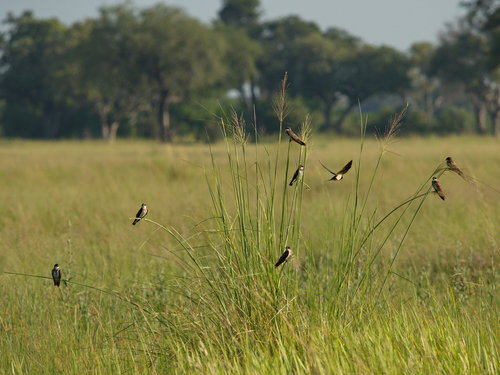 Banded Martin
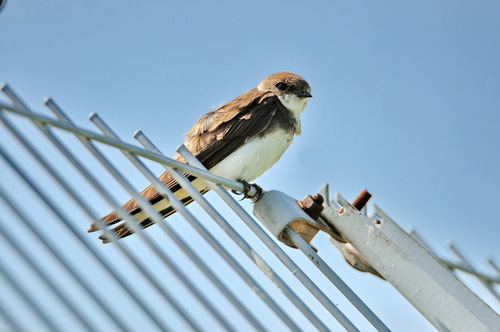 Sand Martin
In short
The most reliable field mark to separate Banded Martin from Sand Martin is size and structure: Banded Martin is noticeably larger, with a squarer tail and a bold white stripe above the eye, while Sand Martin is smaller, with a more compact, quick flight and a less obvious supercilium. Juvenile plumages can be tricky, but Banded Martin young show golden feather tips and a paler breast band, whereas Sand Martin juveniles have rufous tips to the wing coverts and secondaries. In flight, Banded Martin shows white underwing coverts, while Sand Martin's underwing is plainer. Both have a dark breast band, but Banded Martin’s is broader and more contrasting. Habitat overlap is limited: Banded Martin is endemic to Africa, while Sand Martin is a widespread migrant, only wintering in Africa.
Identification tips
- Size and bulk: Banded Martin is much larger and heavier than Sand Martin. If you see both together, the difference is striking, but even singly, Banded Martin looks more robust and longer-winged.
- Tail shape: Banded Martin has a square tail, while Sand Martin’s tail is slightly forked. This is best seen when the birds are perched or banking in flight.
- Supercilium (eyebrow): Banded Martin shows a clear white stripe above the eye, visible at close range or in good light. Sand Martin lacks this feature.
- Breast band: Both species have a dark breast band, but Banded Martin’s is broader and more contrasting, especially in adults. Sand Martin’s band is narrower and less bold.
- Underwing pattern: In flight, Banded Martin shows white underwing coverts, creating a pale flash under the wing. Sand Martin’s underwing is more uniformly dull and lacks this contrast. This is a key mark for flying birds of all ages.
- Juvenile plumage: Young Banded Martins have golden tips to the upperpart feathers and a paler breast band. Juvenile Sand Martins have rufous tips to the wing coverts and secondaries, which can be visible on perched birds or in slow flight.
- Ventral line: Banded Martin sometimes shows a thin dark line across the vent, which Sand Martin never shows. This is subtle and not always visible.
- Flight style: Sand Martin has a quick, jerky, fluttering flight, while Banded Martin is steadier and more direct. This difference is most apparent when watching flocks or mixed groups.
- Social behavior: Sand Martin is highly gregarious, often seen in large colonies or flocks. Banded Martin is more often in pairs or small groups.
- Habitat and range: Banded Martin is resident in Africa year-round (except for some migratory subspecies), while Sand Martin is only present in Africa as a migrant or winter visitor. If seen in Europe, Asia, or North America, it is almost certainly Sand Martin.
- Perched posture: Banded Martin tends to look longer and more upright when perched, while Sand Martin appears compact and hunched.
- Bill and legs: Both have dark bills and legs; these are not useful for separation.
- Sexes: Both species are sexually monomorphic; plumage differences do not help with sexing or separating the two species.
- Voice: Sand Martin’s gravelly twitter and harsh alarm are typical, but Banded Martin’s calls are not distinctive in the field, so do not rely on voice for separation.
- Season: In Africa, Sand Martin is present mainly in the non-breeding season, while Banded Martin is present year-round (except for local migrations). Use season and location as supporting context, not primary ID marks.
Size
Banded Martin is distinctly larger: 15–17 cm in length, compared to Sand Martin’s 12–13 cm. Banded Martin is also heavier (nearly double the weight of Sand Martin), making it bulkier and longer-winged in direct comparison. Sand Martin is noticeably more petite and lightweight, with a wingspan of 26.5–29 cm and a typical weight of 11–16 g (sometimes up to 19.5 g pre-migration). These differences are especially apparent when both species are seen together, but even singly, Banded Martin’s larger, more robust jizz stands out.
Plumage
- Juveniles/immatures: Banded Martin young have golden tips to the upperpart feathers and a paler, less distinct breast band. Sand Martin juveniles show rufous (warm brown) tips to the wing coverts and edges of the secondaries, which can be seen in good light on perched or banking birds.
- Adults: Both species have brown upperparts and a dark breast band on white underparts, but Banded Martin’s breast band is broader and more sharply defined. Banded Martin also has a conspicuous white supercilium (stripe above the eye), lacking in Sand Martin. The underwing coverts of Banded Martin are white, contrasting with the rest of the underwing, while Sand Martin’s underwing is more uniformly dull and lacks this contrast. Banded Martin sometimes shows a thin dark line across the vent, absent in Sand Martin.
- Tail: Banded Martin has a square tail, while Sand Martin’s tail is slightly forked, though not as deeply as some other swallows.
Behaviour
Banded Martin is less gregarious, typically seen in pairs or small flocks, while Sand Martin is highly social, often forming large, noisy colonies and flocks. In flight, Sand Martin has a quick, jerky, fluttering style, reflecting its smaller size and lighter build. Banded Martin’s flight is steadier and more direct, matching its larger, squarer shape. Perched, Banded Martin often looks longer and more upright, while Sand Martin appears compact and hunched.
Habitat
Banded Martin is endemic to Africa, favoring open habitats like farmland, grassland, and savannah, usually near water. It is absent from the driest regions. Sand Martin breeds across the Holarctic (Europe, Asia, North America) and only occurs in Africa as a migrant or winter visitor, often near rivers, lakes, or sandbanks. In Africa, Sand Martin is present mainly in the non-breeding season, so context and time of year are helpful clues.
Voice
Sand Martin gives a continuous, gravelly twittering in flight and a harsh alarm call when disturbed. There are no distinctive vocal notes for Banded Martin in the provided sources, so voice is not a reliable separator in the field for these two species.