

Banded Martin vs Plain Martin
Neophedina cincta versus Riparia paludicola
Play a quiz with Banded Martin and Plain Martin
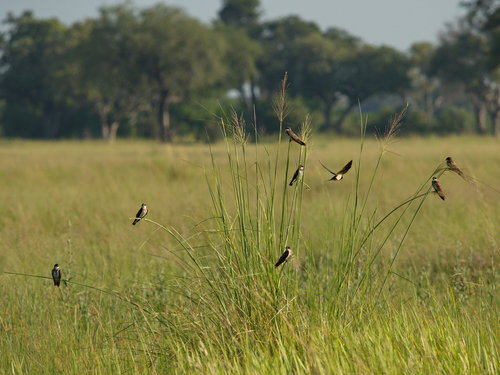 Banded Martin
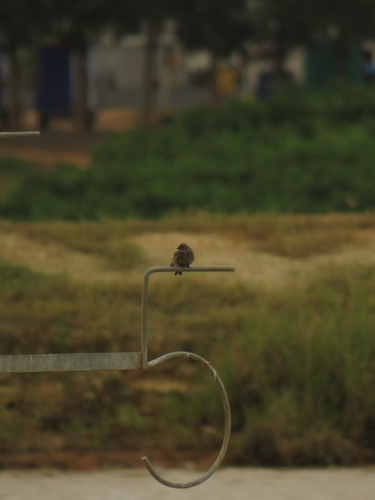 Plain Martin
In short
The most reliable field mark to separate Banded Martin from Plain Martin is the presence of a distinct dark breast band on Banded Martin of all ages, which Plain Martin always lacks. Juvenile Banded Martins have a paler version of this band, but it is still visible, while juvenile Plain Martins never show any breast band. In flight or perched, Banded Martin also shows a squarer tail and white underwing coverts, compared to Plain Martin's more uniformly brownish underparts and underwings. Both species are similar in overall brown-and-white coloration, but careful attention to the breast and tail shape will separate them in most conditions.
Identification tips
- Breast band (all ages): Banded Martin always shows a dark breast band, even in juveniles (though paler). Plain Martin never has a breast band at any age. This is the single most reliable mark.
- Juvenile upperparts: Juvenile Banded Martins have golden tips to the upperpart feathers, while juvenile Plain Martins have pale tips to rump and wing feathers. Look for these subtle contrasts in fresh plumage.
- Underwing coverts: Banded Martin shows white underwing coverts, often visible in flight or when preening. Plain Martin's underwings are more uniformly pale brown, lacking this contrast.
- Tail shape: Banded Martin has a square tail, which is especially obvious when perched or in flight. Plain Martin's tail is slightly forked or rounded, never square.
- Supercilium (eyebrow): Banded Martin has a white stripe above the eye, which can be seen at close range. Plain Martin lacks a distinct supercilium.
- Throat color: Banded Martin has a white throat, while Plain Martin has a brown throat. This is a key mark when seen head-on or in good light.
- Size: Banded Martin is significantly larger (15–17 cm) and bulkier than Plain Martin (12 cm). Use with caution unless both are seen together.
- Flight style: Plain Martin has a quicker, jerkier flight, while Banded Martin is steadier and more direct. This can help when plumage is hard to see.
- Social behavior: Plain Martin is more gregarious, often in larger flocks, while Banded Martin is usually in pairs or small groups.
- Habitat preference: Banded Martin favors open country (farmland, savannah), while Plain Martin is more often in marshy or wetland areas, though both can overlap.
- Vocalizations: Plain Martin gives a continuous twittering song in flight and a harsh alarm call. Banded Martin's voice is not described here, so use this only to confirm Plain Martin.
- Bill and legs: Both species have blackish bills and brown legs; these are not useful for separation.
- Sexes: Both species are sexually monomorphic; do not rely on sex for identification.
- Subspecies variation: Some subspecies of Banded Martin are paler or differ slightly in breast band tone, but the band is always present. Plain Martin subspecies may vary in tone but never develop a breast band.
- Pitfall: Do not confuse Plain Martin with Sand Martin (Riparia riparia), which does have a breast band, but is smaller and has a different range in Africa.
Size
Banded Martin is noticeably larger, measuring 15–17 cm in length, while Plain Martin is only about 12 cm long [wikipedia]. This size difference is often apparent in direct comparison or when seen with other swallows. Banded Martin also appears bulkier and longer-winged, while Plain Martin is more compact and delicate. However, size can be hard to judge without a reference, so it should be used cautiously unless both species are present together.
Plumage
- Juveniles: Juvenile Banded Martins have a paler breast band (but still visible) and golden tips to the upperpart feathers. Juvenile Plain Martins have pale tips to the rump and wing feathers, but never show a breast band.
- Adults: Adult Banded Martins are earth-brown above with a white supercilium (eyebrow), white underparts, and a strong dark brown breast band. Their underwing coverts are white, and they sometimes show a thin dark line across the vent. Adult Plain Martins are brown above and white or pale brown below, lacking any breast band. Their underparts and underwing coverts are more uniformly pale brownish, and their throat is brown, not white.
- In flight: Banded Martin's white underwing coverts can be a useful mark, especially in good light. Plain Martin's underwings are more uniformly pale brown, lacking the contrast. Tail shape is also useful: Banded Martin has a square tail, while Plain Martin's tail is slightly forked or rounded.
Behaviour
Banded Martin is less gregarious, typically seen in pairs or small flocks, while Plain Martin is often found in larger groups and is generally more social [wikipedia]. In flight, Plain Martin has a quicker, jerkier flight style, appearing more agile and restless compared to the steadier, more direct flight of Banded Martin. Banded Martin often perches more openly and for longer periods, while Plain Martin is more likely to be seen constantly on the wing.
Habitat
Both species are found near water, but Banded Martin prefers open habitats such as farmland, grassland, and savannah, often near water but not strictly tied to marshy areas. Plain Martin, as its Latin name ('paludicola' = marsh-dweller) suggests, is more often found in wetland or marshy habitats, although it can also occur in open country near water. Both can overlap in range, but context may help if habitat is typical.
Voice
Plain Martin has a continuous twittering song when flying and a conversational undertone when perched, along with a harsh alarm call. No specific vocalization is described for Banded Martin in these notes, so voice is only useful for confirming Plain Martin when the twittering is heard.