

Balearic Shearwater vs Barolo Shearwater
Puffinus mauretanicus versus Puffinus baroli
Play a quiz with Balearic Shearwater and Barolo Shearwater
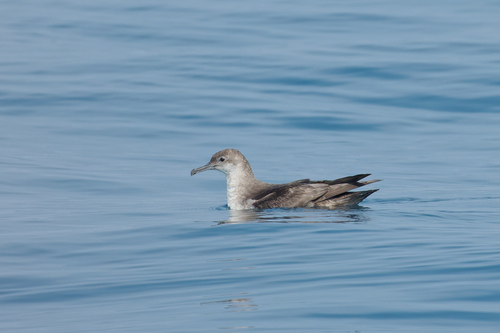 Balearic Shearwater
 Barolo Shearwater
In short
Barolo Shearwater is distinctly smaller and more compact than Balearic Shearwater, with a pale face, dark eye, and a silvery upperwing panel that stands out in flight—especially on younger birds. Balearic is larger, longer-winged, and overall duskier, lacking Barolo’s crisp contrasts and silvery wing panel. Both species can look superficially similar at a distance, but careful attention to size, wing shape, and face pattern will separate them. Age-specific upperwing patterns are key in flight, while perched birds can be separated by facial and structural features.
Identification tips
- Upperwing panel (juvenile/immature Barolo): Look for a silvery panel on the upperwing in flight—diagnostic for Barolo and never shown by Balearic.
- Face pattern: Barolo has a pale face with a sharply contrasting dark eye; Balearic’s face is duskier and less defined, blending into the crown and upperparts.
- Overall contrast: Barolo is more crisply marked, with clear dark-and-light contrasts, while Balearic is generally duskier, with less contrast between upperparts and underparts.
- Size and structure: Balearic is larger, with a longer body and wings; Barolo is small, compact, with shorter, rounder wings—especially obvious in direct comparison or with other seabirds for scale.
- Wing shape in flight: Barolo’s wings are shorter and more rounded, giving a quicker, more fluttery flight; Balearic’s wings are longer, narrower, and held stiffly, with fewer wingbeats.
- Underpart coloration: Balearic has dirty white underparts that often look sullied or brownish, while Barolo’s underparts are cleaner and whiter, accentuating the contrast with the darker upperparts.
- Blue feet (Barolo): Barolo has blue feet, which may be glimpsed when landing or taking off, but this is rarely visible in the field.
- Habitat and range: If seen in the Mediterranean, Balearic is far more likely; in Macaronesian or adjacent Atlantic waters, Barolo is expected. Out-of-range records should be scrutinized carefully.
- Perched views: On land or close views, Barolo’s pale face and smaller size are clear; Balearic appears bulkier and duskier.
- Mixed flocks: If seen with Manx or other Puffinus, compare directly—Barolo will be the smallest, with the most contrasting face and wing panel; Balearic will be larger and more uniformly brown.
- Age-specific marks: The silvery upperwing panel is most obvious in juvenile and immature Barolo; adults may show it less distinctly but still more than Balearic.
- Flight jizz: Barolo’s flight is more agile and fluttery, while Balearic is steadier and more gliding.
- Pitfalls: Distant or poor-light views can make Balearic look paler or Barolo duskier; always look for the silvery wing panel and face pattern when possible.
- Plumage overlap: Both can look superficially similar to Manx or Yelkouan Shearwater, but the combination of size, face, and wing panel is unique to Barolo among these two.
- No reliable vocal field marks: Calls are rarely heard at sea and not diagnostic in the field for separation of these two.
Size
Balearic Shearwater is a medium-sized shearwater (34–39 cm length, 78–90 cm wingspan) [wikipedia], noticeably larger and longer-winged than Barolo Shearwater, which is a small, compact species [wikipedia]. Barolo’s shorter, rounder wings and smaller body are apparent in direct comparison, especially when seen together or with other Puffinus species for scale.
Plumage
Juvenile and immature Barolo Shearwaters show a distinctive silvery panel on the upperwing, which is visible in flight and contrasts with the rest of the upperparts. This mark is absent in Balearic Shearwater of all ages, which instead shows less contrast overall, with dark brown upperparts and dirty white underparts. Barolo also has a pale face with a dark, contrasting eye, while Balearic’s face is duskier and blends more with the rest of the upperparts. In all plumages, Balearic appears more uniformly brown above and below, lacking the crisp contrasts and silvery highlights of Barolo.
Behaviour
Both species exhibit the typical 'shearing' flight style of Puffinus, but Balearic Shearwater flies with longer, stiffer wings and often appears more languid, with fewer wingbeats and a tendency to fly low over the water. Barolo, being smaller and with shorter, rounder wings, appears more fluttery and agile, with quicker wingbeats. Barolo is more likely to show blue feet when landing or taking off, though this is rarely visible at sea.
Habitat
Balearic Shearwater is a Mediterranean species, while Barolo Shearwater breeds in the Azores and Canaries of Macaronesia in the North Atlantic [wikipedia]. Overlap at sea is rare, but possible in the eastern Atlantic. Context of location can be a strong clue: Balearic is unlikely far from the Mediterranean, while Barolo is tied to Macaronesian waters.