

Austral Rail vs Plumbeous Rail
Rallus antarcticus versus Pardirallus sanguinolentus
Play a quiz with Austral Rail and Plumbeous Rail
 Austral Rail
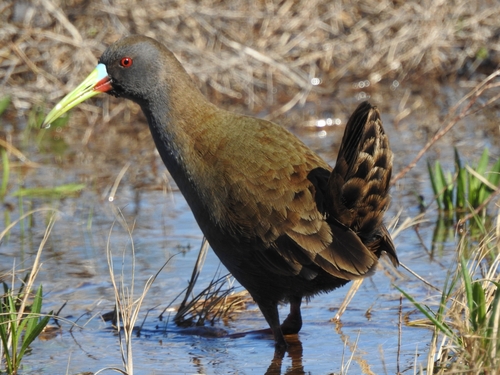 Plumbeous Rail
In short
The most reliable field mark to separate Austral Rail from Plumbeous Rail is size: Plumbeous Rail is much larger and heavier, with a noticeably longer body and bill. For plumage, Austral Rail adults show buff-edged black centers on the back feathers and bold black-and-white flank barring, while Plumbeous Rail is plainer gray below and lacks strong flank barring. Juvenile Austral Rails have sooty-tipped breast feathers and a white throat, which is not matched by any Plumbeous Rail age. In the field, focus on overall size, bill color, and the pattern of the flanks and upperparts for the best separation.
Identification tips
- Size is the fastest check: Plumbeous Rail is nearly twice the length of Austral Rail and much heavier. If the bird looks large and robust for a rail, it's almost certainly Plumbeous.
- Juvenile Austral Rail is unique: Look for sooty-tipped breast feathers and a white throat in juveniles—Plumbeous Rail juveniles do not show these marks.
- Flank barring: Austral Rail (all ages) has bold black-and-white barring on the flanks, while Plumbeous Rail has plain or only faintly marked flanks.
- Back pattern: Austral Rail has buff-edged black centers to the back feathers, giving a streaked effect. Plumbeous Rail's upperparts are mottled brown (nominate) or plain olive-brown (some subspecies), lacking the crisp buff-edged centers.
- Face and throat color: Both have gray faces, but Austral Rail's throat is gray (adults) or white (juveniles), while Plumbeous Rail's is always plain gray.
- Bill color: Plumbeous Rail has a green bill with a sky blue base and bright red mandible (except P. s. luridus), which can be striking in good light. Austral Rail's bill is not described as colorful.
- Underparts: Plumbeous Rail is plain gray below (with some subspecies paler), while Austral Rail is olive-brown on the breast and barred on the flanks.
- Leg and eye color: Plumbeous Rail has red eyes and legs, which can be seen at close range. Austral Rail's leg and eye color are not described as distinctive.
- Geographic range: Outside Argentina and Chile, a rail matching these descriptions is almost certainly Plumbeous Rail.
- Subspecies variation in Plumbeous Rail: Some subspecies (e.g., P. s. luridus) lack mottling and are paler below, but none match the barred flanks or back pattern of Austral Rail.
- Behavior: Both are secretive, but Plumbeous Rail may appear less delicate due to its size.
- Habitat: Both use wetlands; habitat is not a reliable separator within their shared range.
- Flight views: No distinctive upperwing or flight pattern marks are described for either species, so focus on size and body pattern.
- Sexes alike: In both species, males and females look similar; do not rely on sex differences.
- Season: No strong seasonal plumage changes are described for either species; age is more important than season for identification.
Size
Size is a decisive difference: Austral Rail is about 20 cm (7.9 in) long, while Plumbeous Rail is much larger at 30–38 cm (12–15 in) and 170–230 g (6.0–8.1 oz) [wikipedia]. Even at a distance, Plumbeous Rail appears bulkier and longer-bodied, with a proportionally longer bill. If you see two rails together, the size gap is obvious; if alone, use the bird's scale against reeds or water edges for context.
Plumage
Juvenile Austral Rails are distinctive, with sooty tips on the breast feathers and a white throat—features not seen in any Plumbeous Rail age. Adult Austral Rails have dull brown upperparts with buff-edged black centers on the back, a gray face and throat, olive-brown breast, and bold black-and-white barring on the flanks. Plumbeous Rail (nominate and most subspecies) has mottled brown upperparts, a plain gray face and underparts, and lacks strong flank barring. Some subspecies of Plumbeous Rail have olive-brown upperparts and paler gray underparts, but none show the Austral Rail's combination of barred flanks and buff-edged black back centers. Bill color is also a clue: Plumbeous Rail has a green bill with a sky blue base and bright red mandible (except in P. s. luridus), while Austral Rail's bill color is not described as distinctive.
Behaviour
Both species are rails and tend to be secretive, but there is little comparative information on foraging or movement. Plumbeous Rail is known to be sedentary in some regions and partially migratory in others, while Austral Rail's behavior is less well documented. In the field, both may be seen skulking in wetland vegetation, but Plumbeous Rail's larger size may make it appear more robust and less delicate in movement.
Habitat
Both species overlap in Argentina and Chile, but Plumbeous Rail has a much broader range, occurring in Bolivia, Brazil, Ecuador, Paraguay, Peru, and Uruguay as well [wikipedia]. Austral Rail is more restricted to southern South America. If you are outside Argentina or Chile, Plumbeous Rail is far more likely. Within overlapping areas, both occur in wetland habitats, so habitat alone is not diagnostic.