

Motmot

Atlantic Puffin vs Little Auk

Fratercula arctica versus Alle alle

Play a quiz with Atlantic Puffin and Little Auk
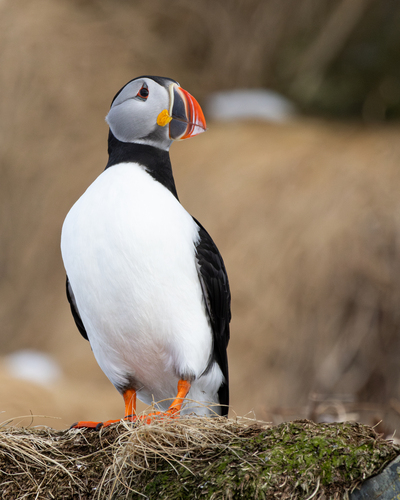
Atlantic Puffin (Fratercula arctica) Atlantic Puffin
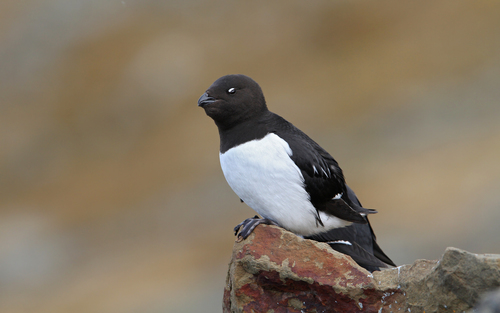
Little Auk (Alle alle) Little Auk

Media

Loading…

In short

The most reliable field mark separating Atlantic Puffin from Little Auk is size: Little Auk is about half the length and less than half the mass of Atlantic Puffin, appearing noticeably smaller even at a distance. In flight, Little Auk shows a compact, starling-sized shape with rapid wingbeats, while Atlantic Puffin is much bulkier with a larger head and heavier bill. Bill shape is also key: Atlantic Puffin has a large, deep, triangular bill (brightly colored in breeding adults), whereas Little Auk's bill is very short and stubby. Both species are black-and-white auks, but Little Auk lacks the colorful bill and facial pattern of Puffin and shows more extensive black on the head in breeding plumage. Confusion is most likely with immatures or distant birds in flight, but size and bill structure remain reliable.

Identification tips

  1. Size is the most immediate clue: Little Auk is about half the length and less than half the mass of Atlantic Puffin. If the bird looks starling-sized or smaller than a pigeon, it is a Little Auk; if it is pigeon-sized or larger, it is a Puffin. This applies to all ages and seasons.
  2. Bill shape and size: Atlantic Puffin has a large, deep, triangular bill (brightly colored in breeding adults, duller in winter/immature), while Little Auk has a very short, stubby, all-black bill. Even at a distance, Puffin's bill looks massive and distinctive; Little Auk's bill can appear almost absent.
  3. Facial pattern: Puffin shows a pale face with a dark eye mark and a large, colorful bill in breeding adults; Little Auk has a more uniformly dark face in breeding plumage, with no pale cheek or eye mark. In winter, Little Auk's lower face and fore neck become white, but the bill remains tiny and black.
  4. Flight jizz: Little Auk flies with rapid, whirring wingbeats and appears compact, almost like a starling or small thrush. Puffin's flight is heavier, with slower, deeper wingbeats, and it looks bulkier and less agile.
  5. White trailing edge to secondaries (Little Auk): In flight, Little Auk shows a white trailing edge to the secondaries, visible as a narrow white line on the wing. Puffin lacks this feature. This is a key mark for adults and immatures in flight.
  6. Bill color (breeding season): Puffin's bill is bright orange-red with a yellow and blue base in breeding adults; Little Auk's bill is always black. In non-breeding Puffins, the bill is duller but still large and deep.
  7. Body shape: Puffin is chunky and deep-chested with a large head and thick neck; Little Auk is compact, short-necked, and has a more rounded body.
  8. Tail shape: Both have short tails, but Little Auk's is described as small and rounded, while Puffin's is less distinctive.
  9. Plumage above and below: Both are black above and white below, but Puffin's pale face and colorful bill are unique. Little Auk is more uniformly black above, with a white belly and no pale face in breeding plumage.
  10. Habitat at breeding sites: Puffin breeds in burrows on grassy clifftops or among rocks, often seen standing upright at burrow entrances. Little Auk breeds in the high Arctic, nesting among rocks or scree, often in huge colonies.
  11. Flock size: Little Auk often forms large flocks at sea, especially in winter or during migration. Puffin is more often seen singly or in small groups.
  12. Context in winter: After storms, Little Auk may appear far south of its normal range, sometimes in large numbers ('wrecks'). Puffin is less likely to appear in such numbers away from breeding sites.
  13. Vocalizations: Only helpful at breeding colonies; Little Auk gives twittering and cackling calls, Puffin's calls are not described here.
  14. Pitfalls: Distant or backlit views can obscure bill color and face pattern; rely on size and bill shape. Immature Puffins have duller bills but are still much larger than Little Auk.
  15. When in doubt: If the bird looks tiny, with a short, stubby bill and rapid, whirring flight, it is almost certainly a Little Auk. If it looks large, chunky, with a massive bill and upright stance, it is a Puffin.

Size

Atlantic Puffin is substantially larger: it weighs about 376 g ([wikidata]), while Little Auk weighs only 130–200 g ([wikipedia]). Puffin is roughly twice as long (noted as 'half the size' for Little Auk), and has a much greater wingspan. In the field, Puffin appears chunky and pigeon-sized, whereas Little Auk is closer to a starling or small thrush. This difference is obvious when both are seen together, but even singly, Little Auk's small, compact jizz is distinctive compared to the robust, heavy look of Puffin.

Plumage

Juvenile and immature plumages are not described in detail for either species in the provided notes, but adults in breeding plumage are distinct. Little Auk in breeding plumage is black above (head, neck, back, wings) with white underparts, a white trailing edge to the secondaries, and white fringes on the scapulars. In winter, the lower face and fore neck turn white. Atlantic Puffin, in contrast, has a black back and white underparts as well, but the face is pale with a striking large, multicolored bill in adults during breeding, and a black collar. Puffin's bill is much larger and more triangular, and the face is pale with a dark eye mark, while Little Auk has a small, all-black bill and a more uniformly dark face in breeding plumage. In flight, Little Auk shows a white trailing edge to the secondaries, which can be a helpful mark, while Puffin lacks this feature. Both species have black upperparts and white underparts, but the facial pattern and bill are key.

Behaviour

Little Auk flies with very rapid, whirring wingbeats, appearing fast and agile, often in large flocks. Puffin's flight is more labored and direct, with slower, deeper wingbeats, and it appears heavier in the air. On land, Puffin is often seen standing upright near burrow entrances, while Little Auk is less often seen on land except at breeding colonies. Puffins are more solitary or in pairs when on land, while Little Auks can be seen in huge, dense colonies. At sea, Little Auk is more likely to be seen in flocks, Puffin singly or in small groups.

Habitat

Both species breed on islands and coastal cliffs in the North Atlantic, but Little Auk nests in the high Arctic, often on scree slopes or among rocks, in huge colonies. Atlantic Puffin breeds further south as well, on grassy clifftops or among rocks, often in burrows. In winter, Little Auk is found further north and is more likely to be seen near ice edges or coastlines, sometimes far offshore. Puffin is more widespread in the North Atlantic, including more southerly colonies. Little Auk may be seen in large flocks near shore in winter, especially after storms, while Puffin is more solitary at sea.

Voice

Little Auk produces a variety of twitters and cackling calls at breeding colonies but is silent at sea. Puffin vocalizations are not described in the provided notes. In the field, vocalizations are unlikely to be helpful for separation unless at a breeding colony.

Submit a better description

Use the same sections as the comparison. Your text is published immediately.

The most reliable field mark separating Atlantic Puffin from Little Auk is size: Little Auk is about half the length and less than half the mass of Atlantic Puffin, appearing noticeably smaller even at a distance. In flight, Little Auk shows a compact, starling-sized shape with rapid wingbeats, while Atlantic Puffin is much bulkier with a larger head and heavier bill. Bill shape is also key: Atlantic Puffin has a large, deep, triangular bill (brightly colored in breeding adults), whereas Little Auk's bill is very short and stubby. Both species are black-and-white auks, but Little Auk lacks the colorful bill and facial pattern of Puffin and shows more extensive black on the head in breeding plumage. Confusion is most likely with immatures or distant birds in flight, but size and bill structure remain reliable.

  1. Size is the most immediate clue: Little Auk is about half the length and less than half the mass of Atlantic Puffin. If the bird looks starling-sized or smaller than a pigeon, it is a Little Auk; if it is pigeon-sized or larger, it is a Puffin. This applies to all ages and seasons.
  2. Bill shape and size: Atlantic Puffin has a large, deep, triangular bill (brightly colored in breeding adults, duller in winter/immature), while Little Auk has a very short, stubby, all-black bill. Even at a distance, Puffin's bill looks massive and distinctive; Little Auk's bill can appear almost absent.
  3. Facial pattern: Puffin shows a pale face with a dark eye mark and a large, colorful bill in breeding adults; Little Auk has a more uniformly dark face in breeding plumage, with no pale cheek or eye mark. In winter, Little Auk's lower face and fore neck become white, but the bill remains tiny and black.
  4. Flight jizz: Little Auk flies with rapid, whirring wingbeats and appears compact, almost like a starling or small thrush. Puffin's flight is heavier, with slower, deeper wingbeats, and it looks bulkier and less agile.
  5. White trailing edge to secondaries (Little Auk): In flight, Little Auk shows a white trailing edge to the secondaries, visible as a narrow white line on the wing. Puffin lacks this feature. This is a key mark for adults and immatures in flight.
  6. Bill color (breeding season): Puffin's bill is bright orange-red with a yellow and blue base in breeding adults; Little Auk's bill is always black. In non-breeding Puffins, the bill is duller but still large and deep.
  7. Body shape: Puffin is chunky and deep-chested with a large head and thick neck; Little Auk is compact, short-necked, and has a more rounded body.
  8. Tail shape: Both have short tails, but Little Auk's is described as small and rounded, while Puffin's is less distinctive.
  9. Plumage above and below: Both are black above and white below, but Puffin's pale face and colorful bill are unique. Little Auk is more uniformly black above, with a white belly and no pale face in breeding plumage.
  10. Habitat at breeding sites: Puffin breeds in burrows on grassy clifftops or among rocks, often seen standing upright at burrow entrances. Little Auk breeds in the high Arctic, nesting among rocks or scree, often in huge colonies.
  11. Flock size: Little Auk often forms large flocks at sea, especially in winter or during migration. Puffin is more often seen singly or in small groups.
  12. Context in winter: After storms, Little Auk may appear far south of its normal range, sometimes in large numbers ('wrecks'). Puffin is less likely to appear in such numbers away from breeding sites.
  13. Vocalizations: Only helpful at breeding colonies; Little Auk gives twittering and cackling calls, Puffin's calls are not described here.
  14. Pitfalls: Distant or backlit views can obscure bill color and face pattern; rely on size and bill shape. Immature Puffins have duller bills but are still much larger than Little Auk.
  15. When in doubt: If the bird looks tiny, with a short, stubby bill and rapid, whirring flight, it is almost certainly a Little Auk. If it looks large, chunky, with a massive bill and upright stance, it is a Puffin.

Atlantic Puffin is substantially larger: it weighs about 376 g ([wikidata]), while Little Auk weighs only 130–200 g ([wikipedia]). Puffin is roughly twice as long (noted as 'half the size' for Little Auk), and has a much greater wingspan. In the field, Puffin appears chunky and pigeon-sized, whereas Little Auk is closer to a starling or small thrush. This difference is obvious when both are seen together, but even singly, Little Auk's small, compact jizz is distinctive compared to the robust, heavy look of Puffin.

Juvenile and immature plumages are not described in detail for either species in the provided notes, but adults in breeding plumage are distinct. Little Auk in breeding plumage is black above (head, neck, back, wings) with white underparts, a white trailing edge to the secondaries, and white fringes on the scapulars. In winter, the lower face and fore neck turn white. Atlantic Puffin, in contrast, has a black back and white underparts as well, but the face is pale with a striking large, multicolored bill in adults during breeding, and a black collar. Puffin's bill is much larger and more triangular, and the face is pale with a dark eye mark, while Little Auk has a small, all-black bill and a more uniformly dark face in breeding plumage. In flight, Little Auk shows a white trailing edge to the secondaries, which can be a helpful mark, while Puffin lacks this feature. Both species have black upperparts and white underparts, but the facial pattern and bill are key.

Little Auk flies with very rapid, whirring wingbeats, appearing fast and agile, often in large flocks. Puffin's flight is more labored and direct, with slower, deeper wingbeats, and it appears heavier in the air. On land, Puffin is often seen standing upright near burrow entrances, while Little Auk is less often seen on land except at breeding colonies. Puffins are more solitary or in pairs when on land, while Little Auks can be seen in huge, dense colonies. At sea, Little Auk is more likely to be seen in flocks, Puffin singly or in small groups.

Both species breed on islands and coastal cliffs in the North Atlantic, but Little Auk nests in the high Arctic, often on scree slopes or among rocks, in huge colonies. Atlantic Puffin breeds further south as well, on grassy clifftops or among rocks, often in burrows. In winter, Little Auk is found further north and is more likely to be seen near ice edges or coastlines, sometimes far offshore. Puffin is more widespread in the North Atlantic, including more southerly colonies. Little Auk may be seen in large flocks near shore in winter, especially after storms, while Puffin is more solitary at sea.

Little Auk produces a variety of twitters and cackling calls at breeding colonies but is silent at sea. Puffin vocalizations are not described in the provided notes. In the field, vocalizations are unlikely to be helpful for separation unless at a breeding colony.

Discard your changes?

You have unsaved edits. If you leave now, those changes will be lost.

Atlantic Puffin · Little Auk · My Tricky Birds