

Asian Koel vs Hodgson's Hawk-Cuckoo
Eudynamys scolopaceus versus Hierococcyx nisicolor
Play a quiz with Asian Koel and Hodgson's Hawk-Cuckoo
 Asian Koel
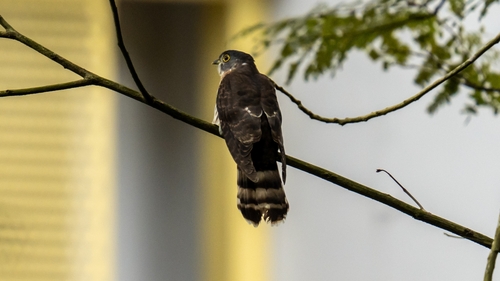 Hodgson's Hawk-Cuckoo
In short
The most reliable field mark for separating Asian Koel from Hodgson's Hawk-Cuckoo is overall size and structure: Asian Koel is a much larger, heavier, and longer-tailed bird, with males showing a glossy blue-black plumage and females heavily spotted and streaked, while Hodgson's Hawk-Cuckoo is smaller, slimmer, and hawk-like, with no glossy sheen and a more muted, barred appearance. Juvenile and immature birds of both species can be confusing, but Koel juveniles tend to resemble adult males (dark, with a black bill), whereas the hawk-cuckoo is always smaller and lacks the Koel's strong tail and bill. In flight or perched, focus on size, tail length, and overall jizz: Koel is crow-sized and languid, while Hodgson's Hawk-Cuckoo is much closer to a thrush or small raptor. Vocalizations are also very different, with Koel males giving a repeated, ringing 'koo-Ooo' and females a shrill 'kik-kik-kik', while Hodgson's Hawk-Cuckoo is known for its whistling calls. Habitat overlap exists, but Koel is more often seen in open woodlands and gardens, while Hodgson's Hawk-Cuckoo favors denser forests.
Identification tips
- Size is the most immediate clue: Asian Koel is nearly crow-sized and much heavier than Hodgson's Hawk-Cuckoo, which is about the size of a thrush or small hawk. Use nearby birds for scale if possible.
- Tail length and shape: Koel has a long, broad, and often slightly rounded tail, especially obvious in flight or when perched. Hodgson's Hawk-Cuckoo has a shorter, more hawk-like tail.
- Bill structure: Koel's bill is pale greenish (in adult males), thick, and slightly downcurved; in juveniles, it's black. Hodgson's Hawk-Cuckoo has a finer, more raptor-like bill, lacking the Koel's bulk.
- Male Koel plumage: Glossy blue-black all over, with a pale bill and crimson eyes. No other large cuckoo in the region matches this combination. Hodgson's Hawk-Cuckoo never shows gloss or such deep black.
- Female Koel plumage: Brownish with rufous streaks on the head, dark brown back and wings with white and buff spots, and heavily streaked whitish underparts. Hodgson's Hawk-Cuckoo is more evenly barred or streaked, lacking the Koel's strong spotting and rufous tones.
- Juvenile Koel: Resembles adult male but with a black bill; still larger and darker than any hawk-cuckoo. Juvenile hawk-cuckoos are smaller, slimmer, and never glossy.
- Flight jizz: Koel flies with slow, deep wingbeats and a languid, crow-like manner. Hodgson's Hawk-Cuckoo is quicker, more agile, and hawk-like in flight.
- Perched posture: Koel often sits upright and bulky, sometimes in the open. Hawk-cuckoo perches more horizontally, with a slimmer profile.
- Vocalizations: Koel's loud, ringing 'koo-Ooo' (male) and shrill 'kik-kik-kik' (female) are unique and diagnostic. Hawk-cuckoo's whistling calls are very different; if you hear a classic Koel song, it is not a hawk-cuckoo.
- Habitat context: Koel is common in gardens, parks, and open woodlands, often near human habitation. Hawk-cuckoo is more likely in dense forest or forest edge.
- Iris color: Adult Koel has crimson eyes, which can be a useful mark at close range. Hawk-cuckoo does not have this feature.
- Bill color in age/sex: Koel males have a pale greenish bill, females and juveniles have a black bill. Hawk-cuckoo's bill is always more raptor-like and never pale greenish.
- No detailed upperwing pattern: Neither species has a distinctive juvenile or immature upperwing pattern described in the sources, so rely on size, tail, and overall coloration.
- Behavior: Koel is often more conspicuous and vocal, while hawk-cuckoo is secretive and less likely to be seen in the open.
- Pitfalls: Female and juvenile Koels can be confused with other large cuckoos, but their size, tail, and heavy spotting/streaking set them apart from the more evenly barred and smaller hawk-cuckoo.
Size
Asian Koel is dramatically larger, measuring 39–46 cm in length and weighing 190–327 g [wikipedia], compared to Hodgson's Hawk-Cuckoo at just 81 g [wikidata]. Koel is nearly crow-sized, with a long, broad tail, while Hodgson's Hawk-Cuckoo is closer to a thrush or small hawk in size and bulk. This size difference is evident even at a distance, especially in flight or when perched side by side with common birds for scale.
Plumage
Juvenile and immature Asian Koels resemble adult males, being mostly dark with a black beak, while adult males are glossy blue-black with a pale greenish bill and crimson eyes. Females are brownish above, with rufous streaks on the head, dark brown back and wings with white and buff spots, and heavily streaked whitish underparts. In contrast, Hodgson's Hawk-Cuckoo lacks any glossy or iridescent tones; its plumage is more muted, with barred or streaked patterns typical of hawk-cuckoos. The Koel's tail is longer and more prominent, while the hawk-cuckoo's tail and wings are proportionally shorter and more hawk-like. No detailed age-specific upperwing pattern is described for either species, but the Koel's overall coloration (especially in males) is much darker and glossier than the hawk-cuckoo's. The hawk-cuckoo's underwing displays gape-colored patches (in chicks), but this is not a field mark for older birds.
Behaviour
Asian Koel is often conspicuous, vocal, and active in fruiting trees or open areas, moving with a slow, direct flight and perching in the open. Hodgson's Hawk-Cuckoo is more secretive, often staying within denser forest cover and moving with a more hawk-like, agile flight. Both are brood parasites, but this is not a field mark for the observer.
Habitat
Both species can occur in overlapping regions of South and Southeast Asia, but Asian Koel is more commonly found in open woodlands, gardens, and near human habitation, while Hodgson's Hawk-Cuckoo prefers denser forests and less disturbed habitats. Koel is more likely to be seen in urban and semi-urban settings, whereas the hawk-cuckoo is usually deeper in woodland or forest edge.
Voice
Asian Koel males give a loud, ringing 'koo-Ooo' call, often repeated, and females emit a shrill 'kik-kik-kik' series. These calls are distinctive and frequently heard during the breeding season. Hodgson's Hawk-Cuckoo is known for its whistling calls, which are very different in tone and pattern from the Koel's. If you hear the classic Koel song, it is diagnostic for that species.