

Asian Dowitcher vs Long-billed Dowitcher
Limnodromus semipalmatus versus Limnodromus scolopaceus
Play a quiz with Asian Dowitcher and Long-billed Dowitcher
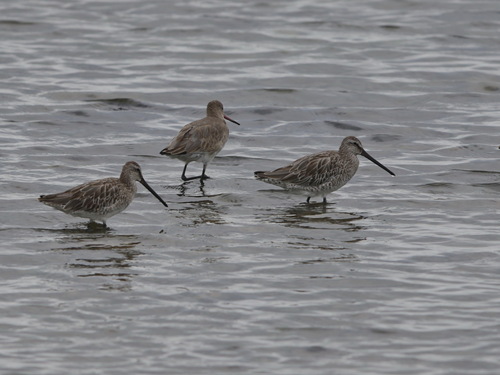 Asian Dowitcher
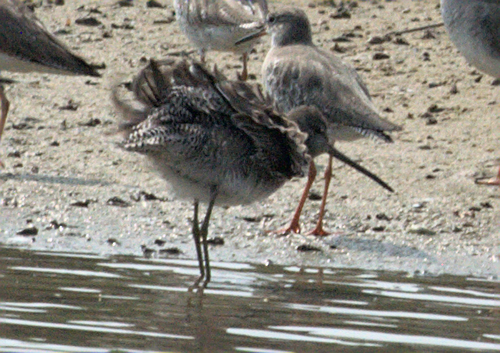 Long-billed Dowitcher
In short
The most reliable field mark between Asian Dowitcher and Long-billed Dowitcher is the presence of a large, bright white rump and uppertail visible in flight on Long-billed Dowitcher of all ages, a feature lacking in Asian Dowitcher. Juvenile and adult Asian Dowitchers never show this white rump patch, instead displaying a more evenly barred black-and-white tail. Structurally, Asian Dowitcher is notably heavier and larger-bodied, with a shorter bill relative to head length, and has dark legs compared to the yellowish legs of Long-billed. Breeding plumage differences are subtle but Asian Dowitcher is more reddish below and browner above, while Long-billed is rufous with a darker, mottled back. Winter and juvenile plumages are very similar, so flight views and structural clues are critical. Calls and habitat context can help, but visual marks are most reliable.
Identification tips
- White rump in flight: Only Long-billed Dowitcher (all ages) shows a large, bright white rump and uppertail extending up the back in flight. Asian Dowitcher never shows this feature; its tail is evenly barred black and white.
- Tail pattern (perched): Long-billed’s tail has black bars about twice as wide as the white; Asian’s tail is more evenly barred.
- Bill length and structure: Asian Dowitcher’s bill is long and straight but shorter than Long-billed’s, which is about twice the length of the head. This is best judged in direct comparison or with experience.
- Leg color: Asian Dowitcher has dark legs; Long-billed Dowitcher’s legs are yellowish to olive-green. This is subtle and can be obscured by mud.
- Body size and shape: Asian Dowitcher is much heavier and bulkier, with a more elongated appearance and longer legs. Long-billed is more compact and stocky.
- Breeding plumage (adults): Asian Dowitcher is brown above and reddish below; Long-billed is rufous on the head and underparts, with a darker, mottled back. Both have barred tails, but the rump pattern is diagnostic in flight.
- Juvenile plumage: Long-billed juveniles have chestnut-fringed upperparts and a gray breast with pale rufous lower belly; Asian Dowitcher juveniles are less well described but lack the white rump and are more evenly brown and gray.
- Winter/non-breeding plumage: Both species are gray above and paler below, making separation difficult. Use structure, leg color, and rump pattern in flight.
- Feeding behavior: Both species use a rapid 'sewing machine' motion, so this is not diagnostic between them.
- Habitat: Asian Dowitcher is more likely on coastal mudflats in Asia and Australasia; Long-billed Dowitcher prefers freshwater habitats in North America.
- Voice: Asian Dowitcher gives a yelping call; Long-billed Dowitcher gives a sharp 'keek' or 'peep'. Use with caution unless calls are clearly heard.
- Supercilium and loral stripe: Long-billed Dowitcher shows a whitish supercilium and dark loral stripe extending past the eye in all plumages; Asian Dowitcher’s head pattern is less distinct.
- Sex and age: Both species are sexually monomorphic; age differences are most apparent in flight pattern (white rump for Long-billed) and subtle plumage details.
- Pitfalls: In dull light or poor views, structure and rump pattern in flight are the most reliable marks. Winter and juvenile birds are especially challenging; prioritize flight views and size/bill structure.
- Context: In North America, Asian Dowitcher is extremely rare; in Asia, Long-billed Dowitcher is a vagrant. Always consider location and likelihood, but do not rely solely on range.
Size
Asian Dowitcher is substantially heavier (180 g vs 104 g) and appears bulkier and longer-legged in the field. Its bill is long and straight but shorter than Long-billed Dowitcher’s, which is about twice the length of the head and often appears proportionally longer. Asian Dowitcher’s overall size approaches that of a small godwit, whereas Long-billed Dowitcher is more compact and stocky.
Plumage
- Juvenile/first-year birds in flight: Long-billed Dowitcher of all ages shows a large, bright white rump and uppertail extending up the back, visible only in flight; Asian Dowitcher lacks this, showing a barred black-and-white tail without a white rump patch.
- Breeding plumage (adults): Asian Dowitcher is brown above and reddish below, with dark legs and a straight, dark bill. Long-billed Dowitcher is rufous on the head and underparts, with a darker, mottled back, and a distinctive white rump in flight. Both have barred tails, but the pattern differs: Long-billed’s tail has black bars twice as wide as the white, while Asian’s is more evenly barred.
- Non-breeding (winter) plumage: Both species become largely gray above and paler below, making separation difficult except by structure and flight pattern. Asian Dowitcher remains larger and darker-legged.
- Juvenile plumage: Long-billed Dowitcher juveniles have upperparts fringed chestnut, a uniformly gray breast, and a pale rufous lower belly; Asian Dowitcher juveniles are poorly described but lack the white rump and show a more even brown and gray appearance.
Behaviour
Both species feed with a rapid 'sewing machine' motion, probing mud or shallow water. Asian Dowitcher is more likely to be seen in coastal habitats during migration and winter, while Long-billed Dowitcher prefers freshwater wetlands. In flight, Asian Dowitcher appears heavier and longer-legged, while Long-billed is more compact and shows a striking white rump. Both species may be seen in flocks, but Asian Dowitcher is generally less gregarious.
Habitat
Asian Dowitcher breeds in inland grassy wetlands of Siberia and Manchuria, migrating to coastal areas in Southeast Asia and northern Australia. It is almost always found on coasts outside the breeding season. Long-billed Dowitcher breeds in northern Alaska and prefers freshwater habitats throughout the year, rarely venturing to marine coasts. Thus, finding a dowitcher on a coastal mudflat in Asia is more likely to be Asian Dowitcher, while freshwater marshes in North America favor Long-billed.
Voice
Asian Dowitcher gives a distinctive yelping call, while Long-billed Dowitcher’s flight call is a sharp, high-pitched 'keek' or 'peep'. Calls are useful in migration and winter when plumages are similar, but are not always heard in the field.