

Arabian Warbler vs Rüppell's Warbler
Curruca leucomelaena versus Curruca ruppeli
Play a quiz with Arabian Warbler and Rüppell's Warbler
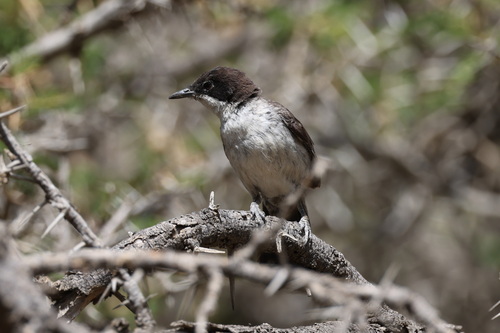 Arabian Warbler
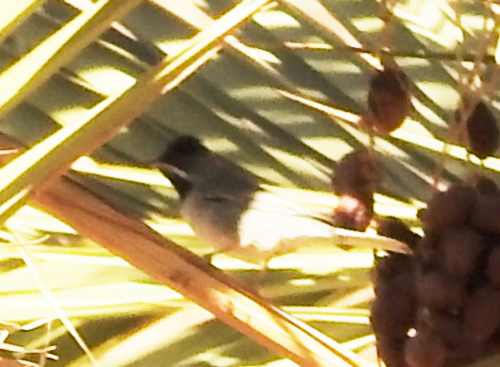 Rüppell's Warbler
In short
The most reliable field mark between Arabian Warbler and Rüppell's Warbler is the head and throat pattern in adult males: Arabian Warbler males show a blackish-brown hood and tail with a white eye-ring, while Rüppell's Warbler males have a striking black head and throat sharply divided by a white 'moustache' (malar streak). Females of both can be confusing, but Arabian Warbler females have a chocolate brown hood and tail and a less obvious eye-ring, whereas Rüppell's females have a greyer head and a paler throat. Arabian Warbler is larger and longer-tailed, often seen in dry acacia scrub, while Rüppell's is slimmer and breeds in Mediterranean scrub. Juvenile and immature plumages are not described in detail for either species, so adult male head pattern is the safest field mark. Structure and habitat can also help, but beware of overlap in dull females.
Identification tips
- Adult male head and throat pattern: Arabian Warbler males have a blackish-brown hood and tail with a white eye-ring; Rüppell's males have a black head and throat with a sharp white malar streak ('moustache'). This is the single most reliable mark in adult males.
- Female plumage: Female Arabian Warbler has a chocolate brown hood and tail and a less obvious eye-ring, while Rüppell's female is greyer-headed with a pale throat and a grey back with a brownish tinge. This is subtle and can be confusing in poor light.
- Tail structure and behavior: Arabian Warbler has a long, graduated tail that it often flicks downwards; Rüppell's has a shorter, less graduated tail and does not show the same tail-flicking behavior.
- Overall size and shape: Arabian Warbler is larger and bulkier with an upright posture; Rüppell's is slimmer and more delicate.
- Eye color: Rüppell's Warbler has red eyes (in adults), which can be a useful mark at close range; Arabian Warbler's eye-ring is white and more conspicuous in males.
- Upperparts color: Arabian Warbler is greyish-brown above; Rüppell's is plain grey with a brownish tinge (especially in females).
- Underparts: Both are pale grey below, but Arabian Warbler's throat is whitish and more sharply set off from the hood in males.
- Habitat: Arabian Warbler is almost always in dry acacia scrub or savanna; Rüppell's prefers Mediterranean scrub or maquis. Use habitat as a strong supporting clue.
- Song: Arabian Warbler's song is a short, melodious, thrush-like bubbling warble; Rüppell's is a slower, deeper rattle. Listen carefully if the bird is singing.
- Alarm call: Arabian Warbler gives quiet 'chack's; Rüppell's alarm call is not described here, so use with caution.
- Perched posture: Arabian Warbler often sits more upright than Rüppell's.
- Geographic range: Arabian Warbler is found in the Arabian Peninsula and northeast Africa; Rüppell's breeds in southeastern Europe and migrates to northeast Africa. Consider location, especially outside migration periods.
- Sexing pitfalls: Females and non-breeding birds are much harder to separate; rely on structure, tail, and habitat if head pattern is not clear.
- Immature/juvenile plumage: No diagnostic marks described for either species, so exercise caution with young birds.
- Mixed flocks: If both species are present (rare), focus on head pattern, tail length, and behavior for separation.
Size
Arabian Warbler is a notably large Curruca warbler, about 14.5 cm in length, with a long, graduated tail and upright posture. Rüppell's Warbler is similar in size to other Curruca warblers but slimmer than Sardinian Warbler, with a less prominent tail. In direct comparison, Arabian Warbler appears bulkier and longer-tailed, while Rüppell's is more slender overall.
Plumage
No detailed information is available for juvenile or immature upperwing patterns in either species, so separation relies on adult plumage.
- Adult male Arabian Warbler: blackish-brown hood and tail, white eye-ring, greyish-brown upperparts, whitish throat, pale grey underparts.
- Adult male Rüppell's Warbler: black head and throat, sharply divided by a white malar streak ('moustache'), plain grey back, paler grey underparts, red eyes.
- Female Arabian Warbler: chocolate brown hood and tail, less conspicuous eye-ring, otherwise similar to male.
- Female Rüppell's Warbler: grey head (not black), pale throat, grey back with brownish tinge.
The key difference is the head and throat pattern, especially in males. Females are more subtle but Arabian Warbler's brown tones and tail contrast with Rüppell's greyer, less contrasting look.
Behaviour
Arabian Warbler often perches upright and flicks its long, graduated tail downwards, a distinctive behavioral trait. It is typically found in acacia patches and dry savanna, often moving methodically through low trees and shrubs. Rüppell's Warbler behaves more like a typical Curruca warbler, moving quickly and actively through Mediterranean scrub, and does not show the same pronounced tail flicking. Both may sing from exposed perches, but Arabian Warbler is more likely to be seen in open, arid landscapes.
Habitat
Arabian Warbler is found in arid, dry savanna regions, especially in acacia-dominated habitats across the Arabian Peninsula and northeast Africa. Rüppell's Warbler breeds in Mediterranean scrub and maquis in southeastern Europe and migrates to northeast Africa for winter. If you are in dry acacia country in Arabia or northeast Africa, Arabian Warbler is much more likely; in Mediterranean scrub in Greece or Turkey, Rüppell's is expected. Habitat is a strong clue, but there is some overlap in wintering grounds.
Voice
Arabian Warbler's song is a short, melodious, thrush-like bubbling warble, usually delivered from an elevated perch. Its alarm call is a series of quiet 'chack's. Rüppell's Warbler has a slower, deeper rattle for its song, distinct from the Arabian's more musical warble. If you hear a rich, bubbling song, think Arabian; a slower, rattling song points to Rüppell's.