

Motmot

Arabian Scops Owl vs Eurasian Scops Owl

Otus pamelae versus Otus scops

Play a quiz with Arabian Scops Owl and Eurasian Scops Owl
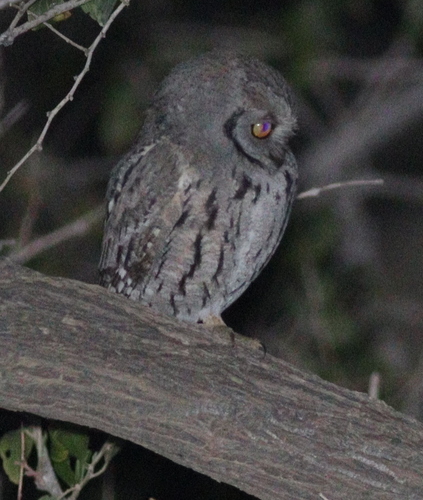
Arabian Scops Owl (Otus pamelae) Arabian Scops Owl
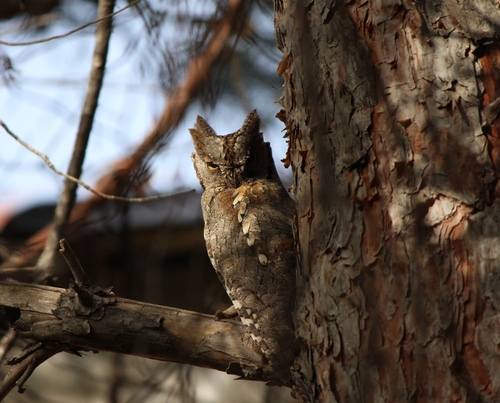
Eurasian Scops Owl (Otus scops) Eurasian Scops Owl

Media

Loading…

In short

Distinguishing Arabian Scops Owl from Eurasian Scops Owl in the field is challenging, as both are small, upright-perching owls with ear-tufts and similar overall coloration. The most reliable separation in the field is by range and context: Arabian Scops Owl is restricted to the Arabian Peninsula, while Eurasian Scops Owl is widespread across Europe and Asia and migratory. In direct comparison, Eurasian Scops Owl is slightly larger with longer, narrower wings suited for migration, and has a paler face and underparts. Vocalizations are also distinct, with Eurasian Scops Owl giving a deep, toad-like whistle. Age-specific wing pattern differences are not detailed in the sources, so focus on structure, context, and subtle plumage cues.

Identification tips

  1. Range is diagnostic: Arabian Scops Owl is only found in Saudi Arabia, Oman, and Yemen. Eurasian Scops Owl is never reliably found in Arabia, but is widespread in Europe and Asia.
  2. Size and structure: Eurasian Scops Owl is slightly larger with longer, narrower wings. Look for a more elongated, migratory 'jizz' in flight, but beware overlap and observer bias.
  3. Facial pattern: Eurasian Scops Owl shows a paler face and underparts, with a pale shoulder line. In good light, this contrast can be visible; Arabian Scops Owl is likely more uniformly colored.
  4. Ear-tufts: Both species have small ear-tufts, so this is not a useful separator.
  5. Perched posture: Both perch upright, but Eurasian Scops Owl may appear slightly more elongated due to wing length.
  6. Plumage tone: Eurasian Scops Owl is described as grey-brown; Arabian Scops Owl's coloration is less well described but is probably similar. Use caution with color-based IDs in poor light.
  7. Flight style: Eurasian Scops Owl has a strong, direct flight on long wings; Arabian Scops Owl may appear less powerful, but this is subtle.
  8. Vocalization: Eurasian Scops Owl's deep, toad-like whistle is distinctive. If you hear this call in Europe or Asia, it's diagnostic. Arabian Scops Owl's call is not described, so do not rely on voice in Arabia.
  9. Habitat context: In Arabia, any scops owl is almost certainly Arabian Scops Owl. In Europe or Asia, Eurasian Scops Owl is the default.
  10. No age-specific wing pattern: Neither species is described as having distinctive juvenile or immature wing marks, so do not rely on this for separation.
  11. Seasonal context: Eurasian Scops Owl is migratory; if seen in Africa south of the Sahara in winter, it is Eurasian. Arabian Scops Owl is resident year-round in its limited range.
  12. Population context: Arabian Scops Owl is much less numerous and more localized; Eurasian Scops Owl is widespread and common in its range.
  13. Pitfalls: Do not rely on size or color alone, as overlap and lighting can mislead. Always consider location first.
  14. Sex and age: No sexual dimorphism or age-specific marks are described for either species, so these are not useful for separation.
  15. Checklist approach: In Arabia, assume Arabian Scops Owl unless proven otherwise. Elsewhere, Eurasian Scops Owl is the default. Use plumage and structure only as supporting evidence.

Size

Eurasian Scops Owl is marginally larger, measuring 19–21 cm in length with a wingspan of 47–54 cm [wikipedia]. Arabian Scops Owl is described as small, but no precise measurements are provided; it is likely similar but perhaps slightly smaller. In hand or with excellent views, Eurasian Scops Owl may appear longer-winged and a bit bulkier, reflecting its migratory lifestyle. For most observers, these size differences will be subtle and not always reliable in isolation.

Plumage

No detailed age-specific wing or flight pattern differences are provided for either species. Both show grey-brown plumage with small ear-tufts and upright posture. Eurasian Scops Owl is noted for a paler face, underparts, and a pale shoulder line, which can be a useful field mark in good light. Arabian Scops Owl is not described in detail, but is likely more uniformly colored overall. In perched birds, look for the contrast between the pale face and darker crown/ear-tufts in Eurasian Scops Owl. No mention is made of distinctive juvenile or immature wing patterns for either species, so these are not diagnostic.

Behaviour

Both species perch upright and are typically seen singly or in pairs. Eurasian Scops Owl is described as having a strong, direct flight on long, narrow wings, a feature associated with its migratory habits. Arabian Scops Owl, being non-migratory and endemic to the Arabian Peninsula, may show less pronounced wing length and a less powerful flight, but this is not explicitly described. Both are nocturnal and secretive, often roosting in dense cover during the day.

Habitat

Arabian Scops Owl is endemic to Saudi Arabia, Oman, and Yemen, and is not found outside the Arabian Peninsula. Eurasian Scops Owl breeds across southern Europe, southern Siberia, and the western Himalayas, and winters in sub-Saharan Africa, with some populations resident in the Mediterranean. Thus, geographic location is often the most reliable clue: any scops owl seen in Arabia is almost certainly Arabian Scops Owl, while those in Europe or Asia are Eurasian Scops Owl. Overlap is not expected.

Voice

Eurasian Scops Owl gives a deep, repetitive whistle reminiscent of midwife toads (Alytes), and both sexes call. No vocal description is provided for Arabian Scops Owl, but the Eurasian's distinctive call is a key field mark in its range. In areas where both might be considered, voice could be diagnostic, but in practice, range is more important.

Submit a better description

Use the same sections as the comparison. Your text is published immediately.

Distinguishing Arabian Scops Owl from Eurasian Scops Owl in the field is challenging, as both are small, upright-perching owls with ear-tufts and similar overall coloration. The most reliable separation in the field is by range and context: Arabian Scops Owl is restricted to the Arabian Peninsula, while Eurasian Scops Owl is widespread across Europe and Asia and migratory. In direct comparison, Eurasian Scops Owl is slightly larger with longer, narrower wings suited for migration, and has a paler face and underparts. Vocalizations are also distinct, with Eurasian Scops Owl giving a deep, toad-like whistle. Age-specific wing pattern differences are not detailed in the sources, so focus on structure, context, and subtle plumage cues.

  1. Range is diagnostic: Arabian Scops Owl is only found in Saudi Arabia, Oman, and Yemen. Eurasian Scops Owl is never reliably found in Arabia, but is widespread in Europe and Asia.
  2. Size and structure: Eurasian Scops Owl is slightly larger with longer, narrower wings. Look for a more elongated, migratory 'jizz' in flight, but beware overlap and observer bias.
  3. Facial pattern: Eurasian Scops Owl shows a paler face and underparts, with a pale shoulder line. In good light, this contrast can be visible; Arabian Scops Owl is likely more uniformly colored.
  4. Ear-tufts: Both species have small ear-tufts, so this is not a useful separator.
  5. Perched posture: Both perch upright, but Eurasian Scops Owl may appear slightly more elongated due to wing length.
  6. Plumage tone: Eurasian Scops Owl is described as grey-brown; Arabian Scops Owl's coloration is less well described but is probably similar. Use caution with color-based IDs in poor light.
  7. Flight style: Eurasian Scops Owl has a strong, direct flight on long wings; Arabian Scops Owl may appear less powerful, but this is subtle.
  8. Vocalization: Eurasian Scops Owl's deep, toad-like whistle is distinctive. If you hear this call in Europe or Asia, it's diagnostic. Arabian Scops Owl's call is not described, so do not rely on voice in Arabia.
  9. Habitat context: In Arabia, any scops owl is almost certainly Arabian Scops Owl. In Europe or Asia, Eurasian Scops Owl is the default.
  10. No age-specific wing pattern: Neither species is described as having distinctive juvenile or immature wing marks, so do not rely on this for separation.
  11. Seasonal context: Eurasian Scops Owl is migratory; if seen in Africa south of the Sahara in winter, it is Eurasian. Arabian Scops Owl is resident year-round in its limited range.
  12. Population context: Arabian Scops Owl is much less numerous and more localized; Eurasian Scops Owl is widespread and common in its range.
  13. Pitfalls: Do not rely on size or color alone, as overlap and lighting can mislead. Always consider location first.
  14. Sex and age: No sexual dimorphism or age-specific marks are described for either species, so these are not useful for separation.
  15. Checklist approach: In Arabia, assume Arabian Scops Owl unless proven otherwise. Elsewhere, Eurasian Scops Owl is the default. Use plumage and structure only as supporting evidence.

Eurasian Scops Owl is marginally larger, measuring 19–21 cm in length with a wingspan of 47–54 cm [wikipedia]. Arabian Scops Owl is described as small, but no precise measurements are provided; it is likely similar but perhaps slightly smaller. In hand or with excellent views, Eurasian Scops Owl may appear longer-winged and a bit bulkier, reflecting its migratory lifestyle. For most observers, these size differences will be subtle and not always reliable in isolation.

No detailed age-specific wing or flight pattern differences are provided for either species. Both show grey-brown plumage with small ear-tufts and upright posture. Eurasian Scops Owl is noted for a paler face, underparts, and a pale shoulder line, which can be a useful field mark in good light. Arabian Scops Owl is not described in detail, but is likely more uniformly colored overall. In perched birds, look for the contrast between the pale face and darker crown/ear-tufts in Eurasian Scops Owl. No mention is made of distinctive juvenile or immature wing patterns for either species, so these are not diagnostic.

Both species perch upright and are typically seen singly or in pairs. Eurasian Scops Owl is described as having a strong, direct flight on long, narrow wings, a feature associated with its migratory habits. Arabian Scops Owl, being non-migratory and endemic to the Arabian Peninsula, may show less pronounced wing length and a less powerful flight, but this is not explicitly described. Both are nocturnal and secretive, often roosting in dense cover during the day.

Arabian Scops Owl is endemic to Saudi Arabia, Oman, and Yemen, and is not found outside the Arabian Peninsula. Eurasian Scops Owl breeds across southern Europe, southern Siberia, and the western Himalayas, and winters in sub-Saharan Africa, with some populations resident in the Mediterranean. Thus, geographic location is often the most reliable clue: any scops owl seen in Arabia is almost certainly Arabian Scops Owl, while those in Europe or Asia are Eurasian Scops Owl. Overlap is not expected.

Eurasian Scops Owl gives a deep, repetitive whistle reminiscent of midwife toads (Alytes), and both sexes call. No vocal description is provided for Arabian Scops Owl, but the Eurasian's distinctive call is a key field mark in its range. In areas where both might be considered, voice could be diagnostic, but in practice, range is more important.

Discard your changes?

You have unsaved edits. If you leave now, those changes will be lost.

Arabian Scops Owl · Eurasian Scops Owl · My Tricky Birds