

Motmot

Andean Flamingo vs James's Flamingo

Phoenicoparrus andinus versus Phoenicoparrus jamesi

Play a quiz with Andean Flamingo and James's Flamingo
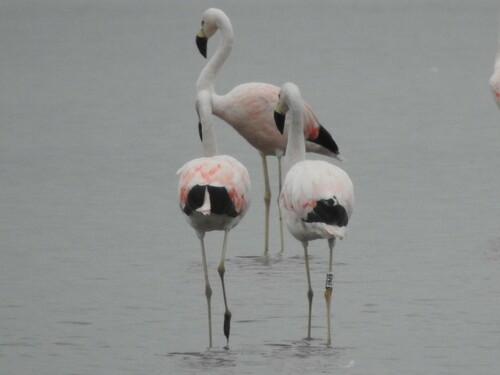
Andean Flamingo (Phoenicoparrus andinus) Andean Flamingo
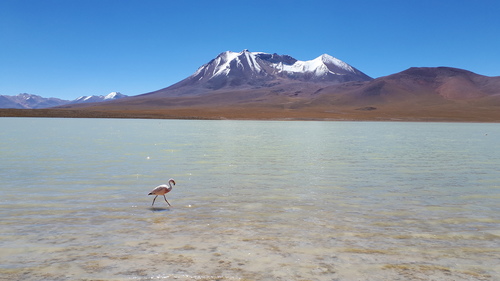
James's Flamingo (Phoenicoparrus jamesi) James's Flamingo

Media

Loading…

In short

The most reliable field mark to separate Andean Flamingo from James's Flamingo is leg color: Andean Flamingo has yellow legs, while James's Flamingo shows brick red legs. In flight or at rest, Andean Flamingo also shows a much larger and bolder black triangle on the wing (from the black primaries and secondaries) than James's, where only a small amount of black is visible when perched. Andean Flamingo is notably larger and heavier, with a deeper, more downcurved bill that is mostly black, compared to the smaller, lighter James's Flamingo with a bright yellow bill tipped black. Both species are pale pink overall, but Andean Flamingo has brighter pink on the lower neck and chest, while James's is paler with carmine streaks. Juvenile Andean Flamingos are uniformly pale gray, while young James's are gray or white, but both lack the adult pink tones. The two species often occur together, so careful attention to leg color and bill pattern is essential.

Identification tips

  1. Leg color is the most reliable field mark: Andean Flamingo has yellow legs, while James's Flamingo has brick red legs. This is visible both in flight and when standing.
  2. Size: Andean Flamingo is much larger and bulkier than James's Flamingo. In mixed flocks, Andean towers over James's.
  3. Bill shape and color: Andean Flamingo's bill is deeper, more downcurved, and mostly black with only the base pale yellow. James's Flamingo has a thinner, shorter bill that is bright yellow with a black tip.
  4. Wing pattern in flight and at rest: Andean Flamingo shows a bold, extensive black triangle on the closed wing (black primaries and secondaries), easily visible when perched or flying. James's Flamingo shows only a small amount of black in the wings when perched.
  5. Plumage tone: Andean Flamingo is pale pink overall, but with much brighter pink on the lower neck, breast, and wing coverts; the rest of the body can appear almost white. James's Flamingo is very pale pink with carmine streaks around the neck and back.
  6. Juvenile plumage: Juvenile Andean Flamingos are uniformly pale gray (sometimes duskier on the head/neck), with darker brown centers to coverts and scapulars. Juvenile James's Flamingos are gray or white, lacking pink until 2–3 years old. Both can be tricky, but Andean's duskier tones and brownish coverts may help.
  7. Feet: Both have three toes and lack a hallux (rear toe), which separates them from other flamingos, but not from each other.
  8. Eye region: James's Flamingo has bright red skin around the eyes and yellow irises in adults. This is less prominent in Andean Flamingo.
  9. Head and neck color: Andean Flamingo's head and upper neck are brighter pink than the rest of the body, but never as bright as the lower neck and breast. James's Flamingo shows carmine streaks around the neck.
  10. Bill depth: Andean Flamingo's bill is noticeably deeper and more robust, especially at the lower mandible, compared to the slender bill of James's Flamingo.
  11. Context: Both species often occur together in the same habitat, so do not rely on location alone.
  12. Sexes: No sexual dimorphism in plumage or size is noted for either species, so all marks apply to both sexes.
  13. Season: No strong seasonal variation in field marks is described for either species, but molt timing may affect brightness of pink tones.
  14. Pitfalls: In poor light, leg color may be hard to judge; rely on size, bill, and wing pattern as backup. Immature birds can be especially confusing—look for subtle differences in gray/brown tones and structure.
  15. Mixed flocks: When both species are present, compare individuals directly for size, leg color, and bill pattern—these are the most consistent separators.

Size

Andean Flamingo is the largest flamingo in the Andes, standing 1–1.4 m tall and weighing 1.5–4.9 kg, with a wingspan of 1.4–1.6 m [wikipedia]. James's Flamingo is much smaller, about 90–92 cm tall and around 2 kg in weight [wikipedia]. In the field, Andean Flamingo will appear taller, heavier-bodied, and bulkier next to the more delicate, slender James's Flamingo.

Plumage

Juvenile Andean Flamingos are uniformly pale gray, sometimes duskier on the head and neck, with darker brown centers to coverts and scapulars. Juvenile James's Flamingos are gray or white, acquiring pink tones only after 2–3 years. In adults, Andean Flamingo is overall pale pink, but with much brighter pink on the lower neck, breast, and wing coverts; the head and upper neck are also brighter pink but never as intense as the lower neck. The rest of the body can appear almost white. The key in flight is the bold, extensive black triangle on the closed wing (from black primaries and secondaries), which is much more prominent than in James's Flamingo. James's Flamingo adults are very pale pink with bright carmine streaks around the neck and on the back. When perched, only a small amount of black is visible in the wings (flight feathers), not the large black triangle of Andean. Both have three-toed feet with no hallux, but leg color is diagnostic: yellow in Andean, brick red in James's. Bill color also differs: Andean's bill is pale yellow at the base but mostly black, while James's is bright yellow with a black tip.

Behaviour

Both species are filter feeders, often foraging together in shallow, salty Andean lakes. Andean Flamingo has the most flexible foraging pattern and may adopt the feeding style of whichever species it is grouped with (James's or Chilean). James's Flamingo has a long, flexible neck and similar feeding behaviors. No major behavioral differences are noted in the sources for field separation.

Habitat

Both species inhabit high-altitude Andean plateaus and saline lakes of Peru, Chile, Bolivia, and northwest Argentina. They often occur together in mixed flocks. Habitat is not a reliable separator between the two.

Submit a better description

Use the same sections as the comparison. Your text is published immediately.

The most reliable field mark to separate Andean Flamingo from James's Flamingo is leg color: Andean Flamingo has yellow legs, while James's Flamingo shows brick red legs. In flight or at rest, Andean Flamingo also shows a much larger and bolder black triangle on the wing (from the black primaries and secondaries) than James's, where only a small amount of black is visible when perched. Andean Flamingo is notably larger and heavier, with a deeper, more downcurved bill that is mostly black, compared to the smaller, lighter James's Flamingo with a bright yellow bill tipped black. Both species are pale pink overall, but Andean Flamingo has brighter pink on the lower neck and chest, while James's is paler with carmine streaks. Juvenile Andean Flamingos are uniformly pale gray, while young James's are gray or white, but both lack the adult pink tones. The two species often occur together, so careful attention to leg color and bill pattern is essential.

  1. Leg color is the most reliable field mark: Andean Flamingo has yellow legs, while James's Flamingo has brick red legs. This is visible both in flight and when standing.
  2. Size: Andean Flamingo is much larger and bulkier than James's Flamingo. In mixed flocks, Andean towers over James's.
  3. Bill shape and color: Andean Flamingo's bill is deeper, more downcurved, and mostly black with only the base pale yellow. James's Flamingo has a thinner, shorter bill that is bright yellow with a black tip.
  4. Wing pattern in flight and at rest: Andean Flamingo shows a bold, extensive black triangle on the closed wing (black primaries and secondaries), easily visible when perched or flying. James's Flamingo shows only a small amount of black in the wings when perched.
  5. Plumage tone: Andean Flamingo is pale pink overall, but with much brighter pink on the lower neck, breast, and wing coverts; the rest of the body can appear almost white. James's Flamingo is very pale pink with carmine streaks around the neck and back.
  6. Juvenile plumage: Juvenile Andean Flamingos are uniformly pale gray (sometimes duskier on the head/neck), with darker brown centers to coverts and scapulars. Juvenile James's Flamingos are gray or white, lacking pink until 2–3 years old. Both can be tricky, but Andean's duskier tones and brownish coverts may help.
  7. Feet: Both have three toes and lack a hallux (rear toe), which separates them from other flamingos, but not from each other.
  8. Eye region: James's Flamingo has bright red skin around the eyes and yellow irises in adults. This is less prominent in Andean Flamingo.
  9. Head and neck color: Andean Flamingo's head and upper neck are brighter pink than the rest of the body, but never as bright as the lower neck and breast. James's Flamingo shows carmine streaks around the neck.
  10. Bill depth: Andean Flamingo's bill is noticeably deeper and more robust, especially at the lower mandible, compared to the slender bill of James's Flamingo.
  11. Context: Both species often occur together in the same habitat, so do not rely on location alone.
  12. Sexes: No sexual dimorphism in plumage or size is noted for either species, so all marks apply to both sexes.
  13. Season: No strong seasonal variation in field marks is described for either species, but molt timing may affect brightness of pink tones.
  14. Pitfalls: In poor light, leg color may be hard to judge; rely on size, bill, and wing pattern as backup. Immature birds can be especially confusing—look for subtle differences in gray/brown tones and structure.
  15. Mixed flocks: When both species are present, compare individuals directly for size, leg color, and bill pattern—these are the most consistent separators.

Andean Flamingo is the largest flamingo in the Andes, standing 1–1.4 m tall and weighing 1.5–4.9 kg, with a wingspan of 1.4–1.6 m [wikipedia]. James's Flamingo is much smaller, about 90–92 cm tall and around 2 kg in weight [wikipedia]. In the field, Andean Flamingo will appear taller, heavier-bodied, and bulkier next to the more delicate, slender James's Flamingo.

Juvenile Andean Flamingos are uniformly pale gray, sometimes duskier on the head and neck, with darker brown centers to coverts and scapulars. Juvenile James's Flamingos are gray or white, acquiring pink tones only after 2–3 years. In adults, Andean Flamingo is overall pale pink, but with much brighter pink on the lower neck, breast, and wing coverts; the head and upper neck are also brighter pink but never as intense as the lower neck. The rest of the body can appear almost white. The key in flight is the bold, extensive black triangle on the closed wing (from black primaries and secondaries), which is much more prominent than in James's Flamingo. James's Flamingo adults are very pale pink with bright carmine streaks around the neck and on the back. When perched, only a small amount of black is visible in the wings (flight feathers), not the large black triangle of Andean. Both have three-toed feet with no hallux, but leg color is diagnostic: yellow in Andean, brick red in James's. Bill color also differs: Andean's bill is pale yellow at the base but mostly black, while James's is bright yellow with a black tip.

Both species are filter feeders, often foraging together in shallow, salty Andean lakes. Andean Flamingo has the most flexible foraging pattern and may adopt the feeding style of whichever species it is grouped with (James's or Chilean). James's Flamingo has a long, flexible neck and similar feeding behaviors. No major behavioral differences are noted in the sources for field separation.

Both species inhabit high-altitude Andean plateaus and saline lakes of Peru, Chile, Bolivia, and northwest Argentina. They often occur together in mixed flocks. Habitat is not a reliable separator between the two.

Discard your changes?

You have unsaved edits. If you leave now, those changes will be lost.

Andean Flamingo · James's Flamingo · My Tricky Birds