

Amur Falcon vs Tricoloured Munia
Falco amurensis versus Lonchura malacca
Play a quiz with Amur Falcon and Tricoloured Munia
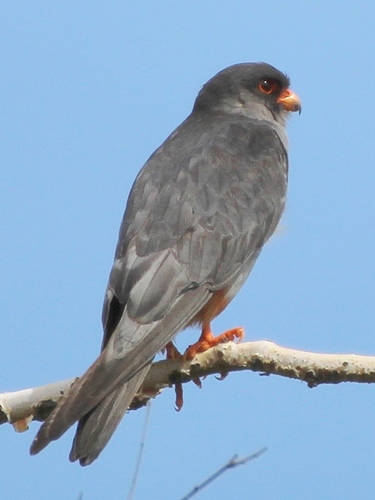 Amur Falcon
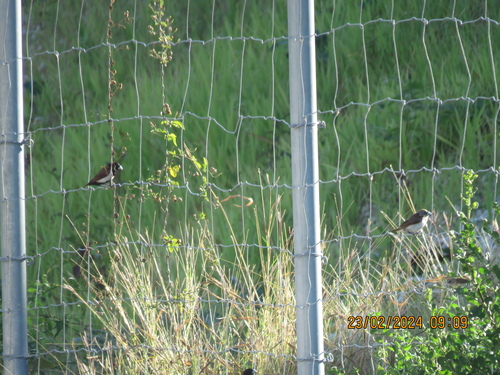 Tricoloured Munia
In short
The most reliable field mark to separate Amur Falcon from Tricoloured Munia is overall structure: Amur Falcon is a small raptor with long, pointed wings and a hooked bill, while Tricoloured Munia is a compact, seed-eating finch with a short, conical bill and much shorter wings. In flight, Amur Falcon (especially juveniles) shows contrasting white wing linings and rufous thighs, while Tricoloured Munia (adults) displays a striking tricolored pattern with black head and chest, white belly, and chestnut back. Juvenile plumages differ: young Amur Falcons lack buffy underwing coverts, while juvenile munias are plain brown above and buff below. Size is dramatically different, with Amur Falcon being over ten times heavier than the munia. These two are unlikely to be confused except at a distance or in silhouette, but confusion may occur with distant perched birds or immatures.
Identification tips
- Size and structure: Amur Falcon is much larger and bulkier than Tricoloured Munia; look for a long-tailed, long-winged raptor vs. a small, round-bodied finch. This is the most immediate separation at any reasonable distance.
- Bill shape: Amur Falcon has a hooked, raptor bill; Tricoloured Munia has a short, thick, conical finch bill. Bill color is pale-bluish grey in munia adults, red cere in female falcons.
- Wing shape in flight: Amur Falcon shows long, pointed wings with wing tips reaching or extending beyond the tail when perched. Munia has short, rounded wings and a stubby tail.
- Adult male plumage: Male Amur Falcon is sooty grey above with rufous thighs and vent, white wing linings, and dark flight feathers. Male Tricoloured Munia is black-headed and chested, with a white belly and chestnut back.
- Adult female plumage: Female Amur Falcon has orange eye-ring, red cere, and reddish-orange feet, with less contrast than the male but still a raptor. Female munia is similar to male but with paler uppertail coverts.
- Juvenile/immature plumage: Juvenile Amur Falcon lacks buffy underwing coverts and is more uniform below; juvenile munia is plain warm brown above and buff below, with no dark head or tricolored pattern.
- Underwing pattern: In flight, Amur Falcon (all ages) shows white wing linings contrasting with dark flight feathers; Tricoloured Munia has white to cream underwing coverts but not the same strong contrast or wing shape.
- Leg and foot color: Amur Falcon females have reddish-orange feet; munias have grey legs and feet.
- Perching behavior: Amur Falcon often perches high and exposed (wires, bare branches); munias perch low, often in dense grass or reeds.
- Flight style: Amur Falcon has direct, buoyant, powerful flight; munia has short, undulating, weak flight.
- Habitat context: Amur Falcon is seen in open country, often during migration; munia is found in wetlands, grasslands, and rice fields, usually in flocks.
- Sex differences: Munia sexes are similar, with females slightly paler; Amur Falcon sexes differ, especially in soft part colors.
- Confusion risk: Juvenile Amur Falcon could be mistaken for a plain brown bird at distance, but structure and flight are always raptorial. Juvenile munia may be confused with other munias, not with falcons.
- Feet and cere color: Only Amur Falcon shows red cere (female) and rufous thighs; munia never does.
- No raptor features in munia: Tricoloured Munia never shows hooked bill, long pointed wings, or rufous vent.
Size
Amur Falcon is vastly larger and heavier (137.5g) than Tricoloured Munia (12.6g). The falcon is a small raptor, but still much bulkier and longer-winged than any munia. In the field, Amur Falcon's wingspan (63–71 cm) and long, pointed wings are obvious in flight or when perched, with wing tips reaching or extending beyond the tail. Tricoloured Munia is a small, compact finch, only about 11.5 cm in length, with short, rounded wings and a stubby tail. Even at a distance, the falcon's silhouette is raptorial, while the munia appears sparrow-like.
Plumage
-
Juvenile/immature birds: Juvenile Amur Falcons lack buffy underwing coverts (unlike similar Red-footed Falcon), and show a more uniform underwing. Juvenile Tricoloured Munias are warm brown above and buff below, lacking the dark head and tricolored pattern of adults; they may resemble other juvenile munias but not a falcon.
-
Adult males: Amur Falcon males are dark sooty grey above with rufous thighs and vent, white wing linings (contrasting with dark flight feathers), and long pointed wings. Tricoloured Munia adults have a black head, throat, and chest, white belly and flanks, and chestnut upperparts, with dark brown flight feathers and white to cream underwing coverts.
-
Adult females: Female Amur Falcons have orange eye-rings, red cere, and reddish-orange feet, with less contrast than males but still raptorial in appearance. Female munias are similar to males but with paler fringes on the uppertail coverts.
-
In flight: Amur Falcon shows long, pointed wings with white linings and rufous vent; Tricoloured Munia has short, rounded wings and a compact, undulating flight, with no raptor-like features.
Behaviour
Amur Falcon is a migratory raptor, often seen soaring, gliding, or actively hunting insects in open country or over water, sometimes in large flocks during migration. Its flight is powerful, direct, and buoyant, typical of falcons. Tricoloured Munia is a gregarious, seed-eating finch, usually seen in flocks, feeding in grasslands, reedbeds, or agricultural fields. Its flight is short, undulating, and weak compared to the falcon, and it often perches in dense cover or on grass stems. The falcon may be seen perched on wires or exposed branches, while munias prefer low, concealed perches.
Habitat
Amur Falcon breeds in open woodlands and steppe in East Asia, migrates across India, and winters in open habitats in southern Africa. It is rarely found in dense vegetation or reedbeds. Tricoloured Munia is native to South and Southeast Asia but is now widespread in the tropics, favoring wetlands, reedbeds, rice fields, and grassy areas, often near water. While both may occur in open country in India, the falcon is usually seen in the sky or on exposed perches, while the munia is associated with dense grasses or crops.