

Motmot

American Woodcock vs Eurasian Woodcock

Scolopax minor versus Scolopax rusticola

Play a quiz with American Woodcock and Eurasian Woodcock

American Woodcock (Scolopax minor) American Woodcock
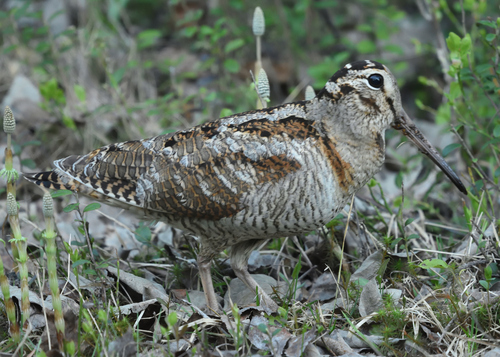
Eurasian Woodcock (Scolopax rusticola) Eurasian Woodcock

Media

Loading…

In short

The most reliable field mark between American and Eurasian Woodcock is size: Eurasian is distinctly larger and longer-winged, with a longer bill and broader wingspan. Both species have cryptic brown, black, and gray camouflage, but Eurasian Woodcock shows richer reddish-brown upperparts and buff underparts, while American is more muted and grayish. In flight, both appear plump with rounded wings, but Eurasian’s wings and body are noticeably bulkier. Bill length and structure are also helpful: Eurasian’s bill is longer and stouter. Habitat and range are diagnostic—American Woodcock is only in North America, Eurasian only in Eurasia, so context is crucial. Vocalizations and display flights differ, but these are rarely heard side by side.

Identification tips

  1. Size is the single most reliable field mark: Eurasian Woodcock is much larger and heavier than American, with a longer wingspan and bill. If the bird looks notably big and bulky for a woodcock, Eurasian is likely.
  2. Bill length and thickness: Eurasian’s bill is longer (6–8 cm) and stouter than American’s (6.4–7.1 cm), but this is subtle unless seen very well or in hand.
  3. Plumage tone: Eurasian Woodcock has richer, more reddish-brown upperparts and buff underparts; American is duller, more gray-brown overall. This is best judged in good light.
  4. Head pattern: Eurasian’s head is barred with black; American’s is more muted, but this is not a strong field mark unless seen very close.
  5. Wing and body shape in flight: Eurasian appears bulkier, with broader, longer wings and a more robust body. American looks more compact and rounded.
  6. Habitat and range: American Woodcock only occurs in North America; Eurasian Woodcock only in Eurasia. Always consider location first.
  7. Behavior: Both species walk with a rocking motion and probe for food, but this is not diagnostic.
  8. Display flight and calls: American males give a buzzy 'peent' and twittering flight sound; Eurasian males give 'orr, orr, orr, pist' calls during roding. These are distinct but rarely compared directly.
  9. Sexual dimorphism: Both species show size differences between sexes, but only female American Woodcock is notably larger than the male; in Eurasian, males are larger, but sexes cannot be separated in the field.
  10. Leg color: Eurasian’s legs vary from grey to pinkish; American’s are not distinctly described, so not a reliable separator.
  11. Camouflage: Both are extremely well camouflaged on the ground; do not rely on plumage alone unless you have a direct comparison.
  12. Juvenile/immature plumage: No distinctive age-specific wing pattern differences are described between these two species in the sources; do not rely on this mark.
  13. Context: If you are in a region where only one species occurs, that is almost always the correct identification.
  14. Pitfall: Do not rely on display flight alone unless you are familiar with both species’ sounds and behaviors.
  15. In hand or at very close range: Eurasian’s richer color and longer bill may help, but in the field, size and location are your best clues.

Size

Eurasian Woodcock is significantly larger: adults measure 33–38 cm in length with a 55–65 cm wingspan, and a bill 6–8 cm long. American Woodcock is smaller: 25–30 cm long, 42–48 cm wingspan, and a bill 6.4–7.1 cm long. Eurasian is heavier and bulkier overall, with a broader, longer-winged appearance in flight. Female American Woodcocks are larger than males, but even the largest American is smaller than Eurasian. If seen side by side (rare in the wild), Eurasian would appear much more robust and long-billed.

Plumage

Both species are superbly camouflaged with brown, black, and gray or reddish tones, but Eurasian Woodcock has more pronounced reddish-brown upperparts and buff underparts, while American is generally duller, with more gray and less rufous. The Eurasian’s head is barred with black, not striped, and its plumage is intricately patterned. American Woodcock has a large, rounded head with a more muted, grayish cast overall. Juvenile and immature plumages are not described as distinctively different between these two species in the sources, so age-specific wing pattern is not a reliable separator here. In hand or at close range, Eurasian’s richer color and more extensive buff below may help, but in the field, these are subtle and easily missed.

Behaviour

Both species spend most of their time on the ground in dense, brushy or woodland habitats, relying on camouflage and a slow, rocking walk while foraging. Both perform elaborate aerial display flights at dawn and dusk in spring: American Woodcock males spiral high and descend with twittering wings, while Eurasian males perform 'roding' flights with distinctive calls. Foraging behavior is similar, probing for invertebrates with their long bills. American Woodcock sometimes rocks its body while walking, a behavior also seen in Eurasian but less emphasized in the notes.

Habitat

Habitat is a strong separator: American Woodcock is found only in eastern North America, favoring brushy, young-forest habitats, often near moist ground. Eurasian Woodcock occupies temperate and subarctic Eurasia, in woodland and sometimes tall heather, with a preference for cryptic cover. Both avoid open ground and are rarely seen in the open. If you are in North America, you are almost certainly seeing American; in Eurasia, Eurasian is the default.

Voice

American Woodcock males give a short, buzzy 'peent' on the ground, followed by a high, twittering sound in flight produced by their wing feathers. Eurasian Woodcock males give a series of 'orr, orr, orr, pist' calls during their roding display flights. These vocalizations are not similar and are unlikely to be confused, but both are most often heard at dawn or dusk in spring. Calls are rarely diagnostic unless you are familiar with both species’ displays.

Submit a better description

Use the same sections as the comparison. Your text is published immediately.

The most reliable field mark between American and Eurasian Woodcock is size: Eurasian is distinctly larger and longer-winged, with a longer bill and broader wingspan. Both species have cryptic brown, black, and gray camouflage, but Eurasian Woodcock shows richer reddish-brown upperparts and buff underparts, while American is more muted and grayish. In flight, both appear plump with rounded wings, but Eurasian’s wings and body are noticeably bulkier. Bill length and structure are also helpful: Eurasian’s bill is longer and stouter. Habitat and range are diagnostic—American Woodcock is only in North America, Eurasian only in Eurasia, so context is crucial. Vocalizations and display flights differ, but these are rarely heard side by side.

  1. Size is the single most reliable field mark: Eurasian Woodcock is much larger and heavier than American, with a longer wingspan and bill. If the bird looks notably big and bulky for a woodcock, Eurasian is likely.
  2. Bill length and thickness: Eurasian’s bill is longer (6–8 cm) and stouter than American’s (6.4–7.1 cm), but this is subtle unless seen very well or in hand.
  3. Plumage tone: Eurasian Woodcock has richer, more reddish-brown upperparts and buff underparts; American is duller, more gray-brown overall. This is best judged in good light.
  4. Head pattern: Eurasian’s head is barred with black; American’s is more muted, but this is not a strong field mark unless seen very close.
  5. Wing and body shape in flight: Eurasian appears bulkier, with broader, longer wings and a more robust body. American looks more compact and rounded.
  6. Habitat and range: American Woodcock only occurs in North America; Eurasian Woodcock only in Eurasia. Always consider location first.
  7. Behavior: Both species walk with a rocking motion and probe for food, but this is not diagnostic.
  8. Display flight and calls: American males give a buzzy 'peent' and twittering flight sound; Eurasian males give 'orr, orr, orr, pist' calls during roding. These are distinct but rarely compared directly.
  9. Sexual dimorphism: Both species show size differences between sexes, but only female American Woodcock is notably larger than the male; in Eurasian, males are larger, but sexes cannot be separated in the field.
  10. Leg color: Eurasian’s legs vary from grey to pinkish; American’s are not distinctly described, so not a reliable separator.
  11. Camouflage: Both are extremely well camouflaged on the ground; do not rely on plumage alone unless you have a direct comparison.
  12. Juvenile/immature plumage: No distinctive age-specific wing pattern differences are described between these two species in the sources; do not rely on this mark.
  13. Context: If you are in a region where only one species occurs, that is almost always the correct identification.
  14. Pitfall: Do not rely on display flight alone unless you are familiar with both species’ sounds and behaviors.
  15. In hand or at very close range: Eurasian’s richer color and longer bill may help, but in the field, size and location are your best clues.

Eurasian Woodcock is significantly larger: adults measure 33–38 cm in length with a 55–65 cm wingspan, and a bill 6–8 cm long. American Woodcock is smaller: 25–30 cm long, 42–48 cm wingspan, and a bill 6.4–7.1 cm long. Eurasian is heavier and bulkier overall, with a broader, longer-winged appearance in flight. Female American Woodcocks are larger than males, but even the largest American is smaller than Eurasian. If seen side by side (rare in the wild), Eurasian would appear much more robust and long-billed.

Both species are superbly camouflaged with brown, black, and gray or reddish tones, but Eurasian Woodcock has more pronounced reddish-brown upperparts and buff underparts, while American is generally duller, with more gray and less rufous. The Eurasian’s head is barred with black, not striped, and its plumage is intricately patterned. American Woodcock has a large, rounded head with a more muted, grayish cast overall. Juvenile and immature plumages are not described as distinctively different between these two species in the sources, so age-specific wing pattern is not a reliable separator here. In hand or at close range, Eurasian’s richer color and more extensive buff below may help, but in the field, these are subtle and easily missed.

Both species spend most of their time on the ground in dense, brushy or woodland habitats, relying on camouflage and a slow, rocking walk while foraging. Both perform elaborate aerial display flights at dawn and dusk in spring: American Woodcock males spiral high and descend with twittering wings, while Eurasian males perform 'roding' flights with distinctive calls. Foraging behavior is similar, probing for invertebrates with their long bills. American Woodcock sometimes rocks its body while walking, a behavior also seen in Eurasian but less emphasized in the notes.

Habitat is a strong separator: American Woodcock is found only in eastern North America, favoring brushy, young-forest habitats, often near moist ground. Eurasian Woodcock occupies temperate and subarctic Eurasia, in woodland and sometimes tall heather, with a preference for cryptic cover. Both avoid open ground and are rarely seen in the open. If you are in North America, you are almost certainly seeing American; in Eurasia, Eurasian is the default.

American Woodcock males give a short, buzzy 'peent' on the ground, followed by a high, twittering sound in flight produced by their wing feathers. Eurasian Woodcock males give a series of 'orr, orr, orr, pist' calls during their roding display flights. These vocalizations are not similar and are unlikely to be confused, but both are most often heard at dawn or dusk in spring. Calls are rarely diagnostic unless you are familiar with both species’ displays.

Discard your changes?

You have unsaved edits. If you leave now, those changes will be lost.

American Woodcock · Eurasian Woodcock · My Tricky Birds