

American White Pelican vs Little Blue Heron
Pelecanus erythrorhynchos versus Egretta caerulea
Play a quiz with American White Pelican and Little Blue Heron
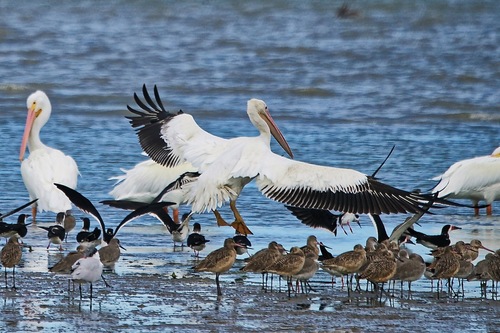 American White Pelican
 Little Blue Heron
In short
The most reliable field mark between American White Pelican and Little Blue Heron is overall size and structure: the pelican is a massive, heavy-bodied bird with a huge orange bill and black flight feathers visible only in flight, while the heron is a slender, small wader with a two-toned bill and, in juveniles, all-white plumage. Immature Little Blue Herons are often mistaken for white birds like pelicans due to their pale color, but their much smaller size and different proportions are unmistakable. In flight, American White Pelicans show striking black primaries and secondaries against otherwise white wings, while juvenile Little Blue Herons have mostly white wings with only slightly darker primaries. Adults of both species are easily told apart by color: pure white with black wingtips for the pelican, and dark blue with maroon head for the heron. Structure, bill shape, and flight style are also key for separation.
Identification tips
- Size is decisive: If the bird is anywhere near a Canada Goose or Great Blue Heron, compare directly—American White Pelican is vastly larger than any heron, including Little Blue.
- Bill shape and color: Pelican has a huge, flat-topped bill with a large throat pouch (vivid orange in breeding adults); Little Blue Heron has a slender, pointed, two-toned bill (bluish base, black tip).
- Flight pattern: In flight, pelicans show bold black primaries and secondaries contrasting with white wings; herons have uniform wings (white in juveniles, dark in adults) with only slightly darker primaries in white juveniles—never a crisp black-and-white pattern.
- Neck posture in flight: Pelicans fly with necks outstretched; herons fly with necks retracted in an S-shape.
- Plumage—adults: Adult pelicans are all white (except black flight feathers, seen only in flight); adult Little Blue Herons are dark blue with maroon or reddish heads in breeding season.
- Plumage—juveniles: Juvenile Little Blue Herons are all white with a two-toned bill and greenish legs, sometimes confused with white birds like pelicans, but are much smaller and lack the pelican’s black flight feathers.
- Plumage—immature/transitional: Immature Little Blue Herons molting into adult plumage show patchy white and blue feathers; pelicans never show patchy or blue coloration.
- Leg color: Herons have greenish or blackish legs (breeding: black); pelicans have pale, orange or yellowish legs, never dark.
- Bare part color in breeding: Pelican’s bill and facial skin become vivid orange; heron’s lores turn turquoise and legs/feet black.
- Feeding behavior: Pelicans feed by swimming in groups and dipping bills; herons stalk slowly and spear prey in shallow water.
- Perched posture: Pelicans are bulky, often sitting low in the water or on sandbars; herons are upright, slender, and often stand motionless at water’s edge.
- Habitat context: Pelicans are rarely in tight marshes or among reeds; herons are rarely far from shore or on open water.
- Flock size: Pelicans often in large, conspicuous flocks; Little Blue Herons are mostly solitary or in small groups.
- Wing shape: Pelican wings are broad and long, suited for soaring; heron wings are narrower and more rounded.
- Confusion risk: The only likely confusion is a juvenile Little Blue Heron (all white) with a distant pelican; use size, bill, and flight pattern to separate—pelicans are always much larger and show black in the wings in flight.
Size
Size is the most dramatic difference: American White Pelican is one of the largest North American birds, averaging nearly 6 kg (5945 g), with a wingspan up to 3 meters. Little Blue Heron is a small heron, weighing about 340 g, with a wingspan just over 1 meter. Even at great distance, the pelican’s bulk and long wings stand out compared to the heron's much smaller, slimmer build. In mixed flocks or at a distance, the pelican will dwarf any heron present.
Plumage
-
Juvenile/immature birds: Juvenile Little Blue Herons are almost entirely white, with only slightly darker upper primaries, and a two-toned bill (bluish base, black tip). Juvenile American White Pelicans are also pale but have light grey plumage with a darker brownish nape and remiges, and dull grey bare parts. In flight, the pelican’s black primaries and secondaries are bold and obvious, creating a strong black-and-white contrast; the heron's wings are mostly white with only faintly darker primaries, lacking any bold pattern.
-
Adults: Adult American White Pelicans are bright white with black primaries and secondaries visible only in flight; perched birds look all white. During breeding, the pelican’s bill and facial skin turn vivid orange. Adult Little Blue Herons are dark blue overall with a maroon (breeding: dark red) head and neck, and a two-toned bill. No white is present in adult plumage except in transitional immatures.
-
Transitioning immatures: Little Blue Herons in molt show patchy white and dark feathers, sometimes confusing, but never with the crisp black-and-white wing pattern of the pelican.
Behaviour
American White Pelicans are often seen soaring in large flocks, gliding with steady, shallow wingbeats and rarely flapping. They feed by swimming in groups and dipping their bills in the water, never diving. Little Blue Herons are solitary or in small groups, moving slowly and deliberately as they hunt in shallow water. In flight, herons have slow, deep wingbeats and fly with their necks retracted, unlike the pelican’s straight neck and massive, gliding flight. Pelicans are much more likely to be seen high overhead or on open water; herons stick to marsh edges, shallows, and mudflats.
Habitat
American White Pelicans prefer large lakes, reservoirs, and coastal lagoons, often far from shore or on open water. They breed inland and winter along coasts. Little Blue Herons are found in marshes, swamps, ponds, and shallow wetlands, both fresh and saltwater, usually close to vegetation or mudflats. While both may occur in some coastal areas, pelicans are rarely found in the tight, vegetated marshes favored by herons.
American White Pelican · Little Blue Heron · My Tricky Birds