
American Robin vs Eyebrowed Thrush
Turdus migratorius versus Turdus obscurus
Play a quiz with American Robin and Eyebrowed Thrush
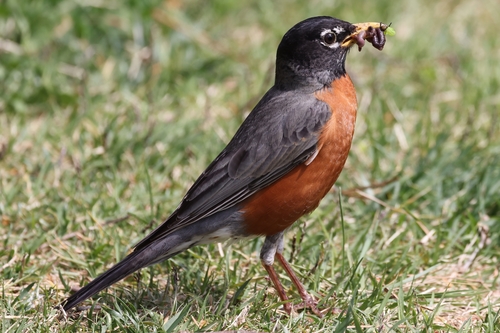 American Robin
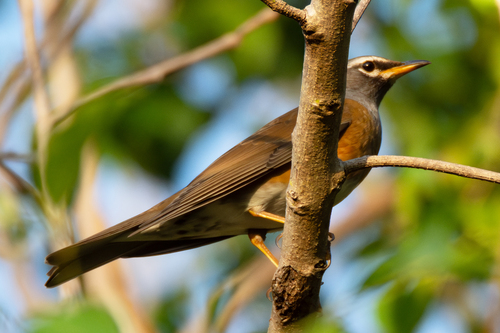 Eyebrowed Thrush
In short
The most reliable field mark to separate American Robin from Eyebrowed Thrush is the head pattern: Eyebrowed Thrush always shows a sharp black eyeline with bold white borders above and below, while American Robin has a plain dark (blackish or gray) head with broken white eye-arcs but no strong eyeline. Both species have orange on the breast, but the robin's is deeper and more extensive, while the Eyebrowed Thrush's orange is more confined to the breast and flanks, with a cleaner white belly. Juvenile robins show distinct breast spotting and pale wing coverts, which Eyebrowed Thrush lacks. Robins are also noticeably bulkier and longer-bodied, with a stouter yellow bill. In flight or at rest, look for the robin's white undertail coverts and lack of a facial stripe, versus the Eyebrowed Thrush's crisp facial pattern and smaller, slimmer build.
Identification tips
- Head pattern is key: Eyebrowed Thrush always shows a sharp black eyeline with bold white borders above and below (supercilium and subocular line), giving a striking facial contrast. American Robin lacks any eyeline or strong supercilium, instead showing broken white eye-arcs and a plain dark head.
- Breast and belly color: Robin's reddish-orange breast is deeper, richer, and more extensive, often maroon to peachy orange, and sharply contrasts with the white belly and undertail coverts. Eyebrowed Thrush has a more confined orange breast and flanks, with a crisp, clean white belly.
- Juvenile marks: Juvenile robins are heavily spotted on the breast and have pale, whitish wing coverts—these features are never present on Eyebrowed Thrush of any age. First-year robins may retain some juvenile feathers, appearing patchy or dull.
- Bill structure and color: Robin's bill is stouter and mostly yellow with a dark tip (especially in winter), while Eyebrowed Thrush has a slimmer, less prominent bill.
- Back and upperparts: Robin has a brown back, while Eyebrowed Thrush is gray above (browner in immatures), further accentuating the facial pattern in the latter.
- Throat pattern: Robin shows a white throat with black streaks; Eyebrowed Thrush has a plain throat, with the facial stripes dominating the pattern.
- Sex differences: Female robins are duller, with browner upperparts and less-bright underparts, but still lack a strong facial pattern. Eyebrowed Thrush sexes are similar, though immatures are browner above.
- Size and structure: Robins are bulkier, longer-bodied, and heavier (77 g vs 63 g), with a broader chest and more upright stance. Eyebrowed Thrush is slimmer and more compact.
- Flight and undertail: In flight, robin shows white undertail coverts and a uniform upperwing; Eyebrowed Thrush's flight pattern is not described as distinctive, but its smaller size and lack of white undertail are clues.
- Habitat context: Robins are common in open, urban, and suburban habitats across North America, often seen on lawns. Eyebrowed Thrush prefers dense forest and taiga in Asia and is rarely found in open or urban areas.
- Behavior: Robins are bolder, often foraging in the open and nesting near humans. Eyebrowed Thrush is more secretive, sticking to dense cover.
- Plumage pitfalls: Dull female or first-year robins can appear less colorful but never show the crisp facial pattern of Eyebrowed Thrush. Immature Eyebrowed Thrush may be browner but retain the eyeline and white borders.
- Seasonal variation: Robin's bill darkens at the tip in winter, but overall structure and plumage remain similar year-round. Eyebrowed Thrush does not have strong seasonal plumage change in these notes.
- When marks fail: In poor light or distant views, rely on the presence or absence of the bold facial stripes for Eyebrowed Thrush, and the robin's larger size and plain head. If the breast is heavily spotted, it's a juvenile robin.
- Voice: If heard, Eyebrowed Thrush has a simple whistling song (not as rich as robin's carol), but this is rarely diagnostic without experience.
Size
American Robin is the larger and heavier of the two, averaging about 77 g compared to the Eyebrowed Thrush's 63 g [wikidata]. Robins appear more robust, with a longer body, broader chest, and a stouter, more prominent yellow bill. Eyebrowed Thrush is slimmer and more delicate overall, with a proportionally smaller bill and shorter, more compact appearance. In direct comparison, robins look noticeably bulkier both perched and in flight.
Plumage
Juvenile American Robins are distinctive: they show a pale, spotted breast and whitish wing coverts, which are never present on Eyebrowed Thrush. First-year robins may retain some juvenile coverts, making them appear patchy or duller than adults, but they still lack any strong facial markings. Adult robins have a uniform dark head (blackish in males, browner in females), white broken eye-arcs, a white throat with black streaks, a rich reddish-orange breast, brown back, and white belly and undertail coverts. In contrast, Eyebrowed Thrush of all ages shows a gray head and back, a sharp black eyeline with bold white supercilium and subocular line, orange breast and flanks, and a clean white belly. Immature Eyebrowed Thrush are browner above but still show the facial pattern. The robin's bill is mainly yellow with a dark tip (especially in winter), while Eyebrowed Thrush has a slimmer, less conspicuous bill. In flight, robin shows white undertail coverts and a more uniform upperwing; no distinctive upperwing pattern is noted for either species in these sources.
Behaviour
American Robins are often seen foraging on lawns, hopping upright, and are tolerant of human presence, frequently nesting near houses. They may be seen singly or in loose flocks, especially outside the breeding season. Eyebrowed Thrush tends to be more secretive, frequenting dense coniferous forests or taiga, and is less likely to be seen in open or urban habitats. Their movements are more furtive, and they are less likely to be seen on open ground.
Habitat
American Robin is widespread across North America, often found in open woodlands, gardens, parks, and suburban areas, and is comfortable around human habitation [wikipedia]. Eyebrowed Thrush breeds in dense coniferous forest and taiga from Siberia to Japan, and winters in forested areas of East and Southeast Asia. It is rarely found in open or urban habitats, so context can help: a thrush in a city park or on a lawn in North America is almost certainly a robin, while a bird in dense Asian forest is more likely Eyebrowed Thrush.
Voice
Eyebrowed Thrush has a simple whistling song, reminiscent of the Mistle Thrush [wikipedia]. American Robin sings a rich, caroling series of phrases, but this is not described in the provided notes. Calls are not detailed for either species in these sources, so vocalization is not a primary field mark here.