

American Moorhen vs Purple Gallinule
Gallinula galeata versus Porphyrio martinica
Play a quiz with American Moorhen and Purple Gallinule
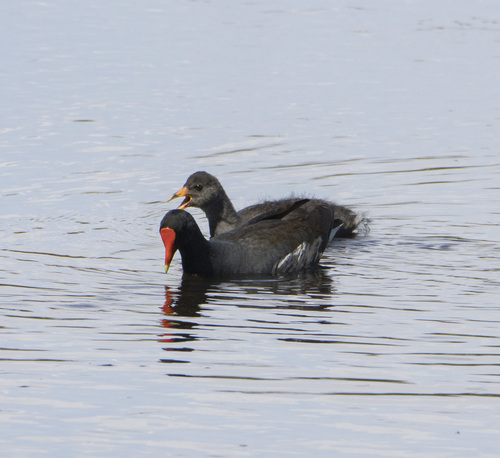 American Moorhen
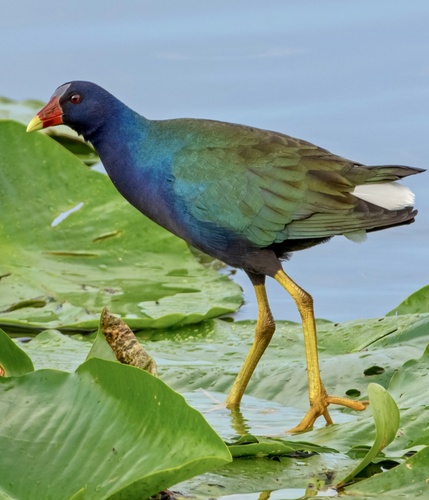 Purple Gallinule
In short
The most reliable field mark between American Moorhen and Purple Gallinule is the color and shape of the forehead shield: American Moorhen shows a bright red shield, while Purple Gallinule has a pale blue shield in adults. Immature birds can be confusing, but Purple Gallinule immatures are brown-bronze with a pale shield, while young moorhens are browner and lack any colored shield. In all ages, Purple Gallinule adults have a striking purple-blue body with green and turquoise iridescence, while American Moorhen is mostly dark grayish with a white undertail and yellow legs. Bill color and leg color are also helpful, but beware of lighting and age effects.
Identification tips
- Forehead Shield Color (all ages): Adult American Moorhen shows a bright red shield above the bill; Purple Gallinule adult has a pale blue shield. Immature Purple Gallinule has a pale shield; young Moorhen lacks a colored shield entirely.
- Bill Pattern (adults): Moorhen's bill is red with a yellow tip, matching the red shield; Purple Gallinule's bill is red with a yellow tip but connects to a pale blue shield, not red.
- Leg Color (adults): Both species have yellow legs as adults, but Purple Gallinule's are especially bright yellow and extend to the toes, while Moorhen's may be duller.
- Plumage Color (adults): Purple Gallinule is purple-blue with green and turquoise iridescence in good light; Moorhen is dark grayish-black with no iridescence, except for white undertail.
- Plumage Color (immatures/juveniles): Immature Purple Gallinule is brown-bronze with some purple on the chest and green-bronze on wings/back; Moorhen young are brownish but lack bronze or purple tones.
- Undertail Pattern: Both have white undertail coverts, but this is not diagnostic between the two.
- Flight Behavior: Purple Gallinule often flies with legs dangling; Moorhen's flight is more direct and less likely to show dangling legs.
- Structure/Jizz: Moorhen is chunkier and heavier; Purple Gallinule is more slender and delicate, especially in the neck and bill.
- Habitat: Both occur in marshes and wetlands, but Purple Gallinule is more likely to be seen walking on floating vegetation or climbing among reeds.
- Vocalization: Moorhen gives gargling calls and hisses; Purple Gallinule's calls are not described here, so do not rely on voice for separation.
- Lighting Effects: In poor light, Purple Gallinule's colors can look dusky or brownish, so do not rely solely on body color—check shield and bill.
- Seasonal Variation: Both species are present year-round in much of their range, but Moorhen migrates out of areas where water freezes.
- Pitfalls: Immature Purple Gallinule can be confused with Moorhen due to brownish color and pale shield; look for bronze/green tones and shield color.
- Geographic Context: Both species overlap widely, but Purple Gallinule is more prone to vagrancy and may turn up in unexpected places.
- Behavioral Cues: Purple Gallinule is more likely to be seen climbing or balancing on vegetation, while Moorhen is more often seen swimming or walking at the water's edge.
Size
Both species are similar in overall length (American Moorhen: 32–35 cm; Purple Gallinule: 26–37 cm), but American Moorhen is generally heavier and bulkier (310–456 g, not directly listed but inferred from range, vs. Purple Gallinule's average 236 g [wikidata]). Wingspan is similar (Moorhen: 54–62 cm; Gallinule: 50–61 cm). In the field, Purple Gallinule may appear slightly more delicate and slim, especially in the neck and bill, while Moorhen is chunkier.
Plumage
- Juvenile/Immature: Juvenile Purple Gallinule is light brown with green-bronze on wings and back and white undertail coverts; its bill and shield are pale. Immature Purple Gallinule is brown-bronze with some purple on the chest and a pale bill/shield. American Moorhen young are browner than adults and lack the red shield entirely, but do not show the green-bronze or purple tones of Purple Gallinule.
- Adult: Adult Purple Gallinule is unmistakable in good light: purple-blue body with green and turquoise iridescence, pale blue forehead shield, red and yellow bill, and bright yellow legs/feet. Adult American Moorhen is dark overall (grayish-black), with a bright red shield, red and yellow bill, yellow legs, and white undertail. In poor light, Purple Gallinule can look dusky or brownish, but the shield color and bill pattern remain distinctive.
- Flight: No distinctive upperwing pattern differences are described for either species in the sources, but Purple Gallinule's legs often dangle in flight, which can be a behavioral clue.
Behaviour
Both species are often found walking on floating vegetation thanks to their long toes, but Purple Gallinule is especially adept and may appear more agile or acrobatic, often seen clambering on reeds and lily pads. Purple Gallinule tends to fly only short distances, with legs hanging down, while American Moorhen can be more secretive but may also become tame and is often seen swimming or walking on the water's edge. Both defend territories vigorously during breeding.
Habitat
Both species inhabit well-vegetated marshes, ponds, and wetlands in the Americas. American Moorhen is widespread and common in North and South America, especially in marshes and lakes with dense vegetation. Purple Gallinule shares similar habitats but is more likely to be found in areas with abundant floating vegetation and may be more prone to vagrancy, occasionally turning up far outside its normal range.
Voice
American Moorhen gives a wide range of gargling calls and loud hisses when threatened. Purple Gallinule's voice is not described in the provided notes, so vocalization is not a reliable field mark for separating these two based on the current sources.