

American Golden Plover vs Pacific Golden Plover
Pluvialis dominica versus Pluvialis fulva
Play a quiz with American Golden Plover and Pacific Golden Plover
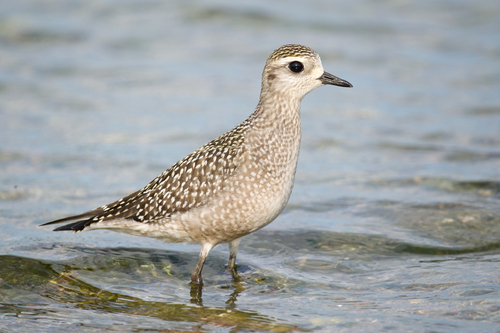 American Golden Plover
 Pacific Golden Plover
In short
The most reliable field mark between American Golden Plover and Pacific Golden Plover is the extent and shape of black on the underparts in breeding plumage: American Golden Plover shows a solid black belly and undertail, while Pacific Golden Plover usually has some white on the flanks or undertail. Outside breeding plumage, both species are very similar, but Pacific Golden Plover tends to be slimmer, longer-legged, and shows more yellow on the back. Structural differences—especially leg length and body shape—are subtle but helpful when plumage is ambiguous. Juvenile and first-summer birds are particularly tricky, with incomplete black underparts and variable gold spotting, so multiple features should be checked.
Identification tips
- Breeding plumage underparts: American Golden Plover shows a solid black belly and undertail, while Pacific Golden Plover usually has some white on the flanks and undertail. This is most reliable in full adult breeding plumage (spring/summer).
- Extent and sharpness of black: In breeding males, American's black is more extensive and sharply bordered by white; Pacific's black is often less extensive and may be mottled, especially in females.
- Back color in breeding plumage: Pacific Golden Plover typically has more yellow/gold on the back and crown, while American is more muted with paler gold spots.
- Leg length and structure: Pacific is slimmer and longer-legged than American. This is subtle but can be seen when birds are side by side or with experience. Look for longer legs and a more upright stance in Pacific.
- Primary projection: American Golden Plover has a longer primary projection (wing tips extending past the tail) compared to Pacific, which has a shorter projection. This is best judged on perched birds.
- Bill size and shape: Both species have small, fine bills, but differences are not reliably diagnostic in the field.
- Nonbreeding plumage: Both species are very similar, but Pacific may appear slightly yellower above. Separation is extremely difficult and should rely on structure and context.
- Juvenile/immature birds: Both species are nearly indistinguishable in juvenile plumage. Pacific may show more yellow on the back, but overlap is significant. Use structural clues and, if possible, context (location and time of year).
- Molt timing: In fall, American Golden Plover molts to nonbreeding plumage later (September–October, often on wintering grounds) than Pacific (August, before migration). This may help in late summer/early fall mixed flocks.
- Habitat/context: In the Americas, Pacific Golden Plover is more likely in coastal areas and islands (especially Pacific coast, Alaska, Hawaii), while American is more widespread inland during migration and winters in South America.
- Behavior in winter: Pacific Golden Plover is often seen in urban or human-altered habitats, especially in Hawaii and the Pacific region. American Golden Plover is less likely in such settings.
- Sex differences: Female breeding Pacific Golden Plovers have less distinct, mottled black on the breast, while American females are similar to males but with less extensive black.
- Flight views: No distinctive upperwing or flight pattern differences are described for juveniles or adults; separation in flight relies on structure and underpart color if visible.
- Pitfalls: First-summer and immature birds of both species often have incomplete black underparts and variable gold spotting, making them very difficult to separate. Use a combination of structure, molt timing, and context.
- Geographic range: In North America, American Golden Plover is much more likely inland during migration, while Pacific is more likely on the Pacific coast and islands. In Hawaii and the Pacific, Pacific Golden Plover is the default species.
Size
American Golden Plover is slightly heavier on average (145 g vs. 135 g [wikidata]), and marginally longer in both body and wingspan (24–28 cm length, 65–67 cm wingspan vs. Pacific's 25 cm length, 61 cm wingspan [wikipedia]). In the field, these differences are subtle and rarely diagnostic. Pacific Golden Plover is described as slimmer and longer-legged, but the difference is best appreciated with direct comparison or experience.
Plumage
-
Juvenile/First-winter/Immature: Both species are very similar in juvenile and first-winter plumage, showing gold-spotted upperparts and pale underparts. No distinctive upperwing pattern is described for either species at these ages in the provided notes, so separation relies on structure and subtle differences in gold spotting (Pacific usually yellower).
-
Adult Breeding Plumage: American Golden Plover has a solid black face, neck, breast, belly, and undertail, sharply bordered by white from the crown down the sides. Pacific Golden Plover also has black on the face, neck, and breast, but typically shows some white on the flanks and undertail, and the black is often less extensive and more mottled, especially in females. Pacific also tends to have more yellow on the back and crown.
-
Nonbreeding Plumage: Both species become very similar: upperparts are grey-brown with gold spotting, underparts pale grey-brown, and a whitish eyebrow is present. Pacific Golden Plover may show a slightly yellower cast to the upperparts, but this is subtle and variable.
Behaviour
Both species are highly migratory and territorial on breeding grounds. Pacific Golden Plover is noted for strong site fidelity, especially in wintering grounds (notably Hawaii), and is more likely to be seen in human-altered habitats such as parks and golf courses. American Golden Plover is also territorial in winter but is less associated with human environments. Both species forage in open areas and display similar behaviors.
Habitat
On breeding grounds, both use Arctic tundra. In migration and winter, Pacific Golden Plover is more likely to be found in a variety of open habitats, including inland grassy areas, parks, and even rooftops, especially in the Pacific and Australasia. American Golden Plover winters mainly in southern South America and is less likely to be found in urban or highly altered habitats. In North America, American Golden Plover is more likely inland during migration, while Pacific is more common on the Pacific coast and islands.
American Golden Plover · Pacific Golden Plover · My Tricky Birds