

American Flamingo vs Lesser Flamingo
Phoenicopterus ruber versus Phoeniconaias minor
Play a quiz with American Flamingo and Lesser Flamingo
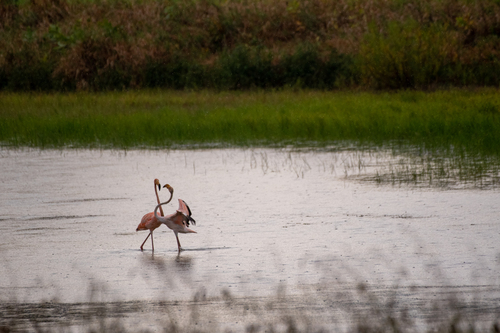 American Flamingo
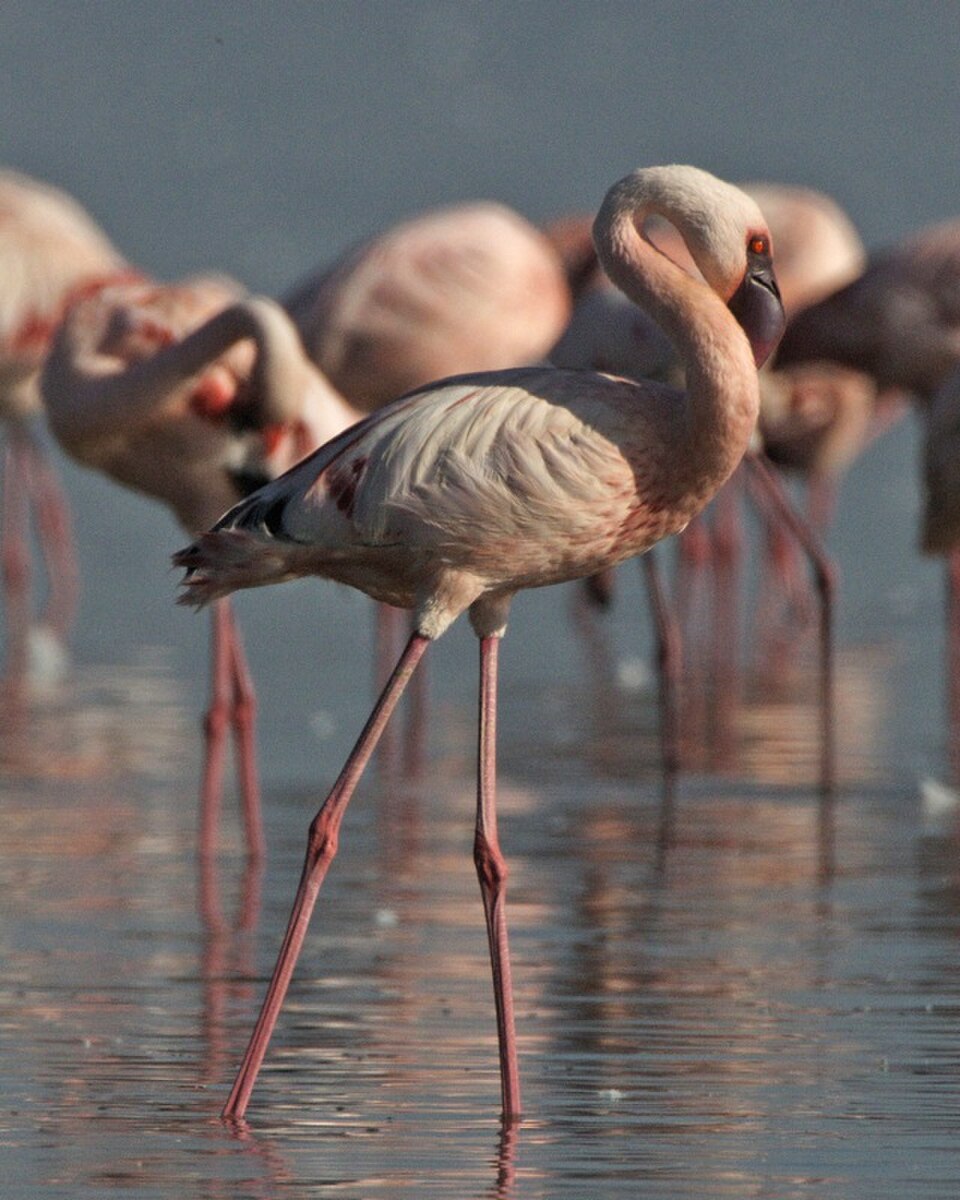 Lesser Flamingo
In short
The most reliable field mark to separate American Flamingo from Lesser Flamingo is overall size and structure: American Flamingo is much taller and heavier, with a longer neck and legs, and shows a brighter, richer pink coloration with solid pink legs and a mostly pink bill with a black tip. Lesser Flamingo is notably smaller, with a shorter neck and legs, and is paler pink overall, but has a much more extensively black bill and often shows a deeper carmine wash on the breast. In flight, both species show black primaries and secondaries, but American Flamingo has redder wing coverts, while Lesser Flamingo's are paler. Bill color and leg color are key at close range. Habitat and range also help: American Flamingo is restricted to the Americas, while Lesser Flamingo is found in Africa and India.
Identification tips
- Size and Structure: American Flamingo is much larger and taller (120–145 cm) than Lesser Flamingo (80–90 cm). Look for a longer neck and legs, especially when birds are standing or wading. This is the most obvious difference when both species are seen together, but can be subtle in isolation or at a distance.
- Bill Color and Pattern: American Flamingo has a mostly pink bill with a black tip, while Lesser Flamingo's bill is extensively black, with only the base showing pale pink. This is a key mark at close range and works for adults.
- Leg Color: Both species have pink legs, but American Flamingo's are solidly pink and often appear longer and more robust. Lesser Flamingo's legs are also pink but look more delicate due to the bird's smaller size.
- Overall Plumage Tone: American Flamingo is a richer, deeper pink overall, sometimes described as 'rosy.' Lesser Flamingo is paler pink to pinkish white, but often with a deeper carmine wash on the breast. Lighting can affect this impression, so use with caution.
- Wing Coverts in Flight: In flight, American Flamingo shows red wing coverts contrasting with black primaries and secondaries. Lesser Flamingo's wing coverts are paler, so the contrast is less striking. This is best seen when birds are flying at close to medium range.
- Geographic Range: American Flamingo is only found in the Americas, while Lesser Flamingo is only found in Africa and India. If you are in the Caribbean, Yucatán, or Galápagos, you are almost certainly seeing American Flamingo. If you are at an alkaline lake in Africa or India, it is Lesser Flamingo.
- Jizz and Posture: American Flamingo appears more elongated and stately, with a long stride and neck. Lesser Flamingo is more compact and often appears shorter-necked and shorter-legged.
- Feeding Behavior: Both species filter-feed, but Lesser Flamingo's deeper bill is adapted for filtering tiny algae. This is not easily observed in the field unless you have a close view.
- Flock Structure: Both species are gregarious, but Lesser Flamingo is famous for forming enormous breeding creches. However, this is not a reliable mark for separating adults in mixed or non-breeding flocks.
- Voice: American Flamingo gives a goose-like honking. No distinctive Lesser Flamingo call is described in the notes, so do not rely on voice for separation.
- Sex and Age: No strong sexual dimorphism is noted for either species in the sources. No age-specific wing pattern differences are described, so use adult marks for all ages unless you have more detailed local knowledge.
- Pitfalls: Do not confuse American Flamingo with Greater Flamingo, which is paler and larger still; Lesser Flamingo is much smaller and has the distinctive black bill. Lighting and distance can make color differences less obvious, so use structure and bill pattern as primary marks.
- When Marks Fail: At great distance or in poor light, size and bill color may be hard to judge. Use range and habitat as strong supporting clues.
Size
American Flamingo is substantially larger: adults stand 120–145 cm tall and average 3052 g in mass [wikidata], making it the largest flamingo in the Americas. Lesser Flamingo is the smallest flamingo species, standing only 80–90 cm tall and weighing 1.2–2.7 kg [wikipedia]. The difference is striking when seen together, but can be harder to judge at a distance or without direct comparison. American Flamingo's longer neck and legs are often apparent even in flight, giving it a lankier, more stately appearance. Lesser Flamingo appears more compact and less elongated.
Plumage
No detailed age-specific wing pattern differences are described in the sources for immatures or juveniles, so separation relies on adult and general plumage. Adult American Flamingo is a vivid pink overall, with red wing coverts and black primary and secondary flight feathers; its legs are entirely pink, and the bill is mostly pink with a black tip. Lesser Flamingo is paler pink to pinkish white, with a deeper carmine wash on the breast and a much more extensively black bill. Its legs are also pink, but the overall impression is of a paler, daintier bird. In flight, both show black primaries and secondaries, but American Flamingo's red wing coverts contrast more strongly. No diagnostic juvenile or immature upperwing patterns are described for either species in the provided notes.
Behaviour
Both species are highly gregarious and often seen in large flocks, feeding in shallow water with their heads down. American Flamingo may appear more stately due to its greater height and longer stride. Lesser Flamingo, while also social, is noted for forming especially massive creches of chicks, sometimes over 100,000 strong, but this is not a field mark for adults. Both species filter-feed in similar fashion, but Lesser Flamingo's deeper bill reflects its specialization for feeding on microscopic algae.
Habitat
American Flamingo is found in the West Indies, northern South America (including the Galápagos), and the Yucatán Peninsula, typically in saline lagoons, mudflats, and shallow coastal lakes [wikipedia]. Lesser Flamingo is restricted to sub-Saharan Africa and western India, favoring highly alkaline or saline lakes, often with extreme chemical conditions unsuitable for most other birds. Thus, geographic context is usually a strong clue: American Flamingo is not found in Africa or India, and Lesser Flamingo is not native to the Americas.
Voice
American Flamingo gives a goose-like honking call [wikipedia]. No vocal description is provided for Lesser Flamingo in the notes, so voice is not a reliable separation feature based on the current information.