

Motmot

American Flamingo vs Andean Flamingo

Phoenicopterus ruber versus Phoenicoparrus andinus

Play a quiz with American Flamingo and Andean Flamingo
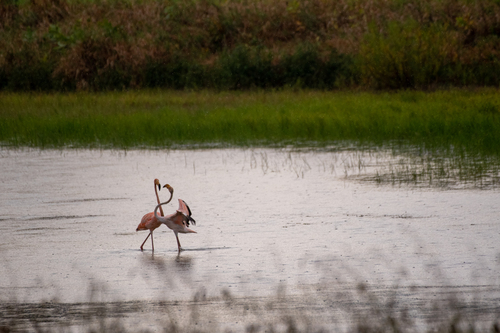
American Flamingo (Phoenicopterus ruber) American Flamingo
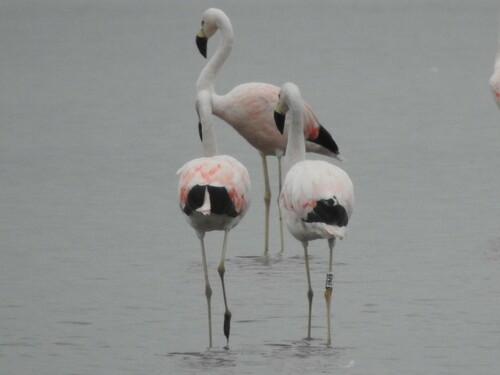
Andean Flamingo (Phoenicoparrus andinus) Andean Flamingo

Media

Loading…

In short

The most reliable field mark to separate American Flamingo from Andean Flamingo is leg color: American Flamingo always shows entirely pink legs, while Andean Flamingo uniquely has yellow legs and three-toed feet, a feature not shared by any other flamingo. In flight or at rest, both species show black primaries and secondaries, but Andean Flamingo’s black forms a bold triangle visible even when the wing is folded. Adult American Flamingos are a much deeper, richer pink overall, while adult Andean Flamingos are paler with only the lower neck and breast showing bright pink. Juvenile Andean Flamingos are uniformly pale gray, lacking any pink, while American Flamingo immatures already show some pink tones. Bill color and structure also differ: American Flamingo has a pink and white bill with a large black tip, while Andean Flamingo’s bill is mostly black with yellow at the base and is deeper, with a distinctive downward curve. Both species are large, but American Flamingo is heavier on average, though there is overlap.

Identification tips

  1. Leg color is diagnostic: American Flamingo always has entirely pink legs; Andean Flamingo uniquely has yellow legs and three-toed feet. This is the most reliable mark at any age or season.
  2. Juvenile plumage: Juvenile Andean Flamingos are uniformly pale gray with no pink, sometimes duskier on the head/neck and with darker brown centers to coverts/scapulars. Juvenile American Flamingos show some pinkish tones as they mature.
  3. Adult body color: Adult American Flamingos are deep, rich pink overall, with especially bright red wing coverts. Adult Andean Flamingos are much paler, almost white on the body, with only the lower neck, breast, and wing coverts showing bright vinaceous-pink.
  4. Wing pattern at rest: Both species have black primaries and secondaries, but on Andean Flamingo, the black forms a bold triangle visible even when perched due to less overlap from coverts. On American Flamingo, black is usually more concealed when wings are folded.
  5. Bill color and shape: American Flamingo has a pink and white bill with a large black tip; the bill is fairly thick but not extremely deep. Andean Flamingo’s bill is mostly black with yellow at the base, is deeper (taller vertically), and has a more pronounced downward curve.
  6. Feet: Andean Flamingo has three-toed feet (not visible at long range, but unique among flamingos); American Flamingo has the usual flamingo foot structure.
  7. Size: American Flamingo is generally heavier and taller, but there is overlap; do not rely on size unless birds are side by side.
  8. Habitat and location: American Flamingo is found in lowland coastal areas of the Caribbean, Yucatán, and northern South America. Andean Flamingo is restricted to high-altitude Andean lakes. If you are in the Andes above 3,000 m, you are almost certainly seeing Andean Flamingo.
  9. Flight jizz: Both species show black primaries and secondaries in flight, but Andean Flamingo’s black triangle is more prominent even when wings are folded.
  10. Head and neck color: On Andean Flamingo, the head and upper neck may be brighter pink than the rest of the body, but never as bright as the lower neck and breast. American Flamingo is more uniformly deep pink.
  11. Bill structure in profile: Andean Flamingo’s bill is deeper and more sharply downcurved, with a less prominent lower mandible compared to American Flamingo.
  12. Association with other flamingos: Andean Flamingo often mixes with James's and Chilean Flamingos in the Andes, sometimes adopting their foraging behaviors. American Flamingo is usually in single-species flocks in its range.
  13. Voice: American Flamingo gives a loud, goose-like honk. Andean Flamingo’s voice is not distinctive for field separation.
  14. Sex and season: No strong sexual or seasonal dimorphism in either species; all field marks above apply year-round and to both sexes.
  15. Beware of vagrants and captive birds: Out-of-range flamingos may occur in zoos or as escapees; always check leg and bill color first, then habitat and location.

Size

Adult American Flamingos average about 3052 g in mass [wikidata], with males reaching up to 2.8 kg and females around 2.2 kg, and stand 120–145 cm tall [wikipedia]. Andean Flamingos are variable in mass (1.5–4.9 kg reported), but tend to be slightly lighter on average, though the largest individuals can approach or exceed American Flamingo weights. In height, Andean Flamingos range from 100–140 cm, so there is substantial overlap. In the field, size alone is unreliable for separation unless birds are side by side, but American Flamingo is generally bulkier and taller in the Americas, while Andean is the largest flamingo in the Andes.

Plumage

Juvenile Andean Flamingos are uniformly pale gray, sometimes duskier on the head and neck, with coverts and scapulars showing darker brown centers; they lack any pink tones. Juvenile American Flamingos, by contrast, show some pinkish hues as they mature. Adult American Flamingos are deep pink overall, with red wing coverts and black primaries and secondaries; their pink is especially vivid compared to the Andean. Adult Andean Flamingos are pale pink to nearly white on the body, with the lower neck, breast, and wing coverts a brighter vinaceous-pink. The head and upper neck can be brighter pink than the rest of the body but never as deep as the lower neck and breast. In both species, the black primaries and secondaries are visible in flight, but on Andean Flamingo, the black forms a bold triangle even when perched, due to less overlap from coverts. Bill color is diagnostic: American Flamingo has a pink and white bill with a large black tip, while Andean Flamingo’s bill is mostly black with yellow at the base and is deeper and more downcurved. Leg color is the most distinctive: American Flamingo has all-pink legs, while Andean Flamingo has yellow legs and three-toed feet (unique among flamingos).

Behaviour

Both species are filter feeders in shallow saline or alkaline lakes, but Andean Flamingo is noted for its flexible foraging strategies, sometimes adopting the feeding patterns of other flamingo species it associates with. American Flamingo is more likely to be seen in large, conspicuous flocks in lowland coastal lagoons and estuaries. Andean Flamingo, by contrast, is typically found at high elevations in the Andes and may be more wary and less approachable. Both species wade and feed with their heads down, but habitat context often gives clues to identity.

Habitat

American Flamingo is native to the West Indies, northern South America (including the Galápagos), and the Yucatán Peninsula, favoring lowland saline lagoons, coastal mudflats, and estuaries. Andean Flamingo is restricted to high-altitude Andean lakes in South America, often above 3,000 meters, in saline or alkaline environments. Thus, location and elevation are strong context clues: a flamingo in the lowland Caribbean or Yucatán is almost certainly American, while one in the high Andes is Andean. Overlap is extremely rare except in captivity or vagrancy.

Voice

American Flamingo gives a loud, goose-like honking. No specific vocalization is described for Andean Flamingo in the provided notes, but it is not noted as distinctive from other flamingos. Voice is not a reliable field mark for separation between these two species.

Submit a better description

Use the same sections as the comparison. Your text is published immediately.

The most reliable field mark to separate American Flamingo from Andean Flamingo is leg color: American Flamingo always shows entirely pink legs, while Andean Flamingo uniquely has yellow legs and three-toed feet, a feature not shared by any other flamingo. In flight or at rest, both species show black primaries and secondaries, but Andean Flamingo’s black forms a bold triangle visible even when the wing is folded. Adult American Flamingos are a much deeper, richer pink overall, while adult Andean Flamingos are paler with only the lower neck and breast showing bright pink. Juvenile Andean Flamingos are uniformly pale gray, lacking any pink, while American Flamingo immatures already show some pink tones. Bill color and structure also differ: American Flamingo has a pink and white bill with a large black tip, while Andean Flamingo’s bill is mostly black with yellow at the base and is deeper, with a distinctive downward curve. Both species are large, but American Flamingo is heavier on average, though there is overlap.

  1. Leg color is diagnostic: American Flamingo always has entirely pink legs; Andean Flamingo uniquely has yellow legs and three-toed feet. This is the most reliable mark at any age or season.
  2. Juvenile plumage: Juvenile Andean Flamingos are uniformly pale gray with no pink, sometimes duskier on the head/neck and with darker brown centers to coverts/scapulars. Juvenile American Flamingos show some pinkish tones as they mature.
  3. Adult body color: Adult American Flamingos are deep, rich pink overall, with especially bright red wing coverts. Adult Andean Flamingos are much paler, almost white on the body, with only the lower neck, breast, and wing coverts showing bright vinaceous-pink.
  4. Wing pattern at rest: Both species have black primaries and secondaries, but on Andean Flamingo, the black forms a bold triangle visible even when perched due to less overlap from coverts. On American Flamingo, black is usually more concealed when wings are folded.
  5. Bill color and shape: American Flamingo has a pink and white bill with a large black tip; the bill is fairly thick but not extremely deep. Andean Flamingo’s bill is mostly black with yellow at the base, is deeper (taller vertically), and has a more pronounced downward curve.
  6. Feet: Andean Flamingo has three-toed feet (not visible at long range, but unique among flamingos); American Flamingo has the usual flamingo foot structure.
  7. Size: American Flamingo is generally heavier and taller, but there is overlap; do not rely on size unless birds are side by side.
  8. Habitat and location: American Flamingo is found in lowland coastal areas of the Caribbean, Yucatán, and northern South America. Andean Flamingo is restricted to high-altitude Andean lakes. If you are in the Andes above 3,000 m, you are almost certainly seeing Andean Flamingo.
  9. Flight jizz: Both species show black primaries and secondaries in flight, but Andean Flamingo’s black triangle is more prominent even when wings are folded.
  10. Head and neck color: On Andean Flamingo, the head and upper neck may be brighter pink than the rest of the body, but never as bright as the lower neck and breast. American Flamingo is more uniformly deep pink.
  11. Bill structure in profile: Andean Flamingo’s bill is deeper and more sharply downcurved, with a less prominent lower mandible compared to American Flamingo.
  12. Association with other flamingos: Andean Flamingo often mixes with James's and Chilean Flamingos in the Andes, sometimes adopting their foraging behaviors. American Flamingo is usually in single-species flocks in its range.
  13. Voice: American Flamingo gives a loud, goose-like honk. Andean Flamingo’s voice is not distinctive for field separation.
  14. Sex and season: No strong sexual or seasonal dimorphism in either species; all field marks above apply year-round and to both sexes.
  15. Beware of vagrants and captive birds: Out-of-range flamingos may occur in zoos or as escapees; always check leg and bill color first, then habitat and location.

Adult American Flamingos average about 3052 g in mass [wikidata], with males reaching up to 2.8 kg and females around 2.2 kg, and stand 120–145 cm tall [wikipedia]. Andean Flamingos are variable in mass (1.5–4.9 kg reported), but tend to be slightly lighter on average, though the largest individuals can approach or exceed American Flamingo weights. In height, Andean Flamingos range from 100–140 cm, so there is substantial overlap. In the field, size alone is unreliable for separation unless birds are side by side, but American Flamingo is generally bulkier and taller in the Americas, while Andean is the largest flamingo in the Andes.

Juvenile Andean Flamingos are uniformly pale gray, sometimes duskier on the head and neck, with coverts and scapulars showing darker brown centers; they lack any pink tones. Juvenile American Flamingos, by contrast, show some pinkish hues as they mature. Adult American Flamingos are deep pink overall, with red wing coverts and black primaries and secondaries; their pink is especially vivid compared to the Andean. Adult Andean Flamingos are pale pink to nearly white on the body, with the lower neck, breast, and wing coverts a brighter vinaceous-pink. The head and upper neck can be brighter pink than the rest of the body but never as deep as the lower neck and breast. In both species, the black primaries and secondaries are visible in flight, but on Andean Flamingo, the black forms a bold triangle even when perched, due to less overlap from coverts. Bill color is diagnostic: American Flamingo has a pink and white bill with a large black tip, while Andean Flamingo’s bill is mostly black with yellow at the base and is deeper and more downcurved. Leg color is the most distinctive: American Flamingo has all-pink legs, while Andean Flamingo has yellow legs and three-toed feet (unique among flamingos).

Both species are filter feeders in shallow saline or alkaline lakes, but Andean Flamingo is noted for its flexible foraging strategies, sometimes adopting the feeding patterns of other flamingo species it associates with. American Flamingo is more likely to be seen in large, conspicuous flocks in lowland coastal lagoons and estuaries. Andean Flamingo, by contrast, is typically found at high elevations in the Andes and may be more wary and less approachable. Both species wade and feed with their heads down, but habitat context often gives clues to identity.

American Flamingo is native to the West Indies, northern South America (including the Galápagos), and the Yucatán Peninsula, favoring lowland saline lagoons, coastal mudflats, and estuaries. Andean Flamingo is restricted to high-altitude Andean lakes in South America, often above 3,000 meters, in saline or alkaline environments. Thus, location and elevation are strong context clues: a flamingo in the lowland Caribbean or Yucatán is almost certainly American, while one in the high Andes is Andean. Overlap is extremely rare except in captivity or vagrancy.

American Flamingo gives a loud, goose-like honking. No specific vocalization is described for Andean Flamingo in the provided notes, but it is not noted as distinctive from other flamingos. Voice is not a reliable field mark for separation between these two species.

Discard your changes?

You have unsaved edits. If you leave now, those changes will be lost.

American Flamingo · Andean Flamingo · My Tricky Birds